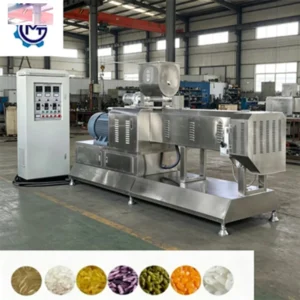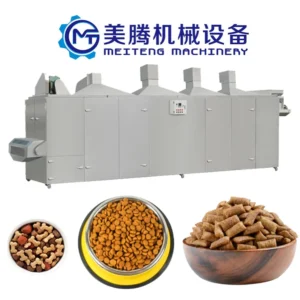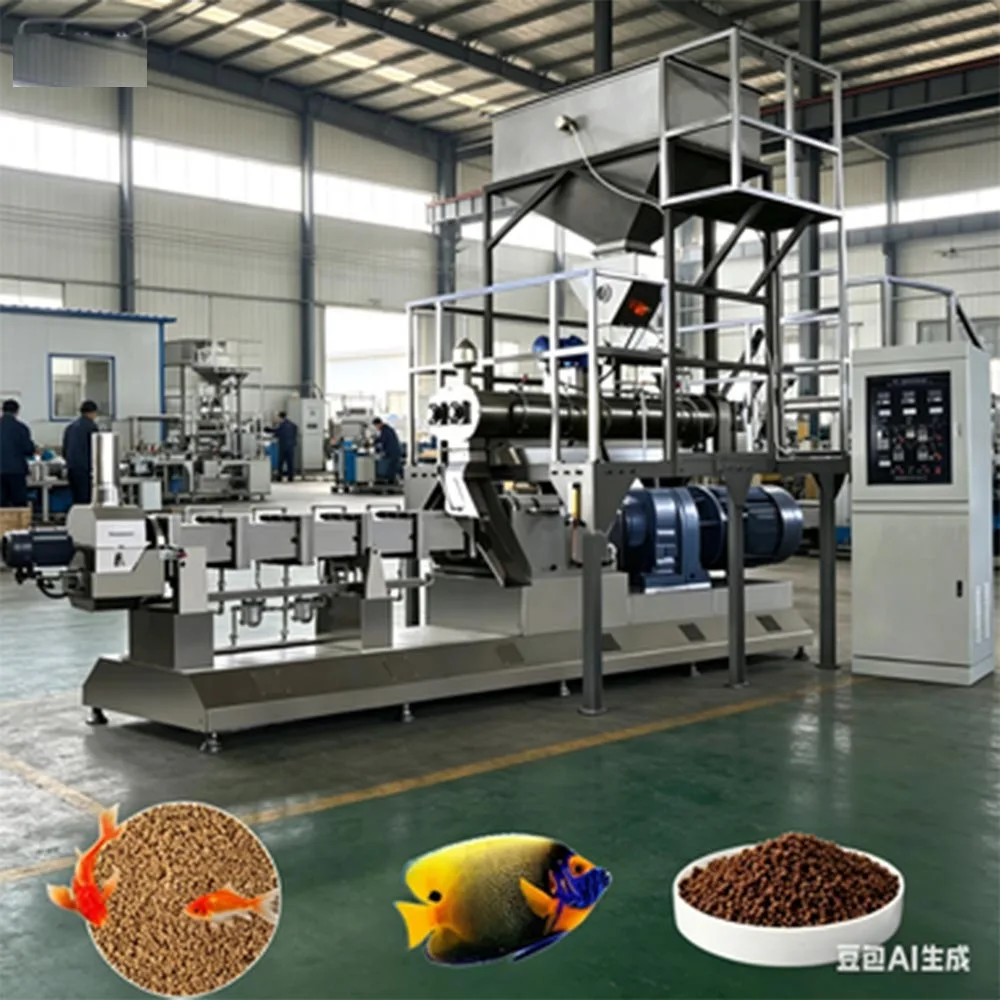
Precision screw geometry — twin-screw extrusion configuration specified to your aquatic feed formulation controls pellet density and floatation behaviour before the line ever leaves the factory.
Technical Specifications
| Parameter | Value |
|---|---|
| Product Type | Twin Screw Extrusion Aquatic Feed Production Line |
| Output Capacity | 500 kg/h (basis not stated in source — confirm raw material formulation and moisture content) |
| Pellet Size Range | 0.5 mm to 12 mm |
| Extruder Type | Twin Screw |
| Screw Configuration | Twin-screw extrusion system (configuration details subject to formulation) |
| Control System | Simple control panel (PLC / MCC option available) |
| Main Structure Material | Stainless Steel |
| Line Stations | Feeding, mixing, extruding, pelletizing (dryer, cooler, coating, packing configurable) |
| Automation Level | Fully Automatic |
| Power Rating | Not stated in source |
| Voltage & Frequency | Configurable to destination grid |
| Standards | CE and ISO certified manufacturing |
Application Suitability
| Application | Material or Output |
|---|---|
| Floating catfish and tilapia grow-out pellets | High-starch formulations requiring controlled expansion for positive buoyancy |
| Sinking shrimp feed pellets | High-protein formulations demanding dense, slow-sinking characteristics |
| Fry and fingerling starter feed | 0.5 mm to 2 mm micro pellets from fine-ground protein and carbohydrate blends |
| Multi-species aquaculture feed mills | Flexible die changes covering 0.5 mm to 12 mm across production runs |
Why Pellet Density Fails Before the Extruder Even Starts
Floatation problems originate in screw configuration and barrel temperature profiling, not in the dryer or the coating drum.
A buyer specifies a line rated at a certain hourly output, but the actual raw material — high-protein fish meal blends or starch-heavy grain mixes — behaves entirely differently under shear and heat than the generic test formulation. The twin screw extrusion aquatic feed production line technology must account for this gap. When the screw elements are copied from a standard build without matching the buyer’s formulation, the gelatinisation window shifts, expansion becomes inconsistent, and pellets that should float end up sinking within minutes of hitting the water. [NEED_CITE: starch gelatinisation temperature thresholds in high-protein aquatic feed formulations]
The real cost is not the wasted batch. It is the two weeks of trial-and-error on site while your commissioning engineer adjusts parameters that should have been locked in before the machine shipped.
Barrel Zone Temperature Profiling and Starch Gelatinisation
The twin screw extrusion aquatic feed production line technology depends on precise thermal management across multiple barrel zones. Each zone contributes differently: upstream zones handle hydration and initial mixing, while downstream zones build the shear energy required for starch gelatinisation. If the temperature profile is too flat, the material passes through without reaching the gelatinisation threshold, resulting in low expansion and pellets that lack structural integrity. Process engineers must specify barrel zone counts and heating capacity against their formulation’s specific gelatinisation curve.
Shear Energy, Screw Element Sequencing, and Pellet Density
Beyond temperature, the sequencing of conveying, kneading, and reverse screw elements determines how much mechanical energy the material absorbs. High-protein aquatic feed formulations require different shear profiles than starch-dominant recipes. A screw configuration built for floating pellets will over-expand high-protein mixes, creating fragile pellets that break during conveying and coating. The screw element arrangement must be documented and matched to the buyer’s target density specification before production begins. [NEED_CITE: twin-screw element sequencing effects on extrudate density in feed applications]
Reading the Specs That Actually Matter for Aquatic Feed
Pellet size range from 0.5 mm to 12 mm is driven by die selection and cutting mechanism configuration, but the usable range depends on formulation behaviour at each extreme. Micro pellets below 2 mm require fine die apertures that increase backpressure, demanding a screw configuration capable of maintaining stable flow without surging. At the upper end, 12 mm pellets need sufficient expansion control to prevent hollow centres. Stainless steel construction in food-grade contact zones supports both hygiene requirements and corrosion resistance when processing fish meal and marine-based protein sources. The control system governs barrel zone setpoints, screw speed, and feeder rates — parameters that must be adjustable in real time as operators monitor pellet density at the die face. Automation level marked as fully automatic covers the coordinated sequencing of feeding, mixing, extruding, and pelletizing stations, though the specific PLC or MCC architecture should be confirmed against the buyer’s existing plant control infrastructure.
What Happens When Screw Configuration Is an Afterthought
The commissioning period stretches well beyond the planned window. Operators run batch after batch adjusting moisture injection and barrel temperatures, searching for a floatation result that the wrong screw elements simply cannot deliver. Sinking feed for shrimp formulations may emerge too buoyant, floating on the surface where the animals cannot reach it. The downstream dryer runs at capacity but cannot correct a density problem that was baked into the pellet at the die. [NEED_CITE: common commissioning delays attributed to mismatched extruder configuration in feed mills]
Engineering Matched to Your Formulation, Not a Catalogue Default
Every twin screw extrusion aquatic feed production line technology deployment requires screw configuration documentation matched to the buyer’s specific raw material and target pellet specification. The in-house testing workshop runs trial extrusions on customer-supplied raw material before shipment, generating a trial run report that confirms pellet density, expansion ratio, and floatation behaviour against the agreed specification. Line layout and capacity calculation addresses throughput matching across all stations — feeding rate, extruder output, dryer residence time, and coating drum capacity — so no single station bottlenecks the line. Electrical schematics include voltage and frequency confirmation for the destination market grid, preventing commissioning delays caused by incompatible power supply. Wear parts lists document screw elements, die plates, and cutting blades specific to the configuration shipped, so replacement parts are available when the first changeover is due.
Documentation & Verification
- Screw configuration record specifying element sequencing matched to your aquatic feed formulation
- Trial run report on your raw material confirming pellet density and floatation before shipment
- Line layout drawing with throughput calculations across feeding, extruding, drying, and coating stations
- Electrical schematic with voltage and frequency confirmed for your facility grid
- Wear parts list identifying screw elements and dies specific to your configuration
Installation, Commissioning & Support
- Foundation plan specifying load points and floor leveling requirements for the extruder barrel assembly
- Dedicated power circuit sized to the extruder motor rating with confirmed voltage and frequency
- Pre-assembled barrel sections arriving with screw elements sequenced per your formulation record
- First-run commissioning with barrel zone temperature profiling and die pressure adjustment on your material
- Operator training covering screw speed, moisture injection, and die changeover procedures
- Wear parts inventory recommendation based on your production volume and formulation abrasiveness
What We Need to Configure Your Line
Provide your raw material formulation including protein percentage, starch source, and target moisture content at the extruder inlet. Specify the pellet sizes you produce most frequently and the floatation requirement — floating, slow-sinking, or fast-sinking — for each species. Confirm your facility voltage, frequency, and whether your existing plant runs centralized PLC control or standalone panels.
Frequently Asked Questions
Q: How is screw configuration determined for a specific aquatic feed raw material formulation?
A: We review your formulation’s protein-to-starch ratio, fat content, and fibre levels, then select conveying, kneading, and reverse screw elements in a sequence that delivers the shear energy your material requires. A trial run on your actual raw material in our testing workshop confirms the configuration before shipment.
Q: What barrel temperature profile and moisture level are needed to achieve floating versus sinking pellet density?
A: Floating pellets generally require higher barrel zone temperatures and controlled moisture injection to maximise starch expansion at the die. Sinking pellets need lower expansion, achieved through reduced shear energy and adjusted moisture. Exact setpoints depend on your formulation’s gelatinisation behaviour.
Q: Can a trial run be conducted on the buyer’s raw material before shipment?
A: Yes. Our in-house testing workshop runs your actual raw material through the configured extruder, producing sample pellets for density, expansion ratio, and floatation testing. The trial run report ships with the machine and serves as the baseline for on-site commissioning.
Q: How does die design affect pellet size range and expansion ratio across the 0.5 mm to 12 mm spectrum?
A: Smaller die apertures increase backpressure and require screw configurations that maintain stable flow without surging. Larger apertures reduce backpressure but demand precise expansion control to prevent hollow centres. Die plate hole patterns and cutting mechanism speed together determine final pellet geometry and dimensional consistency.
Q: What process parameters should be adjusted when switching between fish species formulations on the same line?
A: Operators typically adjust barrel zone temperatures, screw speed, moisture injection rate, and die selection when changing formulations. The control system stores parameter sets for each recipe, reducing changeover time and maintaining batch-to-batch consistency across production runs.