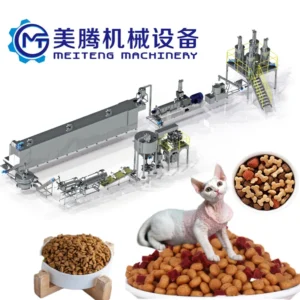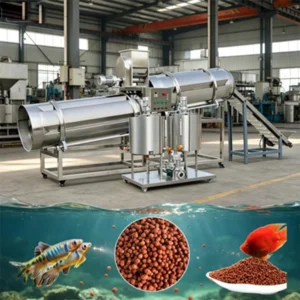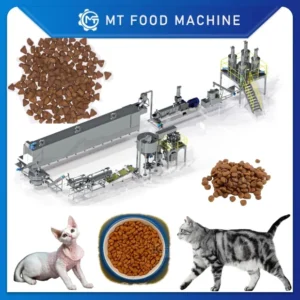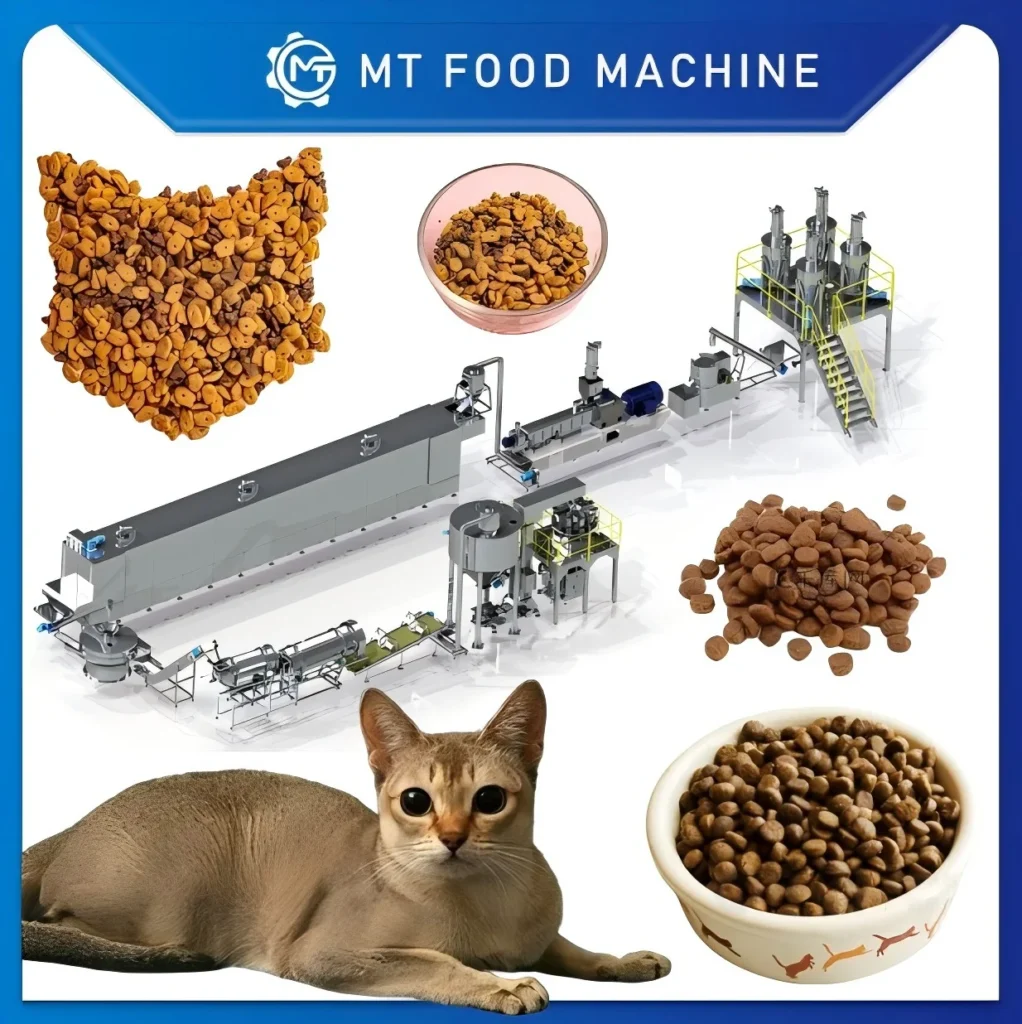
Matched Screw Geometry — the MT-70 twin-screw extruder ships with screw elements and die orifices configured to the buyer’s actual recipe rather than a generic catalog build, verified by an in-house trial run before dispatch.
Technical Specifications
| Parameter | Value |
|---|---|
| Model | MT-70 |
| Product Type | Dog Food Processing Line |
| Extruder Type | Twin-screw |
| Output Capacity | 200–250 kg/h (basis not stated in source — confirm raw material formulation / moisture content / kibble size) |
| Control System | PLC Controlled |
| Application Scope | Multi-species: dog, cat, fish |
| Warranty | 1-year |
| Standards | CE, ISO |
| Voltage & Frequency | Configurable to site requirement (confirm with manufacturer) |
| Overall Dimensions | Confirm with manufacturer |
| Net Weight | Confirm with manufacturer |
Application Suitability
| Application | Material or Output |
|---|---|
| Dry kibble production for dogs | Corn, poultry meal, meat-and-bone meal, starch binders at target moisture |
| Cat food pellet extrusion | Fish meal, animal fat, cereal fractions shaped through small-orifice dies |
| Floating aquatic feed | Soy and starch blends expanded to controlled bulk density |
| Sinking aquaculture pellets | High-protein formulations compressed through restricted die geometry |
What "200–250 kg/h" Actually Means on Your Recipe
Capacity figures on a twin-screw extrusion technology dog food processing line are meaningless without stating the raw material, moisture content, and kibble size they were measured on.
I have watched procurement teams sign off on a line rated at a headline throughput number, only to discover during commissioning that switching from the supplier’s standard corn grits test recipe to their own high-fresh-meat formulation drops real output well below the contract figure. The extruder barrel simply cannot transfer enough heat into a high-fat, low-starch mix at the same screw speed. When that gap surfaces after installation, the buyer faces weeks of screw reconfiguration and barrel temperature reprofiling while raw material sits in the warehouse [NEED_CITE: typical extrusion commissioning delays from recipe mismatch].
Screw Element Sequencing and Starch Gelatinisation
The arrangement of conveying, kneading, and reverse-flight screw elements inside the barrel determines how long material dwells under shear and heat. A sequence biased toward aggressive kneading blocks raises the degree of starch gelatinisation, which directly controls how much the kibble expands when it exits the die. On the MT-70 platform, the screw configuration is documented element by element so that the twin-screw extrusion technology dog food processing line can be re-profiled if the buyer later changes the base cereal or protein ratio.
Barrel Temperature Zones and Moisture Injection Points
Each barrel section carries its own heating and cooling circuit, letting the operator set a temperature gradient that rises toward the die. Pre-conditioning moisture and steam injection work together with barrel heat to bring the starch past its gelatinisation threshold at the right axial position. If the peak temperature arrives too early, the melt loses viscosity before the die and the kibble collapses; too late and expansion is weak. Getting this profile right is where most generic builds fail on unfamiliar recipes [NEED_CITE: barrel temperature profiling in twin-screw food extrusion].
Die Orifice Geometry and Final Kibble Density
The die plate is the last constraint the melt passes through, and its land length and hole diameter govern the pressure drop at exit. A short land with a wide orifice produces rapid expansion and a low-density, crunchy kibble suited to dog and cat dry food. A longer land restricts expansion, yielding a denser pellet that sinks in water — the target for certain aquaculture feed lines. Swapping die plates on the MT-70 takes minutes, so the same extruder can cover multiple product formats across a production week.
Reading the Specs That Actually Matter
The PLC control system stores every setpoint — screw speed, barrel zone temperatures, feeder rates, moisture dosing — as a named recipe, which means shift-to-shift variation drops to operator loading error rather than manual dial tweaking. Twin-screw architecture itself matters because the intermeshing flights create a self-wiping action that handles sticky, high-fat meat slurries without the material wrapping and stalling that would jam a single-screw machine. The 1-year warranty covers the mechanical and electrical assembly, but the real protection is the trial run report generated in the testing workshop on the buyer’s own raw material before the line is crated.
The Hidden Cost of a Copied Screw Build
When a supplier copies a screw and die configuration from a previous order without re-checking it against the new buyer’s formulation, the consequences arrive quietly. Kibble density drifts outside the range the pet food market expects, so floating aquatic feed sinks or premium dog food floats when it should not. Texture turns chalky or overly hard, triggering customer complaints that take months to trace back to extrusion parameters. The buyer then pays for an engineer’s return visit and a new set of screw elements — costs that a matched-configuration trial run would have prevented entirely [NEED_CITE: cost of post-installation extruder reconfiguration].
Why Source This Line Here
Every station from batching through packing is specified under one supplier, so the dryer capacity, coating drum volume, and cooler belt length are calculated against the extruder’s real throughput rather than assembled from separate vendor quotes. The in-house testing workshop runs the buyer’s actual raw material before shipment, producing a trial run report that documents screw speed, temperature profile, and kibble density. Screw configuration and die design records are retained on file, so reorders of wear parts match the original build exactly. Electrical schematics are issued with voltage, frequency, and PLC language confirmed for the destination site before production begins. CE and ISO documentation accompanies every shipment, clearing import compliance without last-minute certificate chasing.
Documentation & Verification
- Line layout drawing showing throughput matching from batching through packing for the MT-70 configuration
- Screw and die configuration record documenting every element position and orifice specification
- Trial run report generated on the buyer’s raw material with kibble density and expansion data
- Electrical schematic with confirmed voltage, frequency, and PLC control language for the target site
- CE declaration of conformity and ISO certificate packaged with customs documentation
Installation, Commissioning & Support
- Foundation plan sized to the MT-70 line footprint, confirming load points for extruder, dryer, and cooler
- Dedicated electrical circuit specification matching the confirmed voltage and frequency for the PLC panel
- Modular shipping configuration allowing the extruder barrel sections to be reassembled on-site in sequence
- Commissioning protocol covering first-run parameter logging and recipe storage in the PLC system
- Operator training covering screw element inspection, die plate changeover, and barrel cleaning procedures
- Wear parts list with reorder codes for screw elements, die plates, and barrel liners specific to the MT-70
What to Prepare Before Requesting a Quotation
Send your target recipe with raw material proportions and moisture content, the kibble size range you need, and the daily or shift output you plan to run. Include your site voltage, frequency, and preferred PLC language so the electrical package is specified correctly from the start. If you have existing upstream mixers or downstream packing equipment, share the model and throughput so the line layout accounts for integration points.
Frequently Asked Questions
Q: How is the 200–250 kg/h capacity verified, and on what raw material formulation?
A: That figure is a reference range. Actual throughput depends on your recipe’s starch content, moisture level, fat ratio, and target kibble size. We run your specific raw material in our testing workshop before shipment and document the verified output, screw speed, and temperature profile in the trial run report so the capacity number on your line is real, not nominal.
Q: How are screw configuration and die design selected for different kibble shapes and densities?
A: Each screw element — conveying, kneading, reverse-flight — is sequenced based on your formulation’s gelatinisation requirement. The die plate orifice diameter and land length are then matched to the expansion ratio your target kibble density demands. Both are recorded in the configuration file retained for future wear-part reorders.
Q: What barrel temperature profile and moisture range are applied for different starch-based recipes?
A: The profile is set zone by zone along the barrel, typically rising toward the die to match the starch gelatinisation window of your specific cereal base. Moisture is added in the pre-conditioner and sometimes at mid-barrel injection points. Exact setpoints are established during the trial run on your raw material and saved as a named recipe in the PLC.
Q: Is a trial run on my raw material performed before shipment, and what does the report include?
A: Yes. We run your actual formulation through the MT-70 in our testing workshop. The report records screw speed, barrel zone temperatures, moisture dosing rate, kibble expansion ratio, bulk density, and visual texture assessment. You receive a copy before the line is crated, so there are no surprises at commissioning.
Q: How is voltage, frequency, and PLC control language confirmed for the target market?
A: During the specification confirmation stage before production begins, we verify your site voltage, frequency, and preferred control language against the electrical schematic. The PLC interface, motor nameplates, and all documentation are prepared to match, so the line powers up correctly on arrival without rewiring or reprogramming delays.