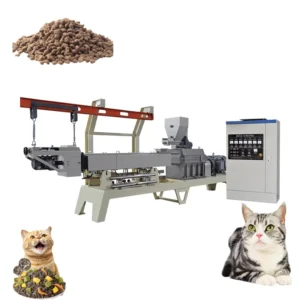
Screw and Die Engineering — Configuration mapped to your raw material formula rather than a generic off-the-shelf build.
Technical Specifications
| Parameter | Value |
|---|---|
| Model | MT85 |
| Product Type | Multi-Purpose Pet Food Processing Line |
| Output Capacity | 500 kg/h (basis not stated in source — confirm raw material formula / moisture content / kibble size) |
| Rated Power | 45 kW |
| Voltage & Frequency | 380V 50Hz Three Phase |
| Control System | PLC and MCC (automated processes from mixing to packaging) |
| Screw Type | Twin-screw |
| Line Stations | Raw material mixing, extrusion, drying, packaging |
| Automation Level | Full automation |
| Contact Material | Food-grade |
| Standards | CE, ISO |
Application Suitability
| Application | Material or Output |
|---|---|
| Dry kibble for dogs and cats | Meat meal, corn flour, wheat, bone meal blends |
| Floating and sinking aquatic feed | Fish meal, soy protein, starch-based formulations |
| Bird seed and pellet feed | Grain mixes, vitamin-fortified powders |
| Semi-moist pet food | High-moisture meat slurries with humectants |
| Pet treats and chewables | Dense protein and starch matrices |
Why "500 kg/h" Means Nothing Without Your Formula
A quoted capacity holds only when the extruder is tuned to your exact raw material.
I have watched lines ship with a rated throughput based on standard corn grits, only for the buyer to switch to a high-fat, high-meat-meal kibble recipe on day one. The twin-screw pet food extrusion line specifications on paper looked adequate, but the actual output dropped because the screw configuration and barrel temperature profile had never seen that formula. Extrusion is not a one-size-fits-all process. Moisture content, fat percentage, protein ratio, and starch source all dictate how the material behaves inside the barrel. When these variables are ignored during line configuration, you end up with a machine that technically runs but never reaches the density or expansion target your market demands [NEED_CITE: typical pet food extrusion parameters and raw material influence].
Barrel Temperature Profiling for Controlled Gelatinisation
The MT85 barrel is divided into independently controlled heating zones. This allows the operator to set a temperature gradient that matches the starch gelatinisation point of the specific grain or tuber in the formula. A corn-heavy recipe requires a different profile than one built on rice flour or potato starch. The twin-screw pet food extrusion line specifications include zone-by-zone thermal management so that expansion happens at the die face rather than prematurely inside the barrel, which would cause surging and inconsistent kibble size.
Shear and Moisture Management for Kibble Density
Achieving a floating aquatic pellet versus a dense sinking kibble is not a matter of changing the die alone. It requires adjusting the shear energy imparted by the screw elements and the preconditioning moisture level before the material enters the barrel. The MT85 twin-screw design allows the screw element sequence to be rearranged, giving the process engineer control over residence time and mechanical shear input. This is how you dial in the bulk density that a specific market segment expects, whether that is a light, crunchy dog treat or a high-density fish pellet [NEED_CITE: relationship between screw shear energy and extrudate density in twin-screw extrusion].
Reading the Specs That Actually Matter
The rated power of 45 kW tells you the mechanical energy available at the screws, which directly limits the maximum shear you can apply to high-protein, low-starch formulations that resist expansion. The 380V 50Hz three-phase supply is standard for industrial facilities in most export markets, but voltage and frequency must be confirmed against the buyer’s local grid before the electrical panel is built. The PLC and MCC control system stores process parameters as recipes, so once a kibble formula is dialled in during the trial run, the exact screw speed, barrel temperatures, and feeder rates can be recalled for every subsequent batch. This repeatability is what separates a production line from a laboratory experiment. Food-grade contact materials throughout the product zone prevent metallic contamination and meet the hygiene expectations of pet food regulatory frameworks.
The Cost of Skipping the Trial Run
When an extruder ships without a trial run on the buyer’s actual formula, the first week of production becomes an expensive experiment. Screw elements get swapped, die plates get re-drilled, and dryer settings are chased in real time while off-spec product accumulates. I have seen facilities lose several days of output because the screw configuration was copied from a different customer’s build that ran a completely different recipe. The downstream dryer and coating drum may also be mismatched if throughput assumptions were based on a lighter formula than what actually gets extruded [NEED_CITE: commissioning delays caused by untested extruder configurations].
What Sets This Configuration Apart
Every MT85 line ships with a screw and die configuration record that documents exactly which elements were selected for your formula. The in-house testing workshop runs your raw material before the machine leaves the factory, so the trial run report reflects real expansion, density, and texture data rather than generic estimates. The complete line from mixing through extrusion to drying and packaging is supplied by a single source, meaning throughput is balanced across every station instead of being assembled from mismatched vendors. Electrical schematics and voltage confirmation are resolved before production begins, not discovered during commissioning. PLC recipe storage means your process parameters are locked in and repeatable from the first production run onward.
Documentation & Verification
- Screw and die configuration record matched to your raw material formula
- Trial run report on customer-supplied formula from in-house testing workshop
- Electrical schematic with confirmed voltage and frequency for your facility
- Machine specification sheet detailing barrel zones, L:D ratio, and station throughput
- CE declaration of conformity for the complete processing line
- Operation and maintenance manual with wear parts list and replacement intervals
Installation, Commissioning & Support
- Foundation requirements based on the 45 kW main drive and total line footprint
- Dedicated three-phase 380V 50Hz circuit with confirmed breaker rating for the MCC panel
- Line arrives in modular sections for positioning within standard industrial ceiling heights
- First-run commissioning includes barrel temperature profiling on your actual formula
- PLC interface language configured to operator preference before shipment
- Wear parts list covering screws, dies, and seals with recommended replacement schedule
Before You Request a Quote
Send your raw material formula including protein, fat, starch, and moisture targets, along with the kibble size and density your market requires. Confirm your facility voltage, frequency, and available floor space for the full line layout. Specify the control language your operators need and whether you plan to run semi-moist or dry formats so the dryer and coating stations are sized correctly from the start.
Frequently Asked Questions
Q: How is the screw configuration and die design matched to my raw material?
A: The screw element sequence and die geometry are selected based on your formula’s protein, fat, and starch content. A trial run on your actual raw material in the testing workshop validates expansion, density, and texture before the line ships. The configuration record is provided so you have a documented baseline for future production runs.
Q: What barrel temperature profiles does the MT85 support for different textures?
A: Each barrel zone is independently heated and monitored. The temperature gradient is set during the trial run to match the gelatinisation behaviour of your specific starch source. This allows the same machine to produce a light, expanded kibble or a dense, semi-moist pellet simply by adjusting the zone profile and moisture preconditioning.
Q: How is output capacity verified before the line ships?
A: Your raw material is run through the MT85 in the in-house testing workshop. The trial run report documents actual throughput, kibble density, and expansion ratio on your formula. This prevents the common problem where a line rated on one recipe cannot hold output when switched to a different formulation.
Q: What PLC control parameters are stored for batch repeatability?
A: The PLC stores screw speed, barrel zone temperatures, feeder rates, and moisture injection levels as named recipes. Once a formula is validated during commissioning, operators recall the recipe with one touch, ensuring every batch runs under identical conditions without manual re-entry of parameters.
Q: How are the extruder, dryer, and coating drum matched to avoid bottlenecks?
A: Every station on the MT85 line is supplied as a single package, so throughput calculations account for the actual extrusion rate on your formula, the moisture removal requirement of your kibble size, and the coating volume your recipe calls for. This prevents the common issue where one station limits the entire line.