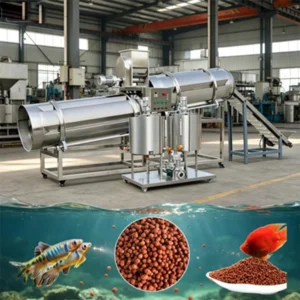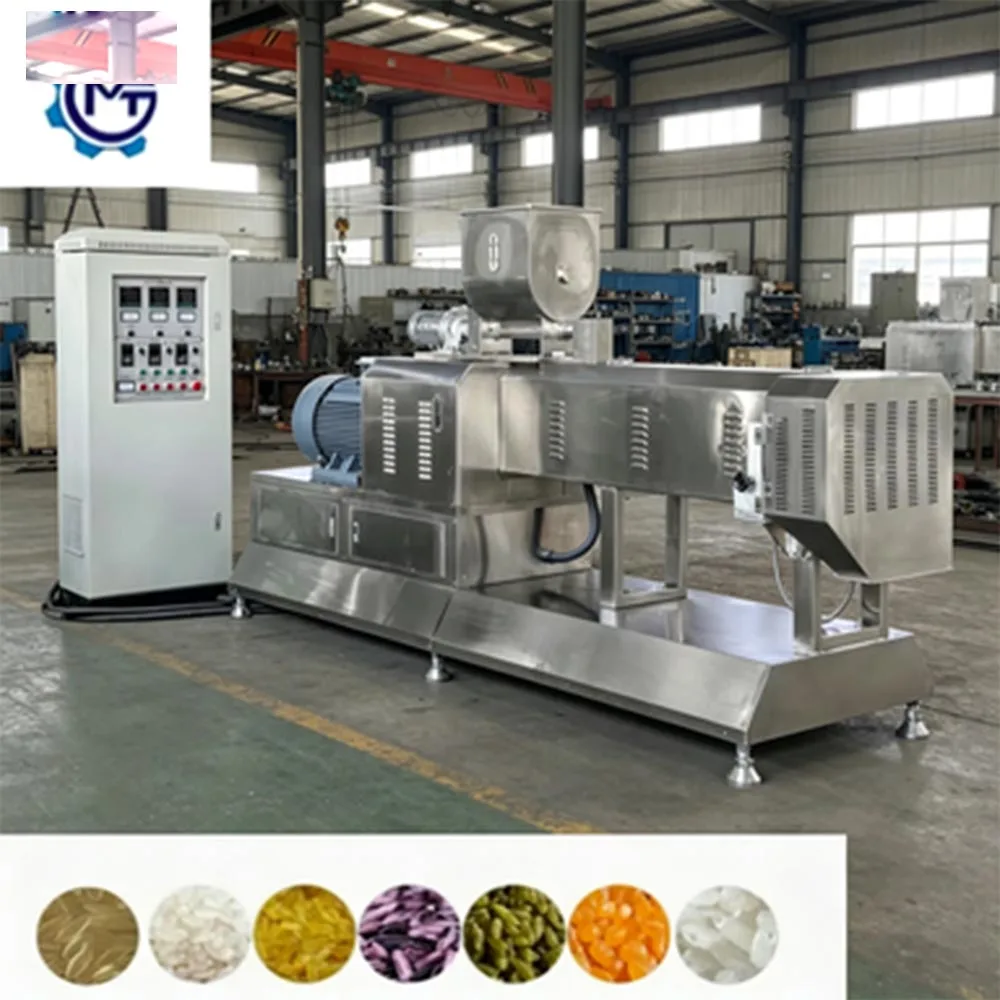
Precision Density Engineering — Every screw element and die bore is matched to your aquatic formulation rather than copied from a generic build, ensuring pellet buoyancy holds within spec from first run onward.
Technical Specifications
| Parameter | Value |
|---|---|
| Product Type | Twin Screw Fish Feed Extrusion Line |
| Screw Type | Twin screw |
| Control System | Intelligent PLC automatic control system |
| Contact Material | Food-grade 304 stainless steel |
| Output Capacity | Large-scale continuous production (basis to be confirmed) |
| Pellet Customization | Adjustable size, hardness, buoyancy (floating and sinking) |
| Line Stations | Raw material mixer, extruder, dryer, seasoning/coating machine, vibrating sieve, conveyor equipment |
| Production Mode | Full continuous automatic production (mixing → extrusion → drying → seasoning → screening → discharging) |
| Transmission | Optimized energy-saving transmission structure |
| Heating System | Optimized heating system with reduced heat loss |
| Assembly State | Complete matched production configuration |
| Maintenance Design | Humanized operation interface, quick replacement of vulnerable parts |
| Certification | CE, ISO |
Application Suitability
| Application | Material or Output |
|---|---|
| Floating fish feed for surface-feeding species | Fish meal, soybean meal, corn powder, compound additives |
| Sinking pellets for bottom-feeding fish | High-starch formulations with controlled gelatinisation |
| Koi and goldfish ornamental feed | Multi-ingredient blends requiring colour stability |
| Tropical fish and freshwater aquaculture feed | Compound formulations with varying fat and protein ratios |
| Dual buoyancy production portfolios | Alternating screw and die configurations on the same line |
What "Rated Capacity" Leaves Out When Screw Geometry Is Ignored
A twin screw fish feed extruder extrusion technology only delivers its rated output when screw configuration is matched to your actual raw material formulation, not a laboratory benchmark.
I watched a European aquaculture producer lose two full production weeks because the extrusion parameters were set for a standard fish meal blend while their real recipe carried a high proportion of plant-based meals. Barrel temperatures, screw speeds, and die geometry all had to be reworked on the factory floor [NEED_CITE: extrusion parameter drift with alternative protein sources]. The rated throughput on paper meant nothing until the screw profile was reconfigured for the starch and fibre behaviour of the actual mix. Quoted capacity figures assume a reference formulation; once your recipe changes the rheology inside the barrel, every number shifts.
Barrel Temperature Profiling and Starch Gelatinisation
The degree of starch gelatinisation directly governs whether a pellet holds air pockets for buoyancy or collapses into a sinking form. Each barrel zone along the twin screw fish feed extruder extrusion technology is heated independently so that moisture migration and thermal input stay aligned with the dwell time of the material. When the gelatinisation window is too narrow, pellets exit with an unexpanded core that sinks unpredictably; when it is too wide, surface blistering weakens pellet integrity during storage.
Die Geometry and Buoyancy Control
Die bore diameter, land length, and face pattern together set the expansion ratio at the moment the melt exits the barrel. A shorter land length reduces back-pressure and promotes rapid expansion, producing a low-density floating pellet. Extending the land length increases shear and compression, yielding a denser sinking pellet. Switching between floating and sinking production on the same line therefore requires a documented die change procedure and verified PLC parameter set for each target buoyancy [NEED_CITE: die land length effect on extrudate density].
Screw Configuration Record and Process Repeatability
The arrangement of conveying, kneading, and reverse elements inside the barrel defines shear intensity and residence time distribution. For aquatic formulations with high fat or fibre content, a configuration that works on a simple corn-soy blend will produce uneven mixing and density variation. Recording the exact screw element sequence — including element thickness, pitch, and stagger angle — allows the operator to reproduce pellet characteristics across batches and after scheduled maintenance.
Why Moisture Window Matters More Than Motor Power
Motor power determines the maximum torque available to push viscous material through the die, but it is the moisture content entering the barrel that sets the viscosity itself. Too little moisture and the melt becomes stiff, overloading the transmission and causing die blockage; too much and the material slips between screw flights, dropping throughput and producing soft pellets that break in the dryer. Maintaining a consistent preconditioning moisture range is therefore a prerequisite for stable extrusion behaviour, regardless of the installed motor rating.
The Hidden Cost of a Generic Screw Build
When a supplier copies a screw configuration from a catalogue rather than engineering it for your formulation, the first sign is usually density drift within a single production run. Pellets that should float begin to sink after the barrel reaches thermal equilibrium because the kneading blocks were never designed for the gelatinisation profile of your starch source [NEED_CITE: thermal equilibrium drift in twin-screw extrusion]. Correcting this after installation means sourcing new screw elements, re-validating the die set, and re-running product trials — costs that far exceed the price difference of a properly configured machine.
Why Sourcing Here Reduces Commissioning Risk
Configuration before quotation. The screw profile and die set are specified against your raw material sample and target pellet density before a commercial offer is issued, preventing the mismatch described above.
Throughput matched across every station. Dryer capacity, coating drum volume, and conveyor speed are calculated from the extruder’s actual output on your formulation, so no single station creates a bottleneck that limits the line.
In-house trial on your raw material. Before shipment, the complete line runs your formulation in the testing workshop, generating a documented trial report that confirms buoyancy, pellet surface quality, and output rate.
PLC parameter library. The control system stores validated recipes for each product variant, so operators can switch between floating and sinking runs without manual recalibration of barrel zones and screw speed.
Post-commissioning parameter support. After on-site installation, process engineers remain available to fine-tune screw speed, moisture addition, and die selection as seasonal raw material variations arise.
Documentation & Verification
- Screw and die configuration record matched to your aquatic raw material formulation
- Trial run report confirming pellet buoyancy and density on your actual recipe before dispatch
- Line layout drawing with station-by-station throughput calculation for your target output
- Electrical schematic confirming voltage, frequency, and PLC language for destination facility
- CE declaration of conformity and ISO certificate for customs and regulatory clearance
Installation, Commissioning & Support
- Foundation plan sized to the line’s total footprint and dynamic load from the twin-screw extruder transmission
- Dedicated electrical circuit sized to the PLC-controlled heating and drive loads with confirmed voltage and frequency
- Modular station delivery allowing phased assembly where workshop access restricts full-line positioning
- First-run parameter validation on your raw material with screw speed and barrel zone logging
- Operator training covering die changeover procedure between floating and sinking pellet production
- Wear parts list identifying screw elements, die inserts, and seal rings with recommended stock quantities
What We Need to Move Your Enquiry Forward
To configure the twin screw fish feed extruder extrusion technology for your facility, share your raw material formulation including protein source, starch percentage, and fat content, along with the target pellet diameter and whether floating, sinking, or both are required. Provide your workshop voltage and frequency, available floor space, and any existing upstream or downstream equipment that the new line must integrate with. If you can send a representative sample of your actual production mix, a trial run in the testing workshop will confirm buoyancy and density before the line is finalised.
Frequently Asked Questions
Q: How is screw configuration and die design matched to my specific aquatic raw material and target pellet density?
A: We review your formulation’s protein source, starch content, and fat level, then select conveying, kneading, and reverse screw elements to achieve the required shear and residence time. Die bore diameter and land length are chosen to set the expansion ratio for your target buoyancy. A trial run on your raw material validates the configuration before shipment.
Q: What extrusion parameters control whether the pellet floats or sinks?
A: Buoyancy is governed by barrel temperature profile, screw speed, moisture content, and die land length. Higher expansion from shorter die land and optimal gelatinisation produces floating pellets, while increased compression through longer die land yields sinking pellets. The PLC stores each parameter set for repeatable switching between buoyancy targets.
Q: How is capacity verified on my actual raw material formulation?
A: Quoted capacity is based on a reference formulation. We run your specific mix in the testing workshop, measuring throughput at steady-state barrel temperature and confirming pellet quality. The trial report documents the verified output so you know what to expect on your recipe rather than a generic benchmark.
Q: Can I run a trial with my own raw material before shipment to confirm pellet buoyancy?
A: Yes. Send a batch of your production formulation to the testing workshop. The complete line — mixer, extruder, dryer, and coating station — runs your material, and a report covering buoyancy, density, pellet surface finish, and output rate is provided before the equipment ships.