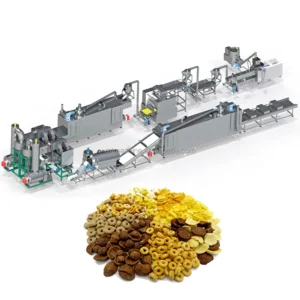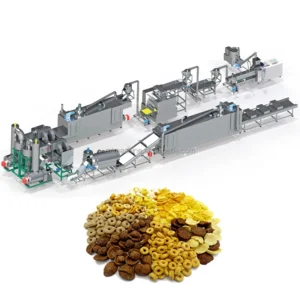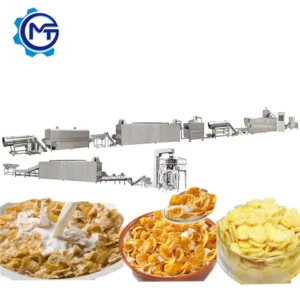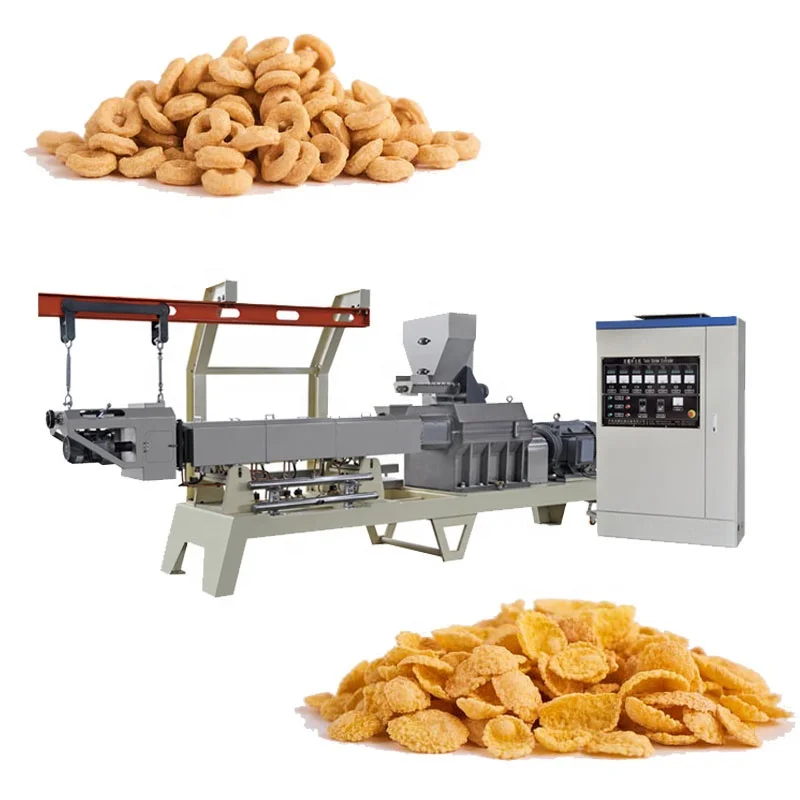
Screw Configuration Matched to Your Raw Material — Our testing workshop runs your actual corn grits or flour formulation on the twin-screw extruder before shipment, documenting starch gelatinization behavior and expansion ratio rather than guessing at generic settings.
Technical Specifications
| Parameter | Value |
|---|---|
| Product Type | Corn Flakes Production Line |
| Extruder Type | Twin Screw (co-rotating, sectional modules) |
| Model MT-65 Installed Power | 84 kW |
| Model MT-65 Real Power | 59 kW |
| Model MT-65 Output | 120-150 kg/h (basis to be confirmed with raw material formulation) |
| Model MT-65 Dimension | 12000×1200×2200 mm |
| Model MT-70 Installed Power | 132 kW |
| Model MT-70 Real Power | 92 kW |
| Model MT-70 Output | 200-250 kg/h (basis to be confirmed) |
| Model MT-70 Dimension | 23000×1500×2200 mm |
| Model MT-75 Installed Power | 186 kW |
| Model MT-75 Real Power | 140 kW |
| Model MT-75 Output | 300-400 kg/h (basis to be confirmed) |
| Model MT-75 Dimension | 24000×1500×2800 mm |
| Model MT-85 Installed Power | 239 kW |
| Model MT-85 Real Power | 167 kW |
| Model MT-85 Output | 400-500 kg/h (basis to be confirmed) |
| Model MT-85 Dimension | 28000×1500×2800 mm |
| Corn Flakes Press Machine Power | 16.12 kW |
| Corn Flakes Press Machine Roller Size | 510×310×1050 mm |
| High-temperature Oven Heat Source | Gas |
| High-temperature Oven Feature | Both side baking system |
| Sugar Spraying System Total Power | 28.75 kW |
| Control System | PLC available |
| Gear Box Lubrication | Oil forced automatic lubrication system |
| Screw Cleaning | Self-cleaning function |
Application Suitability
| Application | Material or Output |
|---|---|
| Traditional breakfast cereal corn flakes | Corn grits with controlled moisture content |
| Flavored corn flakes with sugar coating | Corn flour, rice flour blends with sugar spray |
| Corn puff snacks in various shapes | Corn grits, corn flour with die configuration changes |
| Core-filled snack products | Corn/wheat flour shell with sugar, chocolate, or peanut filling |
What "Standard Screw Configuration" Actually Costs You Downstream
Generic screw builds ignore the starch behavior differences between degerminated corn grits and whole-grain corn flour, producing flakes that shatter during pressing or fail bowl-life tests.
I spent a week in a Mexican plant recalibrating a line because the trial runs used standard degerminated corn meal while the facility sourced high-fat whole-grain corn locally. The extrusion Corn Flakes Extrusion Technology parameters were completely wrong — insufficient gelatinization meant the flakes cracked under roller pressure instead of compressing into uniform sheets. That mismatch between quoted capacity and actual raw material behavior happens more often than buyers realize when they evaluate lines based on nominal throughput alone [NEED_CITE: raw material variability in corn processing across regional supply chains].
How Barrel Temperature Profile Controls Starch Gelatinization
The twin-screw extruder uses sectional barrel modules with independent heating zones, allowing precise temperature staging from feed intake through the cooking and forming sections. Proper starch gelatinization requires gradual temperature escalation — too rapid a rise causes surface hardening while the core remains undercooked, creating internal stress points that manifest as fractured flakes after pressing. The screw configuration works in concert with this thermal profile, with forward and backward transport elements creating the residence time necessary for complete moisture penetration into the corn particles.
Die Design and Its Role in Flake Integrity
The die plate determines the initial shape and density of extruded pellets before they reach the flaking press. For corn flakes specifically, the die geometry must produce pellets that compress uniformly under roller pressure without tearing at the edges or developing internal voids. Pellet moisture content at the die exit, controlled by the barrel’s final zone temperature and screw speed, directly affects how the material behaves when squeezed between the press rollers. Incorrect die design for your specific corn variety results in flakes that either stick to the roller surface or crumble during the high-temperature baking stage [NEED_CITE: die geometry optimization for cereal extrusion applications].
Specification Interpretation for Production Engineers
The installed power versus real power differential across the MT series reflects actual energy consumption during steady-state extrusion, with the gap indicating startup surge capacity and load variation headroom. The corn flakes press machine’s adjustable roller distance directly controls final flake thickness, which determines both mouthfeel and milk absorption rate — critical parameters for breakfast cereal market positioning. The gas-fired high-temperature oven with dual-side baking addresses the uneven moisture removal that causes warping in single-pass systems, while the sugar spraying system’s roller diameter accommodates continuous throughput without batch bottlenecks. Self-cleaning screw functionality reduces downtime between formulation changes, particularly relevant when switching between plain corn flakes and flavored variants requiring different moisture targets.
The Hidden Cost of Mismatched Line Stations
Buyers often focus on extruder capacity while overlooking whether downstream stations can actually handle that throughput. A twin-screw extruder producing at full rate feeds material into a flaking press that may have different cycle characteristics, creating buffer pile-ups or forcing the extruder to run below capacity. The high-temperature oven must have sufficient belt length and residence time to achieve target moisture content at the extruder’s actual output rate, not just its nameplate rating. When sugar coating follows, the spraying system’s roller speed and drum volume must align with the baked flake flow rate to prevent uneven coverage or product backlog [NEED_CITE: line balancing principles in continuous food processing].
Why Procurement Here Differs From Catalog Shopping
Complete line throughput matching means the flaking press, oven, and coating system are specified to handle the extruder’s actual output on your raw material, not assembled from separate vendor catalogs with incompatible capacity assumptions. Screw configuration and die design documentation accompanies each shipment, recording the specific element arrangement tested against your corn formulation rather than a generic build copied across all buyers. The in-house testing workshop runs production trials on your actual raw material before dispatch, generating a trial run report that documents achievable output, flake integrity, and required parameter settings under real conditions rather than laboratory idealizations.
Documentation & Verification
- Line layout showing throughput calculations matched across mixing, extrusion, pressing, baking, and coating stations
- Screw and die configuration record specific to your corn variety and target flake thickness
- Trial run report from testing workshop using your actual raw material formulation
- Electrical schematic with voltage, frequency, and PLC interface language confirmed for your facility
- Factory test record documenting real power consumption and output rate under load conditions
Installation, Commissioning & Support
- Foundation requirements based on the specific model’s installed power and operating weight distribution
- Dedicated electrical circuits sized for the extruder’s real power draw plus startup surge capacity
- Assembly sequence for sectional barrel modules and screw element installation with torque specifications
- Initial parameter setting using trial run report data as baseline, then fine-tuning for local humidity and ambient temperature
- Operator training covering screw configuration changes for different corn formulations and flake thickness targets
- Wear parts inventory list specifying screw elements, die plates, and press roller surfaces with replacement intervals
What We Need to Specify Your Line Correctly
Provide your corn source characteristics — degerminated grits, whole-grain flour, fat content, typical moisture range at intake. Specify your target flake thickness and bowl-life requirements, as these determine die design and baking parameters. Confirm your facility’s voltage, frequency, and preferred control language for the PLC interface. If you have existing upstream mixing or downstream packaging equipment, share those specifications so we can match throughput across the complete system.
Frequently Asked Questions
Q: How does screw configuration change when switching from degerminated corn grits to whole-grain corn flour?
A: Whole-grain flour has higher fat content and different particle size distribution, requiring adjusted screw element arrangement to achieve proper starch gelatinization without over-shearing. The testing workshop documents the specific configuration needed for your raw material, including forward transport element spacing and mixing zone intensity, before the line ships.
Q: What moisture content range works best for corn flakes extrusion?
A: Optimal moisture depends on your corn variety and target flake characteristics, typically falling within a range that allows complete gelatinization without excessive stickiness at the die exit. The trial run report documents the moisture content that produced acceptable flake integrity during testing with your specific raw material.
Q: How do you control final flake density and bowl-life?
A: Flake density results from the interaction of die design, extrudate moisture at the press, roller gap setting, and baking temperature profile. Adjusting roller distance on the press machine controls thickness, while oven residence time and temperature determine final moisture content and crispness retention in milk.
Q: What testing happens before the line ships?
A: The testing workshop runs your actual raw material through the configured extruder, press, and oven sequence, documenting achievable output rate, flake integrity under pressing, and baking parameters required for target moisture content. This trial run report ships with the equipment as the commissioning baseline.
Q: Can the line produce both plain corn flakes and sugar-coated variants?
A: The sugar spraying system operates as a separate station after baking, allowing plain flakes to bypass coating entirely. Switching between variants requires adjusting extruder moisture targets and potentially screw configuration, with changeover procedures documented in the operation manual based on trial run findings.