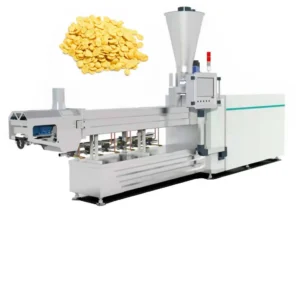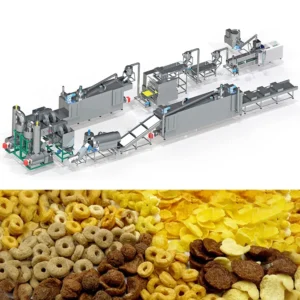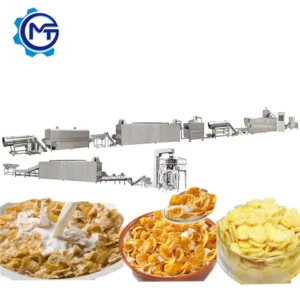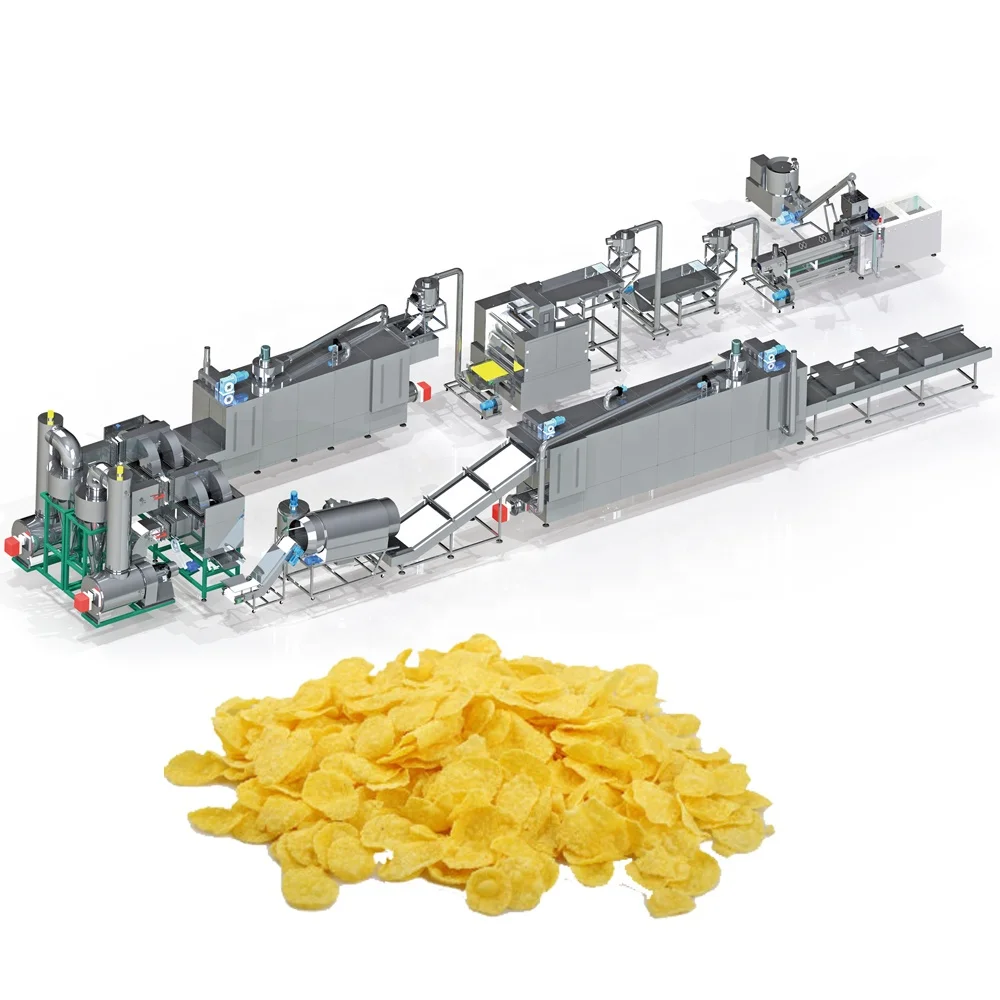
Process-matched extrusion design — Screw configuration and die geometry are specified to the buyer’s actual grain blend rather than copied from a generic build, verified through trial runs on customer raw material before shipment.
Technical Specifications
| Parameter | Value |
|---|---|
| Product Type | Corn Flakes Production Line |
| Output Capacity | 750 kg/hr (basis not stated in source — confirm raw material, moisture content, product format) |
| Screw Type | Twin-screw |
| Control System | Available with PLC and MCC control |
| Product Range | Natural corn flakes, sugar-coated flakes, various shaped breakfast cereals |
| Line Stations | Batching, extrusion, drying, coating, cooling, packing |
| Assembly State | Complete production line with supporting equipment |
| Certification | CE, ISO |
Application Suitability
| Application | Material or Output |
|---|---|
| Natural corn flake production | Degermed corn grits, whole grain corn |
| Sugar-coated flake processing | Corn flakes with sugar syrup, malt, honey coating |
| Multi-grain breakfast cereal | Blends of corn, wheat, oats, rice flour |
| Shaped extruded cereal | Various die-formed pellet and flake geometries |
Why Starch Gelatinisation Degree Decides Your Flake Quality
Getting the barrel temperature profile right is the single most important factor in corn flake extrusion — and it changes with every grain blend you run.
A corn flake that looks right coming off the line but turns to mush in milk thirty seconds later usually traces back to incomplete starch gelatinisation inside the barrel. I have seen this happen when a line configured for standard degermed corn grits gets switched to a high-fibre whole grain formulation without adjusting the thermal profile. The flakes come out dense, hard, and lifeless — or worse, they look acceptable at the die but shatter during drying [NEED_CITE: starch gelatinisation behaviour across grain types]. The twin-screw extrusion technology on this Corn Flakes Production Line is designed so that each barrel zone can be set independently, giving process engineers the resolution needed to match a new recipe rather than forcing the recipe to fit the machine.
Barrel Temperature Profiling and Shear Control
Starch gelatinisation in corn flake extrusion requires a precise balance of heat, moisture, and mechanical shear across multiple barrel zones. The Corn Flakes Production Line extrusion technology uses independently heated zones along the barrel so that the thermal curve can be ramped gradually, preventing surface case-hardening before the core reaches gelatinisation temperature. Moisture injection points allow steam or water addition at defined stages, which directly influences how completely the starch granules swell and rupture under shear.
Die Geometry and Flake Expansion Behaviour
The die plate determines flake thickness, surface texture, and the expansion ratio as material exits the barrel into ambient pressure. A wider die slot with a shorter land length produces a thicker, less expanded flake suited to natural corn flake formats, while a narrower slot with controlled back-pressure yields thinner flakes that hold sugar coating evenly. Die design on this Corn Flakes Production Line is specified to the target product format, so the expansion behaviour at the die face matches what the downstream dryer and flaking rolls can handle consistently [NEED_CITE: die design principles for flaked cereal extrusion].
Reading the Specs That Actually Matter for Flakes
The twin-screw configuration provides self-wiping action that prevents starch buildup inside the barrel — critical when running high-sugar or high-fibre recipes that tend to scorch on stagnant surfaces. The PLC and MCC control system allows operators to store and recall barrel zone temperatures, screw speed, and feed rate as recipe profiles, so batch-to-batch consistency does not depend on a single experienced operator remembering yesterday’s settings. The complete line from batching through packing means throughput at each station is calculated to match the extruder output, preventing the common bottleneck where the dryer cannot keep pace with the extruder and wet flakes pile up waiting for heat treatment.
What a Generic Screw Configuration Costs You Down the Line
Running a corn flake recipe on a screw profile copied from a standard build often produces flakes that are technically edible but commercially wrong — too dense for the bowl-life expectation in your market, or too fragile to survive the coating drum without breaking into dust [NEED_CITE: cereal market texture and density expectations by region]. I once spent weeks on-site rewinding the entire screw element sequence and temperature curve after a client switched to a high-bran whole grain blend; the original configuration produced flakes that snapped rather than bent, and the sugar coating would not adhere to the rougher surface. Those lost production days and wasted raw material are costs that never appear on the quotation.
Why Process Engineers Source This Line
Screw configuration and die design are specified to the buyer’s actual grain blend and target flake density rather than pulled from a standard library. An in-house testing workshop conducts trial runs on customer raw material before shipment, so extrusion parameters are validated on the recipe you will actually run, not on a generic corn flour surrogate. The complete line approach means batching, extrusion, drying, coating, cooling, and packing capacities are engineered together, eliminating station-to-station mismatches. Every electrical schematic and voltage specification is confirmed against the buyer’s facility before production begins, reducing commissioning surprises on site.
Documentation & Verification
- Line layout and capacity calculation matched to your factory footprint and extruder throughput
- Screw and die configuration record specifying elements selected for your grain blend
- Trial run report on your raw material documenting gelatinisation, expansion, and density data
- Machine specification sheet with barrel zone count and temperature control detail
- CE declaration of conformity and ISO certificate for the complete line
- Electrical schematic with confirmed voltage and frequency for your facility
Installation, Commissioning & Support
- Engineered layout drawings specify floor space and utility connections for the twin-screw extruder and all supporting stations
- Power supply requirements confirmed per your local voltage and frequency before electrical panel assembly
- Each line station arrives pre-assembled with matched interface points to reduce on-site fitting time
- Commissioning includes barrel temperature profiling and screw speed calibration on your actual grain recipe
- Operator training covers PLC recipe management, screw element inspection, and die plate maintenance
- Wear parts list identifies screw elements, barrel liners, and die plates with replacement intervals
What to Include in Your Inquiry
Provide your grain formulation — whether degermed corn grits, whole grain corn, or a multi-grain blend — along with the target flake format such as natural, sugar-coated, or shaped. Confirm your local voltage and frequency, the control language for the PLC interface, and whether an in-house trial run on your raw material is required before shipment.
Frequently Asked Questions
Q: How is screw configuration determined for a specific corn flake recipe?
A: The screw element sequence — including conveying, kneading, and reverse elements — is selected based on your grain blend’s starch content, fibre level, and target gelatinisation degree. Trial runs in the testing workshop validate the configuration on your actual raw material, adjusting element positions and barrel zone temperatures until flake density and texture meet specification before the line ships.
Q: What barrel temperature profile is needed for proper starch gelatinisation?
A: Gelatinisation requires progressively increasing heat across barrel zones, typically starting below the starch transition point and rising through it while maintaining adequate moisture. The exact profile depends on your grain type and particle size. Independent zone control on this Corn Flakes Production Line allows the curve to be tuned per recipe rather than relying on a fixed setting.
Q: How does die design affect flake expansion and final density?
A: Die slot width, land length, and back-pressure determine how much the extrudate expands upon exiting the barrel. A wider slot produces thicker, less expanded flakes suited to natural formats, while narrower slots yield thinner flakes ideal for sugar coating. The die is matched to your target product format and downstream dryer capacity.
Q: Can a trial run be performed on my raw material before shipment?
A: Yes. The testing workshop conducts production runs using your supplied grain blend, documenting extrusion parameters, flake expansion ratio, gelatinisation degree, and density. This trial run report accompanies the shipment and serves as the baseline recipe for on-site commissioning, eliminating guesswork during startup.