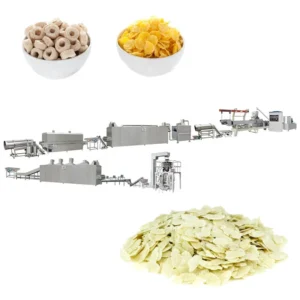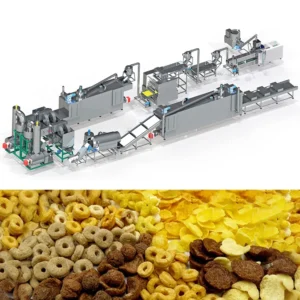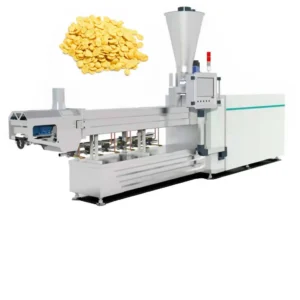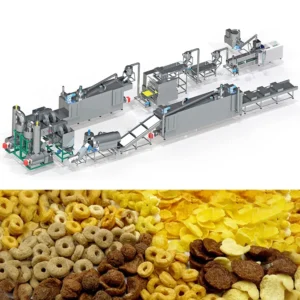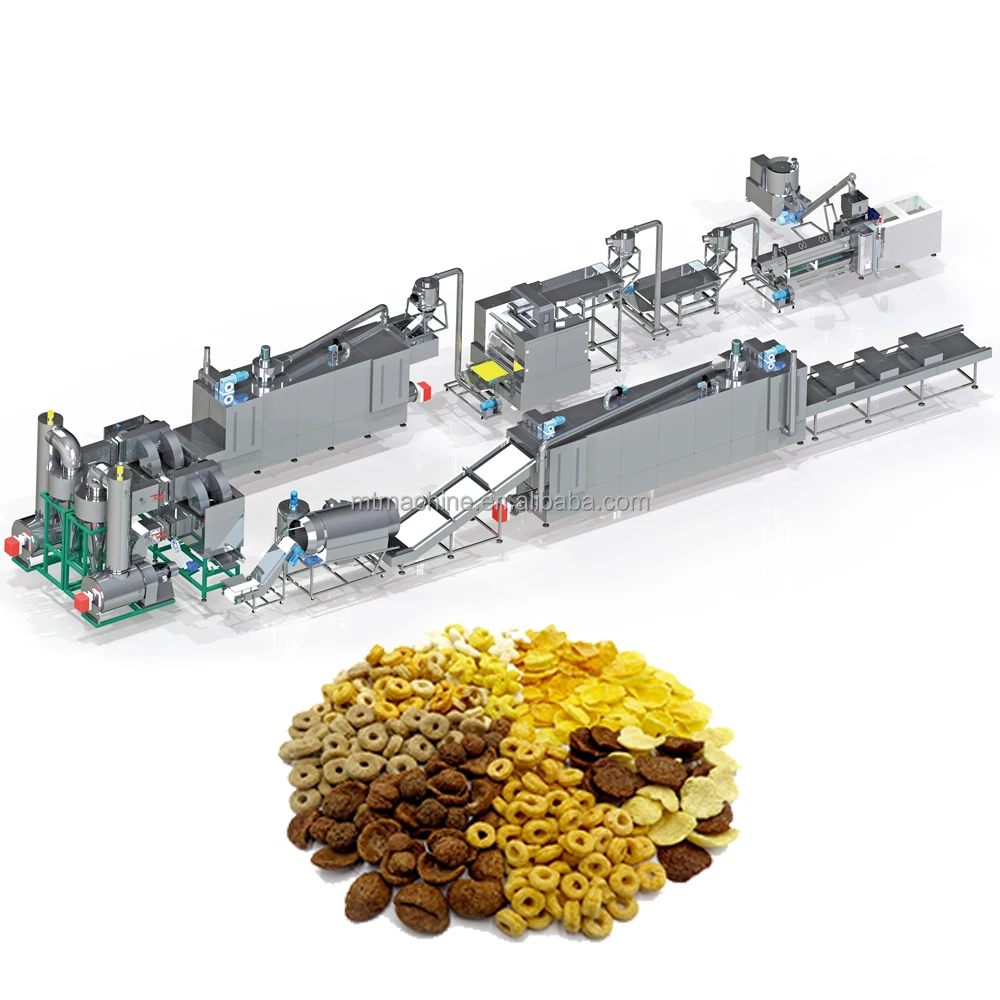
Screw & Barrel Profiling — Every corn flakes extrusion technology production line we ship is dialed to the buyer’s exact grain blend, verified by a trial run on actual raw material before the machine leaves our Jinan workshop.
Technical Specifications
| Parameter | Value |
|---|---|
| Product Type | Corn Flakes Breakfast Cereal Production Line |
| Model Options | MT70 / MT85 / MT75 |
| Extruder Type | Twin Screw |
| Installed Power (MT75) | 210 kW |
| Power Consumption (MT75) | 150 kW |
| Output Capacity (MT75) | 300–500 kg/h (basis not stated in source — confirm raw material type and moisture content) |
| Overall Dimensions (MT75) | 45 × 1.5 × 3.5 m |
| Control System | PLC and MCC |
| Flaking Machine Control | PLC with hydraulic system, double motors, infrared sensor temperature control |
| Heating Source (Dryer) | Gas or Electric |
| Roasting Oven | Hot air with conciliation burner, dual circulating fans, cyclone dust removal |
| Coating System | Double tumble sugar melting, elevator, coating drum, spraying nozzle |
| Screw Feature | Wear-resistant, automatic lubricating and cooling |
| Line Stations | Mixing → Extruding → Flaking → Drying → Hot Air Roasting → Coating → Cooling → Packing |
| Standards | CE (since 2014), ISO |
Application Suitability
| Application | Material or Output |
|---|---|
| Natural corn flake production | Corn grits and corn flour blends |
| Sugar-coated breakfast cereals | Corn, rice, or wheat base with sugar syrup coating |
| Multi-grain flake formats | Blends of rice, wheat, oat, and barley powder |
| Extruded cereal shapes | Ball, tube, ring, fruit loop, star, wheel, and heart profiles |
| Fortified breakfast cereals | Grain powder with added vitamin and mineral premix |
Why "Rated Capacity" Means Nothing Without Your Raw Material
A corn flakes extrusion technology production line quoted on a generic grain test will underperform the moment your specific formulation hits the barrel.
I have watched lines rated for a comfortable daily output choke within the first hour because the buyer’s actual corn blend had higher fiber content or different moisture behavior than the standard test flour. The screw profile that gives perfect expansion on pure corn grits can produce dense, under-gelatinized pellets when oat or barley enters the mix. The starch gelatinisation window shifts, barrel temperature zones need recalibration, and die geometry must match the new viscosity curve. Without a pre-shipment trial on the buyer’s own material, the first several production runs become expensive experiments [NEED_CITE: starch gelatinisation behaviour across grain blends].
Matching Screw Geometry to Grain Behaviour
The twin-screw configuration inside a corn flakes extrusion technology production line must be selected around the buyer’s grain composition, not a default build. Corn grits demand a specific compression ratio and residence time to achieve full starch gelatinisation without excessive shear. When a formulation includes higher-fiber grains like oat or barley, the screw element sequence needs adjustment to maintain consistent dough viscosity through the barrel zones. Die design then controls the extrudate shape and initial density before it reaches the flaking rolls, making this the first critical station for final flake quality.
Barrel Temperature Profiling Across Heating Zones
Precise control over barrel temperature from feed zone to die face determines whether starch granules swell uniformly or rupture prematurely. The PLC system on this corn flakes extrusion technology production line manages multiple independent heating zones, allowing operators to set a gradient that matches the thermal profile of their specific grain blend. Infrared sensor feedback at the flaking stage further refines surface temperature before the extrudate passes through the hydraulic double rollers, ensuring uniform flake thickness [NEED_CITE: PLC temperature profiling in food extrusion processes].
Reading the Specifications Beyond Power Ratings
The installed power of 210 kW on the MT75 reflects the combined demand of the twin-screw extruder, hydraulic flaking unit, and auxiliary drives, while actual consumption settles around 150 kW during steady-state operation. The overall line footprint of 45 × 1.5 × 3.5 m represents the extruder and flaking section; the full production line including dryer, roasting oven, coating system, and cooling conveyor extends considerably further, which is why layout planning must account for the buyer’s actual factory dimensions. The hydraulic flaking system uses double motors for independent roller driving, giving operators separate speed control to fine-tune compression and flake thickness across different grain formulations. Hot air roasting with a conciliation burner and two separate circulating fans provides even heat distribution for surface bubbling, while the cyclone dust removal device captures fines before they affect product appearance or workshop air quality.
The Hidden Cost of Skipping Configuration Verification
Buyers who accept a generic screw and die setup often discover weeks after commissioning that their flakes are too dense for the target market, or too fragile to survive packing and transport. The roasting oven may produce uneven browning if the extrudate density is off, and the sugar coating drum cannot compensate for a flake that absorbs syrup at the wrong rate. These are not warranty issues — the machine runs, but the product misses specification [NEED_CITE: post-installation product density correction in cereal lines].
Why Source the Extrusion Section from the Line Builder
The screw configuration and die design are specified against the buyer’s raw material and target flake density, not copied from a standard catalog. Our in-house testing workshop runs trial batches on your actual grain blend before shipment, producing a documented trial run report so you see real flake quality before the equipment leaves Jinan. PLC and MCC control systems are confirmed for your local voltage, frequency, and operator language before the electrical panels are wired. Every supporting station — flaking, drying, roasting, coating, cooling — is throughput-matched to the extruder output, eliminating bottlenecks that arise when stations are sourced from separate vendors. The complete line layout is drawn to your factory dimensions, and on-site commissioning includes operator training on the specific grain formulations you will run.
Documentation & Verification
- Trial run report on your grain blend confirming flake density before dispatch
- Screw and die configuration record matched to your raw material formulation
- Line layout drawing scaled to your factory floor dimensions and utility points
- Electrical schematic with confirmed voltage, frequency, and control language
- CE declaration of conformity and ISO certificate for customs and compliance
- Operation and maintenance manual with wear parts list and replacement intervals
Installation, Commissioning & Support
- Foundation plan accounts for the 210 kW installed load and vibration isolation at the extruder base
- Dedicated electrical circuit sized for 150 kW steady-state draw with voltage confirmed to local grid
- Extruder and flaking unit ship as separate modules and are aligned on-site to the 45 m line axis
- First production run supervised by our engineer, with barrel temperature zones tuned to your grain blend
- Operator training covers PLC interface navigation, screw speed adjustment, and flaking pressure calibration
- Wear parts inventory includes replacement screw elements, die plates, and flaking roller surfaces
What to Include in Your Inquiry
Send us your grain formulation — including the percentage breakdown of corn, rice, wheat, oat, or barley — along with the target flake density and whether the final product is natural or sugar-coated. Provide your factory floor dimensions and ceiling height so we can draft a layout that fits the full station sequence. Confirm your local voltage, frequency, and preferred control language so the electrical design matches your facility from day one.
Frequently Asked Questions
Q: How is screw configuration selected for different grain blends and target flake densities?
A: We review your grain composition, moisture content, and desired flake density, then select screw element geometry and die design to match. Each configuration is documented and validated through a trial run on your actual raw material in our testing workshop before the extruder ships, ensuring the barrel compression and shear profile produce the correct expansion.
Q: Can trial runs be performed on our specific raw material before shipment?
A: Yes. Our in-house testing workshop is equipped to run your grain blend through the extruder, flaking unit, and roasting stages before dispatch. You receive a trial run report showing flake density, expansion ratio, and surface quality so you can confirm product specification compliance before the line leaves the factory.
Q: How is the barrel temperature profile adjusted for varying starch gelatinisation requirements?
A: The PLC system controls multiple independent heating zones along the barrel, allowing operators to set a temperature gradient matched to their grain blend. Higher-fiber formulations may require a slower ramp to achieve complete gelatinisation without surface scorching, and these settings are established during the pre-shipment trial run.
Q: What voltage, frequency, and control language options are confirmed before commissioning?
A: We confirm your facility’s voltage, frequency, and preferred PLC interface language during the specification stage. The electrical schematic is built to match, and the control panel is labeled in your chosen language so operators can navigate settings from the first production run without translation delays.
Q: How is throughput balanced between extrusion, flaking, drying, and roasting stations?
A: Each station is sized to match the extruder output so no single point creates a bottleneck. The flaking unit, dryer capacity, roasting oven fan volume, and coating drum throughput are all calculated against your target production rate, and the line layout reflects this balanced flow from mixing through packing.