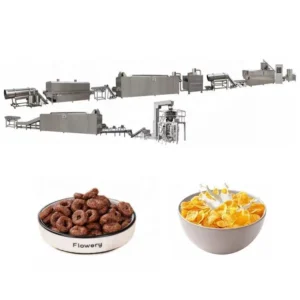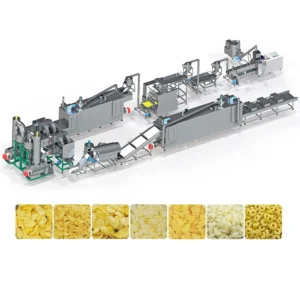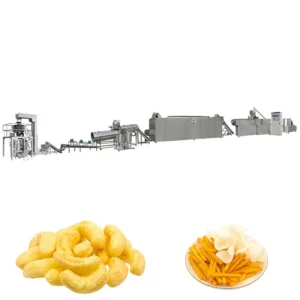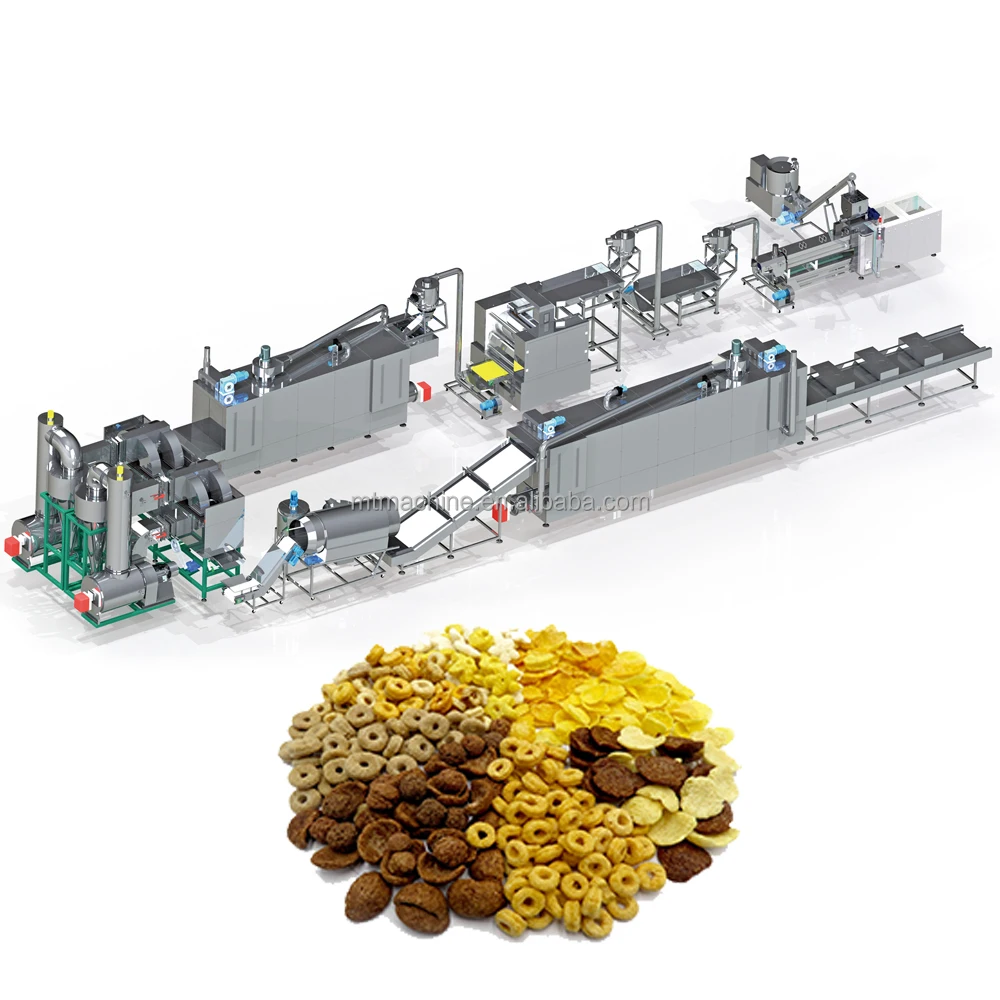
Extrusion Technology Focus — Screw configuration, barrel temperature zones, and die land length are mapped to your specific grain blend and target flake density before the line is finalized.
Technical Specifications
| Parameter | Value |
|---|---|
| Model | MT70 / MT85 / MT75 |
| Product Type | Corn Flakes Production Line |
| Screw Type | Twin Screw |
| Installed Power | MT70 — 160 kW; MT85 — 190 kW; MT75 — 210 kW |
| Power Consumption | MT70 — 120 kW; MT85 — 140 kW; MT75 — 150 kW |
| Output Capacity | MT70 — 150–200 kg/h (basis not stated in source); MT85 — 300–400 kg/h (basis not stated in source); MT75 — 300–500 kg/h (basis not stated in source) |
| Overall Dimensions (L×W×H) | MT70 — 41 × 1.5 × 2.2 m; MT85 — 43 × 1.5 × 3.2 m; MT75 — 45 × 1.5 × 3.5 m |
| Control System | PLC control with MCC available |
| Heating Source (Dryer / Roaster) | Gas or Electric |
| Flaking Station | Hydraulic double-roller system, infrared temperature control |
| Roasting Oven | Vibrating pan, cyclone dust removal, precise temperature control |
| Coating System | Double tumble sugar melting, elevator, coating drum, spraying nozzle |
| Certifications | CE, ISO |
Application Suitability
| Application | Material or Output |
|---|---|
| Natural corn flakes production | Corn grits and maize flour |
| Sugar-coated corn flakes | Corn, rice, or multi-grain base with sugar syrup coating |
| Multi-grain breakfast flakes | Rice, wheat, oat, and barley powder blends |
| Extruded cereal shapes | Ball, tube, stick, ring, fruit loop, star, wheel, flower, heart formats |
| Fortified breakfast cereal lines | Grain blends with added nutritional premix |
Why Generic Screw Profiles Fail on Corn Flakes
Starch gelatinisation demands a screw configuration matched to your exact raw material, not a copied profile from a different cereal application.
I have seen corn flakes extrusion production line specifications quoted with standard screw elements that work fine on yellow corn but collapse entirely when the buyer switches to locally sourced high-moisture maize. The expansion ratio drops, the flakes come out dense, and blistering in the roaster becomes uneven. When we commissioned a plant in Southeast Asia running regional maize, the pre-shipment trial on standard corn gave us no warning — only on their actual material did the problems surface, forcing a complete re-map of roller gap, dryer curve, and toasting temperature. Corn flakes extrusion production line specifications mean little when the screw profile has not been validated on your grain [NEED_CITE: starch gelatinisation behaviour across different maize varieties].
Screw Configuration and Barrel Zone Mapping
The twin-screw extruder in this corn flakes extrusion production line specifications package is built around a modular screw arrangement where element sequencing controls shear intensity and residence time across each barrel zone. For corn-based formulations, the barrel temperature profile must hold a precise curve so that starch gelatinisation reaches completion before the material exits the die. Moisture addition at the mixer stage interacts directly with barrel zone heating, meaning small changes in raw material moisture content shift the entire thermal balance. The die land length is selected to manage expansion at the die face, which sets the initial structure that the flaking rollers then compress into the final flake geometry.
Starch Gelatinisation and Flake Blistering Behaviour
Achieving the characteristic blistered surface on a roasted corn flake requires that the extruded pellet carry the right internal moisture and gelatinised starch structure into the flaking and roasting stages. If gelatinisation is incomplete inside the extruder barrel, the flake will remain dense and fail to crisp properly during hot air roasting [NEED_CITE: cereal flake texture development through roasting temperature profiles]. The hot air roasting oven on this line uses a vibrating pan with high-temperature spraying tubes and two separate circulating fans to deliver even heat distribution, while the cyclone dust removal device keeps fines from accumulating and causing hot spots. Gas or electric heating can be specified depending on local utility availability and cost structure.
Reading the Specification Sheet Against Your Production Target
The installed power figures — 160 kW on the MT70, 190 kW on the MT85, and 210 kW on the MT75 — reflect the total connected load across all line stations including the extruder drive, flaking rollers, dryer, roaster, and coating system. Actual power consumption runs lower at 120 kW, 140 kW, and 150 kW respectively, which matters for transformer sizing and electrical infrastructure planning at the installation site. The flaking machinery uses a hydraulic system for the double rollers with separate motors driving each roller independently, so roller gap and speed differential can be adjusted to control flake thickness without changing the extruder output rate. Infrared sensors monitor roller temperature continuously, preventing the dough sheet from sticking or tearing during the flaking pass. Overall line length ranges from 41 m to 45 m depending on the model, which should be checked against available floor space including infeed and discharge clearance.
The Cost of Skipping Material-Specific Validation
When extrusion parameters are locked in without testing the buyer’s actual grain supply, the consequences show up during commissioning rather than in the factory. Flakes that are too dense will not blister correctly in the roaster, producing a texture that the market rejects. A screw profile that works on one corn variety may generate excessive shear on another, breaking down starch chains and yielding a gummy pellet that the flaking rollers cannot handle cleanly. These problems compound because adjusting one parameter — roller gap, for instance — forces changes downstream in drying time and roasting temperature [NEED_CITE: interdependence of extrusion and downstream processing parameters in cereal production].
Why This Extrusion Technology Approach Works
Screw configuration and die design are specified to the buyer’s raw material blend and target flake density, not pulled from a generic build library. Barrel temperature profiles are developed through in-house testing on your actual grain supply, so starch gelatinisation parameters are confirmed before the extruder ships. Every station on the line — mixing, extruding, flaking, drying, roasting, coating, cooling, and packing — is sized so that throughput is balanced, preventing any single stage from bottlenecking the operation. The in-house machine testing workshop allows trial runs on your raw material, generating a documented report covering flake density, blistering behaviour, and texture before equipment leaves the factory [NEED_CITE: value of pre-shipment product trials for food extrusion equipment].
Documentation & Verification
- Screw and die configuration record matched to your specific grain blend and target density
- Trial run report on your raw material covering flake blistering, expansion, and texture results
- Line layout showing station-by-station throughput balance with capacity calculations
- Electrical schematic with voltage, frequency, and control language confirmed for your site
- CE declaration of conformity and ISO certificate included with shipping documentation
Installation, Commissioning & Support
- Foundation and floor space planning based on line dimensions up to 45 × 1.5 × 3.5 m
- Dedicated electrical circuits sized to the MT75 installed load of 210 kW
- PLC control system configured with operator interface language matching your workforce
- First-run commissioning includes barrel zone temperature calibration on your raw material
- Wear parts list covering screws, dies, and roller surfaces with recommended replacement intervals
What to Include in Your Inquiry
To move forward with a corn flakes extrusion production line specifications review, share your raw material type and typical moisture content along with the target flake density and format — natural or sugar-coated. Confirm your local voltage and frequency, the control language your operators need, and whether an in-house trial run on your grain supply should be scheduled before shipment.
Frequently Asked Questions
Q: How is screw configuration determined for a specific corn or multi-grain blend?
A: The screw element sequence and die land length are selected based on the starch content, moisture level, and target flake density of your formulation. Trial runs in the testing workshop validate the configuration before the extruder is finalized for shipment.
Q: How is output capacity verified on actual raw material?
A: An in-house trial run processes your grain supply through the extruder and downstream stations, producing a report that documents throughput, flake density, and texture results under production-representative conditions.
Q: What barrel temperature profile is needed for proper starch gelatinisation in corn flakes?
A: The barrel zone temperatures are set to complete starch gelatinisation while maintaining enough moisture for proper expansion at the die. The exact profile depends on your corn variety and moisture content, confirmed during the trial run.
Q: How does roller gap and temperature affect final flake quality?
A: The hydraulic double-roller system with infrared temperature control maintains uniform gap and surface condition so that each pellet is compressed to consistent thickness, which directly influences blistering behaviour during hot air roasting.
Q: What does the pre-shipment trial report cover?
A: The report documents screw configuration used, barrel zone temperatures, moisture levels at each stage, flake thickness, blistering results after roasting, and final texture assessment against your target specification.