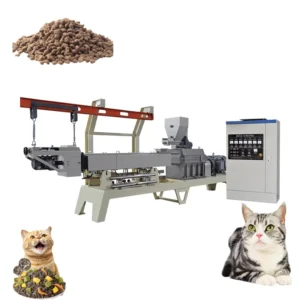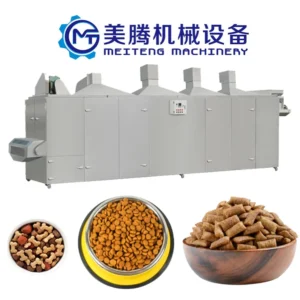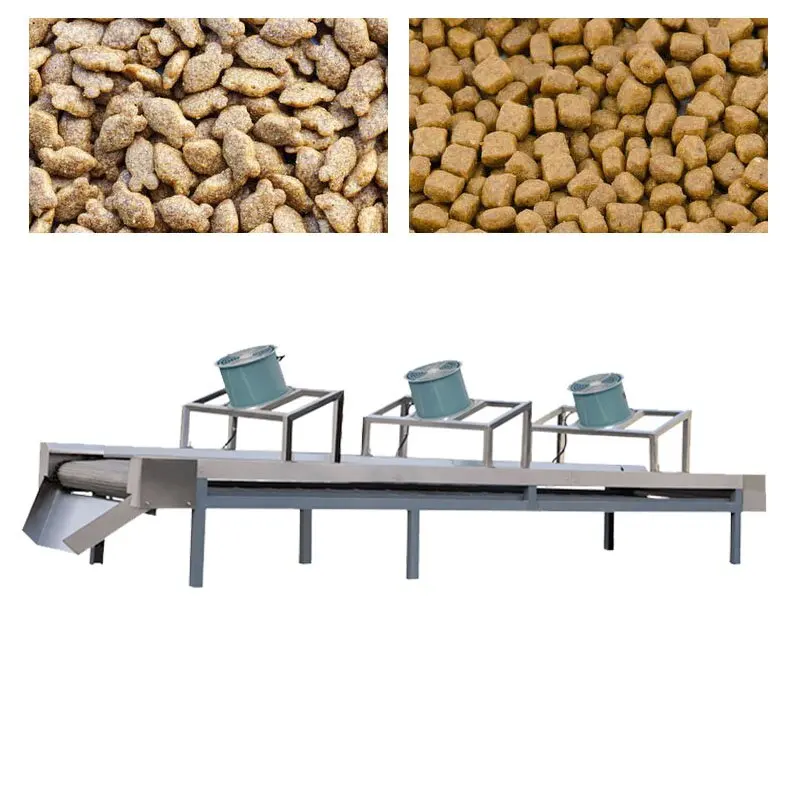
Custom screw profiles — Every barrel section and die plate is matched to the buyer’s specific protein and starch ratio, verified by trial runs on actual customer formulations before the line leaves the workshop.
Technical Specifications
| Parameter | Value |
|---|---|
| Product Type | Twin Screw Pet Food Extrusion Production Line |
| Screw Type | Twin-screw |
| Output Capacity | Up to 3 tons per hour (basis not stated in source — confirm raw material, moisture content, and pellet size) |
| Control System | PLC and MCC (per manufacturer standard) |
| Warranty | 1 year |
| Assembly State | Complete production line |
| Process Documentation | Fish feed process drawing included |
| Standards | CE, ISO 9001 |
Application Suitability
| Application | Material or Output |
|---|---|
| Dry dog and cat kibble production | Corn, poultry meal, fish meal, bone meal, vitamins |
| Floating and sinking aquatic feed | Soybean meal, wheat flour, fish oil for catfish, tilapia, shrimp |
| Grain-based extruded snacks and pellets | Corn grits, rice flour, oat, multigrain blends |
Why Nominal Capacity Figures Fail on High-Protein Formulations
Actual throughput must be proven on the buyer’s specific raw material blend before the line ships.
Most twin screw pet food extrusion machine manufacturer catalogues list a single peak output number derived from pure starch trials. When a pet food producer runs a formulation loaded with meat meal or fish protein, the material behaves entirely differently inside the barrel. Viscosity increases, expansion drops, and the screw profile designed for corn grits cannot convey the mix at the stated rate. I learned this after watching a Middle East installation stall because the trial was done on standard corn flour while the customer’s recipe contained high levels of animal protein, forcing a complete parameter rebuild on site [NEED_CITE: material rheology in twin-screw extrusion].
Barrel Temperature Zoning and Protein Denaturation
The extrusion barrel is divided into multiple heating and cooling zones, each independently controlled. When processing high-protein pet food recipes, the thermal profile must be staged to denature proteins gradually without scorching the outer layer of the kibble. A twin screw pet food extrusion machine manufacturer that offers only a single-zone heater cannot achieve the density gradient required for premium kibble that sinks or floats on command.
Shear Force Control Through Screw Pitch Variation
Screw elements can be arranged in forwarding, reverse, and kneading configurations. The pitch and stagger angle determine how much mechanical shear is applied to the dough. For aquatic feed that must hold together in water for a set duration, higher shear in the metering section gelatinises starch more completely, creating a tighter matrix that resists disintegration [NEED_CITE: starch gelatinisation indices in extruded aqua feed].
Die Aperture and Cutter Speed Define Kibble Geometry
The die plate determines pellet cross-section, while the face cutter speed sets the length. A round die with a slow cutter produces short cylinders suitable for puppy kibble, whereas a star-shaped die at high cutter speed creates small, dense pellets for ornamental fish. Changing the die and recalibrating the cutter takes less than an hour, allowing a single line to serve multiple product SKUs.
Interpreting the Power and Control Specifications
The PLC and MCC control architecture separates high-voltage motor circuits from low-voltage logic, reducing electrical noise on temperature sensors. This matters because a fluctuating thermocouple reading causes the heater to overshoot, burning the product. The twin-screw configuration itself demands more installed motor power than a single-screw unit of the same barrel diameter because two intermeshing shafts must overcome the friction of viscous, protein-rich dough. Buyers should verify that the quoted motor rating covers the highest-viscosity recipe they intend to run, not just the lightest starch blend. CE and ISO 9001 compliance documentation confirms that the electrical enclosure and emergency stop circuit meet European machinery directive requirements [NEED_CITE: CE machinery directive requirements for industrial equipment].
The Cost of Skipping Material-Specific Screw Profiling
When the screw elements are selected from a generic catalogue rather than matched to the buyer’s recipe, the extruder may reach the target temperature but fail to convey the material through the die. The result is surging output — moments of high flow followed by dry spells — which overloads the downstream dryer and produces kibble with inconsistent moisture content. In the field, this forces operators to reduce feed rate well below the nameplate capacity, negating the investment in a larger machine. I have seen lines idle for weeks while replacement screw elements were manufactured and shipped [NEED_CITE: downtime costs in continuous food extrusion].
Why Sourcing from a Single Extrusion Technology Supplier Matters
The line is engineered as one system, not assembled from unrelated vendors. Throughput at the mixer, extruder, dryer, and coater is calculated together so no station becomes a bottleneck. Screw configuration and die design are documented against the buyer’s raw material, not copied from a previous project. An in-house testing workshop runs the customer’s actual formulation before shipment, producing a trial report that records real throughput, expansion ratio, and kibble density. Food-grade stainless steel contact surfaces are used throughout the product zone, meeting the hygiene expectations of premium pet food brands. Pre-sales layout drawings include utility connection points, allowing the buyer to prepare water, steam, and electrical drops before the equipment arrives.
Documentation & Verification
- Trial run report recording actual output and kibble density on your specific protein-to-starch ratio
- Screw element arrangement and die aperture record matched to your target pellet geometry
- Electrical schematic confirming PLC I/O mapping and MCC circuit protection ratings
- Line layout showing footprint and utility drop locations for your workshop floor
- CE declaration of conformity covering the complete extrusion and downstream assembly
Installation, Commissioning & Support
- Foundation bolts and leveling pads supplied for the extruder mainframe weight distribution
- Dedicated circuit breaker sizing confirmed for the combined PLC and MCC load
- Barrel sections arrive pre-assembled; only the die holder and cutter require field mounting
- First-run parameter set uploaded to the PLC from the workshop trial data
- Operator training covers screw element swapping and die changeover procedures
- Wear parts list identifies screw tips, barrel liners, and cutter blades with reorder codes
What to Include in Your Inquiry
To configure the line accurately, provide the raw material list with approximate percentages, the target kibble size range, and the desired daily output in finished tonnes. Confirm the local voltage and frequency, the available workshop ceiling height, and whether existing dryers or packing stations will be retained. If your formulation includes novel protein sources or high fat levels, send a sample batch so a trial run can be scheduled before the quotation is finalised.
Frequently Asked Questions
Q: How is output capacity verified on my specific raw material before shipment?
A: We run your actual formulation through the extruder in our testing workshop. The trial report records real throughput, expansion ratio, and kibble density, so you see the numbers your recipe produces, not a generic starch-based figure.
Q: What screw configuration and die design is specified for my target kibble density?
A: Screw elements are arranged in forwarding, kneading, and reverse sections based on your protein and starch ratio. The die aperture and cutter speed are then set to achieve the pellet size and density your market requires.
Q: How do you ensure the dryer and coating stations match extruder throughput?
A: Every station is calculated together during the layout phase. The dryer belt width, residence time, and air volume are sized to handle the extruder’s verified output on your recipe, preventing a bottleneck downstream.
Q: What voltage, frequency, and control language options are confirmed before production?
A: We confirm your site voltage, frequency, and preferred PLC screen language before the electrical enclosure is wired. This avoids rewiring delays and ensures the operator interface is readable on day one.
Q: How are spare wear parts such as screws and dies supplied for first replacement?
A: A wear parts list with reorder codes ships with the machine. Screw tips, barrel liners, and cutter blades can be dispatched from stock, and we recommend ordering the first set alongside the main line to avoid production pauses.