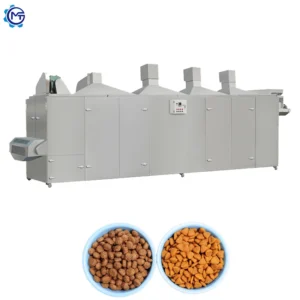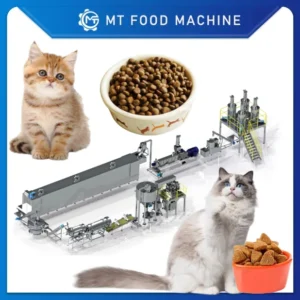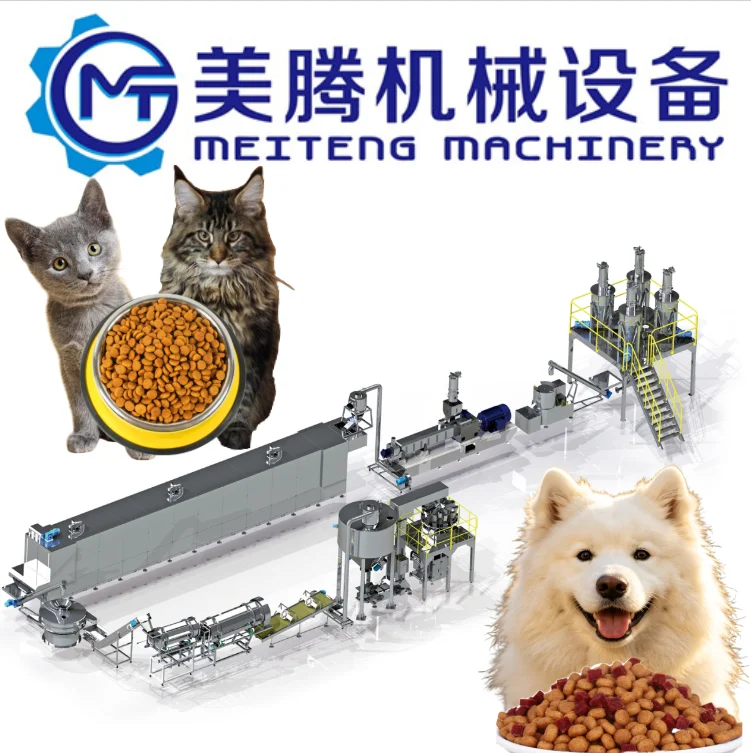
Screw Configuration Matched to Your Recipe — every barrel zone, die, and downstream station is specified against your raw material formulation rather than a generic catalog build.
Technical Specifications
| Parameter | Value |
|---|---|
| Product Type | Pet Food Extrusion Production Line |
| Capacity Range | 150 kg/h – 3 T/h (basis not stated in source — confirm raw material formulation, moisture content, and kibble size) |
| Automation Level | Fully automated from mixing through extrusion, drying, to packaging |
| Control System | Advanced sensors and precision controls (PLC / MCC configuration to be confirmed) |
| Recipe Adaptability | Dry kibble, semi-moist formulations, and treat formats |
| Line Stations | Mixing, extrusion, drying, packaging (inclusion of coating, cooling, and flavouring stations to be confirmed) |
| Contact Material | Food-grade stainless steel on all product contact surfaces |
| Maintenance Design | Modular components for rapid disassembly and cleaning |
| Layout Flexibility | Customizable footprint and station arrangement to match factory dimensions |
| Certifications | CE, FDA |
Application Suitability
| Application | Material or Output |
|---|---|
| Dry kibble for dogs and cats | Corn, meat meal, soy protein, wheat flour, bone meal, vitamin premix |
| Bird feed pellets | Millet, sorghum, ground corn, seed blends, calcium carbonate |
| Floating and sinking fish feed | Fish meal, soybean meal, rice bran, starch binders |
| Semi-moist pet treats | High-moisture meat slurries, glycerin, humectants, flavoring agents |
| Cattle and livestock pellets | Grain mixtures, bran, protein concentrates, mineral supplements |
What "150 to 3,000 kg/h" Leaves Out About Pet Food Extrusion Lines
A capacity number without a recipe attached is not a capacity — it is a guess.
I spent years on the assembly floor in Shandong before moving into technical sales. Early on, we shipped a pet food extrusion production line to a Middle East customer using our standard corn-flour trial recipe. The machine ran perfectly in our workshop. Then it arrived on their floor, loaded with a high-protein formulation, and the kibble would not expand. The screw combination was entirely wrong for their material [NEED_CITE: starch gelatinisation behavior at varying protein concentrations]. That failure changed how I approach every quotation. Now, the pet food extrusion production line capacity is confirmed against your actual raw material and moisture content before the machine leaves our testing workshop.
How Screw Configuration Controls Kibble Texture and Density
The screw profile determines how much shear energy transfers into your material at each barrel zone. A configuration built for high-starch corn will over-shear a meat-heavy recipe, destroying the expansion you need for a light, palatable kibble. On this pet food extrusion production line, screw element sequencing — forward-flight, kneading block, and reverse-flight sections — is laid out after reviewing your ingredient list, fat percentage, and target bulk density.
Barrel Temperature Profiling Across the Extrusion Zones
Starch gelatinisation does not happen at a single temperature. It requires a controlled ramp across multiple barrel zones, each responding differently to the moisture and fat in your specific blend. A flat temperature profile causes inconsistent expansion: some kibble comes out dense and sinks in the bowl, while other pieces over-expand and shatter during drying. The barrel heating and cooling circuits on this line are mapped zone by zone, giving operators the resolution to hold the correct thermal window for each recipe they run [NEED_CITE: thermal profile requirements for multi-ingredient extrusion].
Reading the Specifications That Actually Matter
The capacity range of 150 kg/h to 3 T/h covers everything from a small specialty producer to a high-volume commercial plant, but where your line lands within that band depends entirely on kibble geometry, moisture at the die face, and formulation density. Food-grade contact materials prevent corrosion from acidic meat slurries and salt-heavy premixes that would degrade standard steel within a production season. The modular maintenance design means screw segments and barrel liners can be swapped without pulling the entire shaft, cutting changeover time between recipe trials. The advanced sensor array feeds real-time barrel pressure and temperature data back to the control system, so drift in gelatinisation conditions is caught before a full batch runs off-spec.
The Cost of Skipping the Trial Run
When a line ships without running the buyer’s actual formulation, every production problem waits until installation day to surface. Screw profiles that looked acceptable on paper generate the wrong shear balance. The dryer capacity no longer matches the moisture load coming off the die. Coating drums cannot keep pace because the extruder output was never verified under real conditions. These mismatches mean weeks of lost production while the supplier reconfigures components remotely [NEED_CITE: post-installation reconfiguration costs in extrusion projects]. The trial run in our workshop catches these failures before the crate is sealed.
Why Sourcing This Line From MT Makes a Practical Difference
Every station from the batching mixer to the packaging head is supplied as one matched system, so throughput at the dryer, cooler, and coating drum is calculated against the extruder’s real output on your recipe, not a catalog maximum. Screw and die configuration is documented to your raw material and archived for future reorders. The in-house testing workshop runs your ingredients before dispatch, producing a trial report that travels with the shipment. Twin-screw expertise across dry kibble, semi-moist, and treat formats means the screw profile is drawn from actual production history, not extrapolated from a single reference build. Electrical schematics, voltage, and frequency are confirmed to your facility’s supply before manufacturing begins, eliminating commissioning delays caused by mismatched motor ratings.
Documentation & Verification
- Screw and die configuration record matched to your raw material formulation and target kibble geometry
- Trial run report generated on your actual ingredients before the line leaves the workshop
- Line layout drawing with capacity calculated at every station from batching to packaging
- Electrical schematic confirming voltage, frequency, and control language for your facility
- CE declaration of conformity covering the complete extrusion and downstream system
- Wear parts list specifying screw segments, barrel liners, and die inserts with replacement intervals
Installation, Commissioning & Support
- Foundation and floor space plan reflecting your confirmed line layout and modular station arrangement
- Dedicated circuit specification matching the extruder motor and barrel heater power draw at your local voltage
- Pre-assembled modules shipped in transport-ready sections to reduce on-site mechanical assembly time
- First-run parameter logging across all barrel zones using your raw material to establish baseline recipes
- Operator training covering screw changeover, barrel cleaning, and control system navigation in your specified language
- Spare screw segments, die plates, and barrel liners stocked and shipped with the initial order
What We Need to Configure Your Line
To build a quotation that holds up on your production floor, send your raw material list with approximate percentages, the kibble shapes and sizes you plan to run, and your target daily output. Include your facility’s voltage and frequency, the available floor space with ceiling height, and whether you need coating and flavouring stations integrated into the line. If you can ship a sample batch of your formulation to our workshop, we will run a full trial before finalizing the screw configuration.
Frequently Asked Questions
Q: How is screw configuration determined for my raw material and kibble size?
A: We review your ingredient list, protein and fat percentages, and target kibble geometry. The screw element sequence — forward-flight, kneading blocks, and reverse sections — is then laid out to deliver the correct shear and residence time for your formulation. The configuration is tested on your material in our workshop before shipment.
Q: How is capacity verified on my actual formulation rather than a nominal figure?
A: We run your raw material through the extruder in our testing workshop at the moisture content and feed rate you specify. Output is weighed and kibble density is measured. The confirmed throughput becomes the basis for sizing the dryer, cooler, and packaging station to match.
Q: What barrel temperature profile and moisture range does the line support?
A: Each barrel zone has independent heating and cooling circuits, allowing a stepped temperature ramp tailored to your starch gelatinisation window. Moisture conditioning upstream of the extruder is adjustable to suit formulations ranging from low-moisture dry kibble to high-moisture semi-moist treats.
Q: Is a trial run on my raw material performed before shipment?
A: Yes. Your formulation is run through the complete extrusion and drying sequence in our workshop. The trial report documents output rate, kibble density, expansion ratio, and moisture at the dryer exit. This report ships with the line and serves as your commissioning baseline.
Q: How are downstream stations matched to extruder throughput?
A: Dryer belt length, cooling conveyor residence time, and coating drum volume are all calculated from the extruder output measured during your material trial. This prevents bottlenecks where a downstream station cannot handle the actual production rate coming off the die.