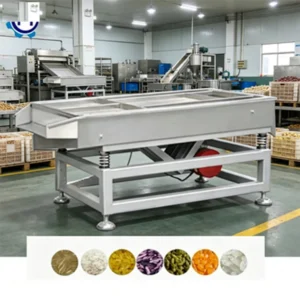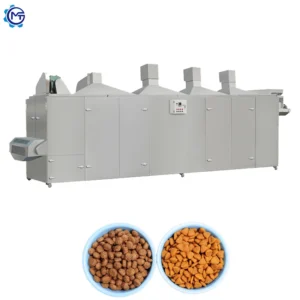
Precision-matched screw geometry — every MT85 barrel segment and die plate is selected against your actual kibble formulation rather than a generic catalog build.
Technical Specifications
| Parameter | Value |
|---|---|
| Model | MT85 |
| Product Type | Twin-Screw Pet Food Extrusion Line |
| Output Capacity | 500 kg/h (basis not stated in source — confirm raw material formulation, moisture content, kibble size & density) |
| Rated Power | 45 kW |
| Voltage & Frequency | 380V 50Hz Three Phase (configurable for destination grid) |
| Screw Configuration | Twin-screw, modular elements matched to recipe |
| Control System | PLC & MCC with automated process management |
| Contact Materials | Food-grade stainless steel on all product zones |
| Line Assembly | Complete production line from mixing through packaging |
| Certifications | CE, ISO |
Application Suitability
| Application | Material or Output |
|---|---|
| Dry kibble for dogs and cats | Corn, wheat, rice, meat meal, poultry by-product blends |
| Bird and small-animal feed | Millet, sorghum, seed-based formulations |
| Semi-moist pet treats | High-meat-slurry recipes with humectant additions |
| Floating and sinking aquatic pellets | Fish meal, soy protein concentrate, starch binders |
What the Nominal 500 kg/h Figure Does Not Guarantee
Capacity is only meaningful when tied to your exact raw material formulation, moisture level and kibble geometry.
A twin-screw pet food extrusion line specifications sheet that lists a single output number without stating the test material leaves the buyer exposed. I have watched lines stall at well below the quoted figure because the local corn grits absorbed water differently than the manufacturer’s trial batch, collapsing expansion and forcing the dryer to run far longer per pass [NEED_CITE: impact of raw material variability on extrusion throughput]. The MT85 avoids this gap by running your actual formulation in the testing workshop before the machine is crated, producing a trial report that locks in the realistic throughput expectation.
How Screw Configuration Shapes Kibble Density
The MT85 uses modular screw elements whose pitch, flight depth and kneading block arrangement are rearranged for each recipe. A high-protein kibble intended for working-dog markets demands greater shear to gelatinise starch while keeping density above the float threshold. Swap to a low-density puppy recipe and the element stack is re-sequenced to reduce shear, preserving a lighter bite. This level of screw configuration is where twin-screw pet food extrusion line specifications move from catalog numbers to real product control.
Barrel Temperature Profiling Across Five Zones
Heat enters the barrel through electric resistance bands and is removed by circulating-water channels, giving operators independent command over each zone. During a high-fat semi-moist run, the feed zone stays cool to prevent fat smearing on the screw flights, while the metering zone climbs to complete starch cook-out [NEED_CITE: barrel zone temperature effects on lipid-rich extrusion]. Mis-setting a single zone shifts the melt viscosity entering the die, and the kibble either fractures on cooling or collapses into undersized pellets.
Reading the Spec Sheet Like a Process Engineer
The 45 kW main drive determines how much mechanical energy can be forced into the melt; running a high-fibre recipe that demands extra shear may push the motor toward its thermal limit if the screw elements are not trimmed back accordingly. The PLC logs barrel pressure in real time, so operators see the moment the die begins to clog with fines rather than discovering it through a sudden drop in kibble length. Twin-screw pet food extrusion line specifications only hold value when every parameter is interpreted as part of a system: power, pressure, moisture and die land length together dictate whether the final kibble passes density and texture tests on the packing table.
The Cost of Skipping the Trial Run
Buyers who waive the pre-shipment test often discover recipe incompatibilities only after the dryer and coater are bolted down. Re-grinding screws or ordering a new die plate overseas adds weeks of idle time, and the commissioning engineer has to re-profile barrel temperatures on a line that is already supposed to be in production [NEED_CITE: downtime cost from unverified extrusion tooling]. Those delays are invisible on the original quotation but show up plainly on the factory floor.
Why Sourcing the MT85 Here Reduces Integration Risk
Screw configuration records are written against your specific raw material blend, not copied from a previous buyer’s project. The testing workshop runs your actual formulation, generating a trial report that documents throughput, kibble density and energy draw before the crate leaves Jinan. PLC and MCC panels are built to the voltage and frequency you confirmed during the layout stage, eliminating the VFD emergency I once faced on a 60 Hz site. Downstream stations — dryer, coating drum, cooler — are sized to the verified output so no single unit becomes a bottleneck. CE documentation travels with the shipment, smoothing customs clearance in markets that enforce the Machinery Directive.
Documentation & Verification
- Screw and die configuration record mapped to your raw material formulation
- Trial run report on customer-supplied ingredients before dispatch
- Electrical schematic confirming voltage, frequency and HMI language
- CE declaration of conformity and ISO certificate pack
- Line layout showing throughput balance across every station
Installation, Commissioning & Support
- Foundation plan matched to the 45 kW drive load and vibration profile
- Dedicated three-phase circuit sized for 380V 50Hz start-up surge
- On-site barrel alignment and screw element stack verification by a Meiteng engineer
- PLC parameter upload using your confirmed HMI language
- Wear-parts list covering screws, dies and barrel liners for the first year of production
Before You Request a Quotation
Share your primary raw material list with moisture percentages, the kibble diameter and density range your market expects, and the daily output target for each recipe. Confirm the voltage, frequency and control language of the destination plant so the MCC and HMI are wired correctly before shipping. If you operate an existing mixing or packing line, send the upstream feed rate and downstream conveyor speed so the MT85 throughput can be balanced against them.
Frequently Asked Questions
Q: How is the 500 kg/h output capacity verified for the MT85?
A: The figure is a reference point; actual capacity depends on raw material formulation, moisture content and kibble geometry. We run your specific ingredients in the testing workshop and issue a trial report that states the verified throughput, so the number on the contract matches what you will see on the production floor.
Q: How are screw configuration and die design chosen for my recipe?
A: Engineers review your protein, fat and starch ratios, then arrange screw elements and select die land length to hit the target expansion and density. The configuration record is locked in your file and can be referenced for every future reorder of wear parts.
Q: What barrel temperature zones does the MT85 support?
A: The barrel is divided into independently heated and cooled zones, each monitored by the PLC. Operators set profiles per recipe, and the control system logs deviations so process drift is caught before kibble falls out of specification.
Q: Can a trial run be performed on my raw material before shipment?
A: Yes. Send a representative sample of your formulation to the testing workshop. We extrude, dry and measure kibble density, then share a full report covering throughput, energy consumption and recommended screw configuration before the machine is packed.
Q: How do you confirm voltage, frequency and control language before production?
A: During the layout stage we collect your factory electrical standard and preferred HMI language. The MCC is wired and the PLC programmed to those values, then tested in the factory so no re-work is needed when the line powers up on your site.