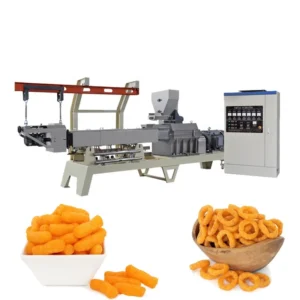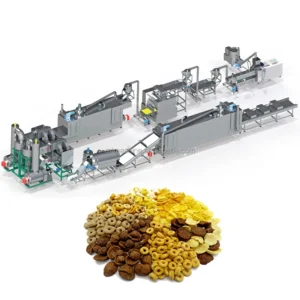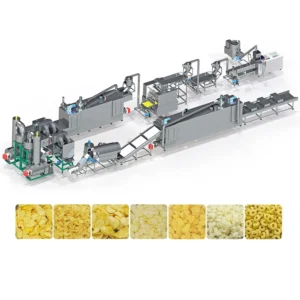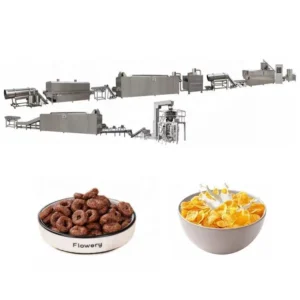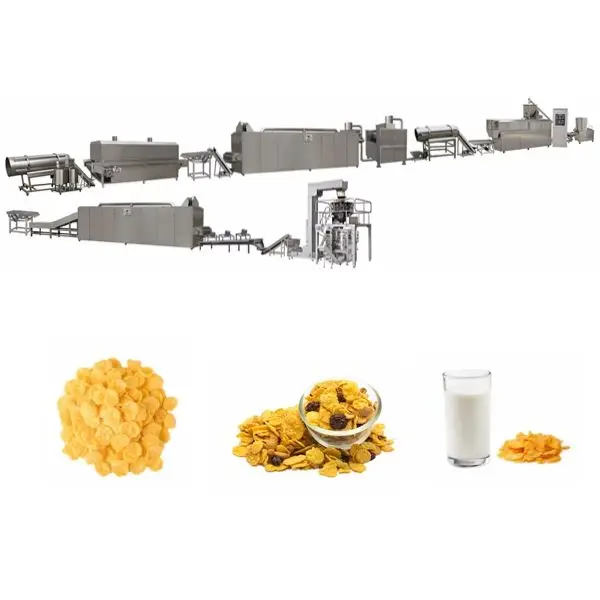
Matched Screw Configuration — Each MT75 barrel and die set is cut for the buyer’s specific corn or multi-cereal blend, verified by a factory trial run before the crate is sealed.
Technical Specifications
| Parameter | Value |
|---|---|
| Model | MT70 / MT85 / MT75 |
| Product Type | Twin Screw Corn Flake Extrusion Line |
| Screw Type | Twin Screw |
| Control System | PLC |
| Installed Power | MT70: 160 kW; MT85: 190 kW; MT75: 210 kW |
| Power Consumption | MT70: 120 kW; MT85: 140 kW; MT75: 150 kW |
| Output Capacity | MT70: 150–200 kg/h (basis to be confirmed); MT85: 300–400 kg/h (basis to be confirmed); MT75: 300–500 kg/h (basis to be confirmed) |
| Overall Dimensions | MT70: 41 × 1.5 × 2.2 m; MT85: 43 × 1.5 × 3.2 m; MT75: 45 × 1.5 × 3.5 m |
| Flaking Machinery | Hydraulic double-roller system with infrared temperature sensing |
| Dryer Heating Source | Gas or Electric |
| Roasting Oven | Vibrating pan, conciliation burner, dual circulating fans, cyclone dust removal |
| Coating System | Double tumble sugar melter, elevator, coating drum, spraying nozzle |
| Assembly State | Complete line from batching to packing |
| Certification | CE |
Application Suitability
| Application | Material or Output |
|---|---|
| Natural corn flake production | Corn grits and corn flour |
| Sugar-coated corn flakes | Corn base with sugar syrup coating |
| Multi-cereal breakfast flakes | Rice, wheat, oat, and barley powder blends |
| Shaped cereal formats | Ball, tube, stick, ring, fruit loop, star, wheel, flower, and heart shapes via die adjustment |
Why a Nominal Capacity Figure Means Nothing Without the Raw Material Context
A twin screw corn flakes extrusion line extrusion technology setup only holds its rated output when the screw profile, moisture level, and barrel heat match the exact flour or grits you feed it.
I have watched a breakfast cereal producer in Colombia lose an entire week because the extruder was tuned for corn grits while the buyer ran an oat-heavy blend. The starch gelatinisation window shifted, the flakes came out dense, and the roasting oven could not rescue the texture. That line was not broken — it was simply configured for someone else’s recipe [NEED_CITE: starch gelatinisation temperature ranges across cereal grains]. Capacity numbers printed on a spec sheet rarely account for the moisture content, particle size, or starch composition of your actual raw material.
Barrel Temperature Profiling for Consistent Gelatinisation
The MT75 barrel is divided into independently heated zones managed through the PLC. Corn starch requires a narrow temperature corridor to reach full gelatinisation without premature expansion inside the screw channel. When the profile drifts too high early in the barrel, the dough expands before it reaches the die, producing uneven flakes that shatter during roasting. Precise zone control keeps the melt temperature stable across the full screw length.
Die Geometry and Its Direct Effect on Flake Expansion
The die plate determines the cross-section of the extrudate rope before it enters the flaking rollers. A round orifice with a specific land length controls how much the dough puffs as it exits into atmospheric pressure. Matching the die land length and orifice diameter to the target flake thickness and expansion ratio is what separates a crispy, blistered flake from a hard, glassy disc. The twin screw corn flakes extrusion line extrusion technology platform supports*n natural flake and shaped cereal formats without mechanical overhaul [NEED_CITE: die land length influence on extrudate expansion in food processing].
Reading the Numbers That Actually Matter
The installed power range across the three models — 160 kW on the MT70 up to 210 kW on the MT75 — reflects motor capacity, not continuous draw. Real power consumption sits lower, between 120 kW and 150 kW depending on load, which is the figure to use when sizing your transformer and dedicated circuit breaker. The twin-screw design gives a longer residence time compared to single-screw extruders of similar diameter, allowing more thorough starch cooking at the same throughput. Hydraulic pressure on the flaking rollers, combined with infrared temperature sensing on the roller surface, maintains uniform gap and heat, which is essential for achieving the target flake thickness within tolerance across an entire production run.
The Cost of Running a Generic Screw Build
When an extruder ships with a screw configuration copied from a standard catalog rather than matched to the buyer’s grain blend, the consequences surface within the first production hour. Moisture and shear distribution become uneven, some pellets over-expand while others remain dense, and the roasting oven cannot correct what the barrel got wrong. Operators end up chasing settings all shift, scrap rates climb, and the brand’s texture promise to consumers is quietly broken. I have seen a Central American plant run two weeks of off-spec product before the supplier agreed to reconfigure the screw elements — two weeks of packaged flakes that had to be sold at a discount [NEED_CITE: impact of screw element arrangement on extrudate uniformity].
Why Procurement Here Differs
The MT75 is not sold as a standalone extruder bolted to third-party dryers and coating drums; the entire line from batching through packing is engineered under one supplier so throughput is matched at every station. Screw configuration and die design are specified to the buyer’s raw material and target flake format before production begins. An in-house testing workshop allows trial runs on the customer’s actual corn, rice, or oat blend, generating a product sample and process record before the machine leaves Jinan. PLC control with zone-level barrel management gives process engineers repeatable recipes, and pre-shipment electrical schematics confirm that voltage, frequency, and control language align with the buyer’s facility before the container is loaded.
Documentation & Verification
- Line layout and capacity calculation matched to your cereal blend and target output
- Screw and die configuration record tied to your specific raw material trial
- Trial run report on your corn or multi-cereal flour before dispatch
- Electrical schematic with voltage and frequency confirmed to your site
- CE declaration of conformity for the complete extrusion and roasting line
- Operation and maintenance manual with wear parts list included
Installation, Commissioning & Support
- MT75 footprint of 45 × 1.5 × 3.5 m requires a level concrete slab with anchor points
- 210 kW installed power demands a dedicated feeder circuit sized by your local electrical code
- Line arrives in modular sections; extruder, flaking rollers, and oven are reassembled on site
- First-run commissioning includes barrel zone calibration and PLC recipe setup for your grain
- Operator training covers screw change procedure, die swap, and hydraulic roller gap adjustment
- Spare screw elements, die inserts, and cutter blades ship with the first container
What to Include in Your Inquiry
To configure the twin screw corn flakes extrusion line extrusion technology for your plant, share the primary grain or flour blend you intend to run, including particle size and typical moisture content. Specify the target flake format — natural, sugar-coated, or a shaped cereal — along with the daily output you plan to sustain. Confirm your local voltage and frequency, the available floor space and ceiling height, and whether you need the line to interface with existing packing equipment upstream or downstream.
Frequently Asked Questions
Q: How is screw configuration and die design determined for a specific raw material and target flake density?
A: The screw element sequence — conveying, kneading, and metering sections — is arranged based on the starch content, fat level, and particle size of your grain blend. Die orifice diameter and land length are selected to achieve the expansion ratio your flake format requires. A trial run on your raw material validates the configuration before the line ships.
Q: What barrel temperature profile and moisture range are required for consistent starch gelatinisation in corn flakes?
A: Corn starch typically gelatinises within a defined temperature band that the PLC maintains across multiple barrel zones. Moisture content of the dough at the die face is managed through preconditioning and steam injection. The exact setpoints are established during the factory trial run and recorded in your process documentation.
Q: How is expansion ratio and final flake crispness controlled through the roasting stage?
A: The vibrating roasting pan uses high-temperature air from conciliation burners and dual circulating fans to drive surface blistering and moisture removal. Temperature and residence time are adjustable. Proper expansion at the die sets the internal cell structure that the oven then dries to the target crispness without collapsing the flake.
Q: Can the extrusion line accommodate multi-cereal blends beyond corn, such as rice, wheat, or oat?
A: Yes. The twin-screw platform handles rice, wheat, oat, and barley powders alongside corn. Each grain has a different gelatinisation profile and lipid content, so screw configuration and barrel temperatures are adjusted accordingly. Multi-cereal trials are conducted in the testing workshop to lock in the recipe before installation.
Q: What trial run process is available before shipment to validate product texture and density?
A: The buyer sends a batch of their raw material to the testing workshop. The line runs with the proposed screw and die setup, producing sample flakes that are measured for thickness, density, expansion ratio, and surface blistering. A full trial run report accompanies the shipment, and any configuration adjustments are made before the machine is crated.