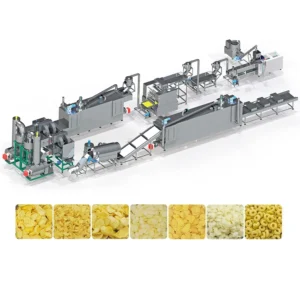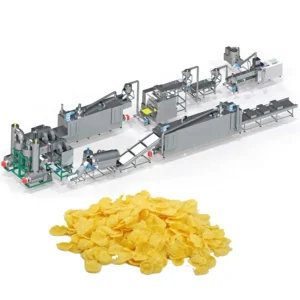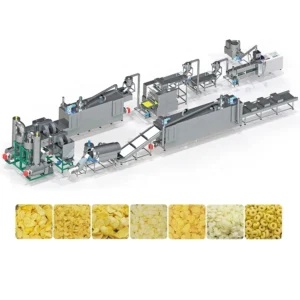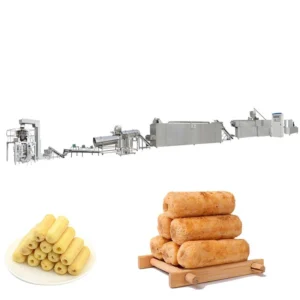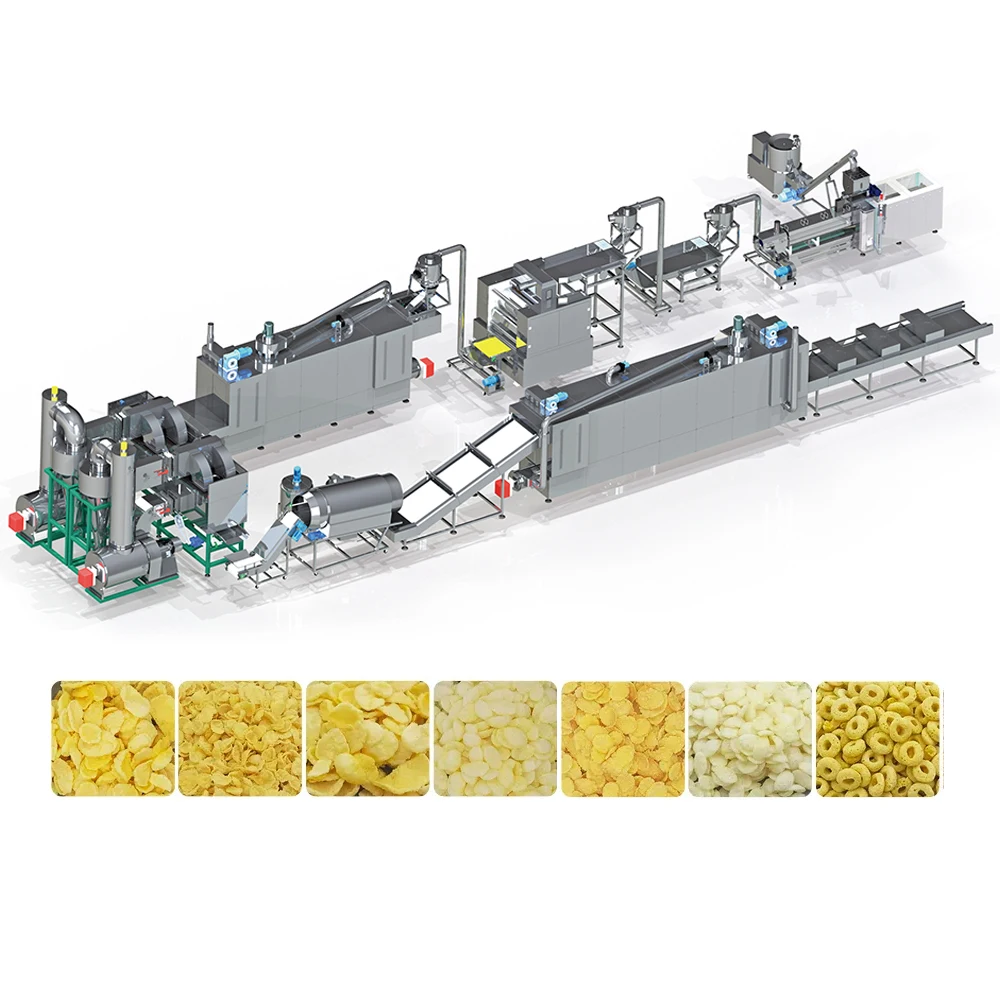
Custom Screw Configurations — screw element arrangement and die geometry matched to your grain flour blend and moisture level, validated in our testing workshop before the line ships.
Technical Specifications
| Parameter | Value |
|---|---|
| Product Type | Corn Flakes Breakfast Cereal Production Line |
| Extruder Model | MT-65 Double Screw Extruder |
| Screw Type | Twin-screw, co-rotating, sectional modules |
| Mixer Power | 4 kW |
| Mixer Tank Size | φ600 × 500 mm |
| Mixer Output | 10–30 kg/load (basis to be confirmed) |
| Corn Flakes Press Power | 16.12 kW |
| Corn Flakes Press Roller Size | 510 × 310 × 1050 mm |
| Corn Flakes Press Dimensions | 1550 × 1300 × 2000 mm |
| Corn Flakes Press Features | Adjustable roller distance, integrated cooling system, separate controller box |
| Screw Conveyor Power | 0.75 kW |
| Screw Conveyor Dimensions | 2700 × 500 × 2400 mm |
| High-Temperature Oven Power | 3.75 kW |
| Oven Heating Source | Gas |
| Oven Baking System | Both-side baking |
| High-Temperature Oven Dimensions | 4.5 × 1.4 × 1.8 m |
| Sugar Spraying System Total Power | 28.75 kW |
| Sugar Spraying System Roller Size | approx. φ600 × 2700 mm |
| Sugar Spraying System Dimensions | 4000 × 1900 × 1880 mm |
| Control System | PLC and MCC |
| Contact Materials | Food-grade stainless steel |
| Standards | CE, ISO |
Application Suitability
| Application | Material or Output |
|---|---|
| Traditional corn flakes for retail breakfast cereal packaging | Corn flour or corn grits blends |
| Multi-grain breakfast flakes | Rice, oat, and blended grain powders |
| Sugar- or honey-coated cereal snacks | Grain-based extrudates with syrup coating, various shapes via interchangeable moulds |
| Fortified breakfast cereals | Grain powders with added nutritional ingredients such as vitamins |
Why "Rated Capacity" Means Nothing Without the Raw Material
Extrusion parameters must be locked to the buyer’s actual flour formulation, moisture content, and target flake thickness — not pulled from a generic data sheet.
A corn flakes line that runs perfectly on standard corn grits at a controlled moisture level can behave completely differently when the buyer’s local flour has a higher fat content or a coarser grind. I have seen extrusion lines arrive on site, power up, and then stall because the pellet density was wrong for the downstream flaking rollers. The line sat idle while the screw configuration was pulled apart and rebuilt [NEED_CITE: importance of raw material matching in twin-screw extrusion]. That is why corn flakes extrusion technology twin-screw configurations should never be specified from a template — every barrel zone, every screw element, and every die opening needs to reflect the material that will actually run through the machine.
Sectional Screw Modules and Starch Gelatinisation Control
The MT-65 uses co-rotating twin screws built from sectional modules, meaning each segment can be swapped to alter transport, mixing, shear, and cooking behaviour along the barrel. For corn flakes, the critical process is starch gelatinisation — the point where granules absorb water, swell, and lose crystalline structure under heat and mechanical shear. By adjusting the arrangement of kneading blocks and reverse elements, the residence time and shear intensity at each barrel zone can be tuned so that gelatinisation reaches the correct degree before the melt exits the die. This is what separates a consistent flake from one that shatters in the bowl or goes soggy within minutes.
Barrel Temperature Profile and Moisture Balance
Barrel temperature zones work in tandem with the moisture added during mixing. Too much moisture and the extrudate leaves the die too soft to hold pellet shape through the flaking press; too little and starch gelatinisation remains incomplete, giving the final flake a raw, starchy mouthfeel [NEED_CITE: starch gelatinisation temperature thresholds in cereal extrusion]. The gas-fired high-temperature oven downstream handles the final moisture reduction, but the extrusion stage must deliver pellets within a narrow moisture window for the flaking rollers to compress them into uniform sheets without cracking at the edges.
How Roller Gap, Die Geometry, and Oven Heat Interact
The corn flakes press features an adjustable roller gap that directly sets flake thickness — a parameter that influences not only texture but also packing density in the retail bag. Thinner flakes toast faster in the oven and deliver a crisper bite, but they are more fragile during conveying and packaging. The die opening on the extruder determines pellet cross-section before it reaches the press, so die geometry and roller gap must be coordinated during the trial run. Downstream, the both-side baking system in the high-temperature oven ensures even heat penetration through the flake bed, avoiding a situation where the top layer over-toasts while the bottom layer remains under-dried. The sugar spraying system adds another variable: its temperature-keeping roller maintains syrup viscosity for uniform coverage, which in turn affects the final moisture content and shelf stability of coated variants.
The Cost of Skipping the Trial Run
When a corn flakes line is shipped without a factory trial on the buyer’s actual raw material, the first production run becomes the trial run — except it happens on the buyer’s factory floor with installation crews still on site and packaging suppliers waiting for product samples. I have watched this play out: the extrudate comes out too dense for the flaking rollers to compress, the oven cannot dry the thicker pellets within its residence time, and the sugar coating pools on uneven surfaces. Five days of reconfiguration, new screw elements flown in, and a very frustrated production manager [NEED_CITE: cost of unplanned downtime in food processing lines]. The entire line’s throughput suffers because one station was never validated against the material it would actually process.
Why This Line Is Configured, Not Catalogued
The screw and die configuration on every MT-65 corn flakes line is specified to the buyer’s grain blend, not copied from a standard build. The in-house testing workshop runs the buyer’s raw material through the extruder, flaking press, and oven before the line is approved for shipment, producing a trial run report that documents the actual process parameters. Throughput is calculated station by station — mixer batch cycle, extruder output, dryer residence time, coating drum capacity — so no single stage bottlenecks the others. Electrical schematics confirm motor voltage, frequency, and PLC interface language against the buyer’s factory power supply before production begins. Every contact surface in the material path is food-grade stainless steel, meeting CE and ISO requirements for food processing equipment.
Documentation & Verification
- Screw and die configuration record matched to your specific grain flour formulation
- Trial run report on your raw material from the in-house testing workshop
- Line layout and capacity calculation showing throughput at each station
- Electrical schematic with voltage, frequency, and PLC language confirmed to your facility
- Factory test record documenting extruder and press performance before dispatch
- Operation and maintenance manual covering all line stations from mixer to cooling conveyor
Installation, Commissioning & Support
- Foundation plan accounting for the 4.5 m oven length and press footprint
- Dedicated electrical circuits sized for the 28.75 kW sugar spraying system and 16.12 kW press
- Modular line stations delivered for sequential assembly from mixer through cooling conveyor
- On-site commissioning with screw speed and barrel temperature tuning to your flour blend
- Operator training on roller gap adjustment and die changeover procedures
- Wear parts list covering screw elements, die plates, and press roller surfaces
What We Need From You to Build the Right Line
To configure the extrusion and downstream stations correctly, we need the specific grain flour types and blend ratios you plan to run, the target flake dimensions and density, and the moisture content of your raw material as received. Share your factory’s available voltage and frequency, the control language your operators require, and the floor space and ceiling height in the designated production area. If you have existing upstream milling or downstream packaging equipment, send the specifications so we can match interface points and avoid throughput mismatches.
Frequently Asked Questions
Q: How is screw configuration matched to different grain flours and moisture levels?
A: The MT-65 uses sectional screw modules that can be rearranged to change mixing intensity, shear, and residence time at each barrel zone. For corn flour, rice flour, or oat blends, the kneading block sequence and reverse element positions are adjusted during the in-house trial run until the starch gelatinisation degree and pellet density meet the target specification for your flake format.
Q: What determines flake thickness and density, and how is it adjusted?
A: Flake thickness is set by the roller gap on the corn flakes press, while density is influenced by extrusion moisture, barrel temperature, and die geometry together. These parameters interact, so the correct process window is established during the factory trial run on your raw material and documented in the configuration record provided with the line.
Q: Can the same line produce both plain and sugar-coated corn flakes?
A: Yes. The sugar spraying system is an integrated station with a melting tank and temperature-keeping roller. Switching between plain and coated production involves stopping the syrup feed and cleaning the coating drum between runs. The changeover procedure and its capacity implications are covered during commissioning and operator training.
Q: How is starch gelatinisation degree verified during extrusion?
A: Gelatinisation is a function of barrel temperature zones, screw speed, moisture content, and residence time. During the trial run, product samples are taken at the die exit and evaluated for texture and internal structure. Adjustments to the screw element arrangement and barrel heating profile are made until the output consistently meets the target specification.
Q: What raw material preparation is needed before extrusion?
A: The flour mixer handles blending and moisture addition, but consistent extrusion performance depends on uniform particle size and pre-weighed batch ratios. Your milling or grinding equipment should deliver flour within the particle size range specified during line configuration. The mixer’s batch cycle time is calculated to keep the extruder continuously fed without material starvation or surging.