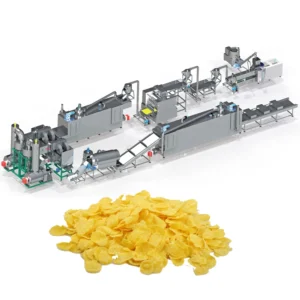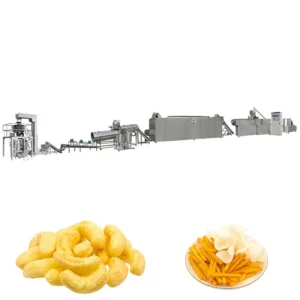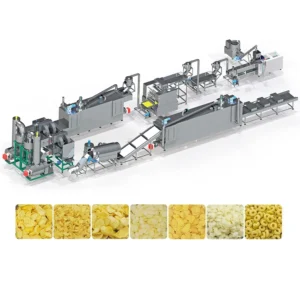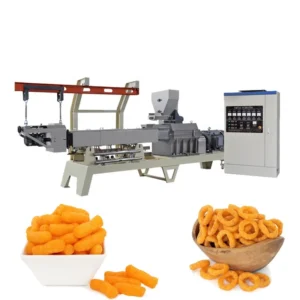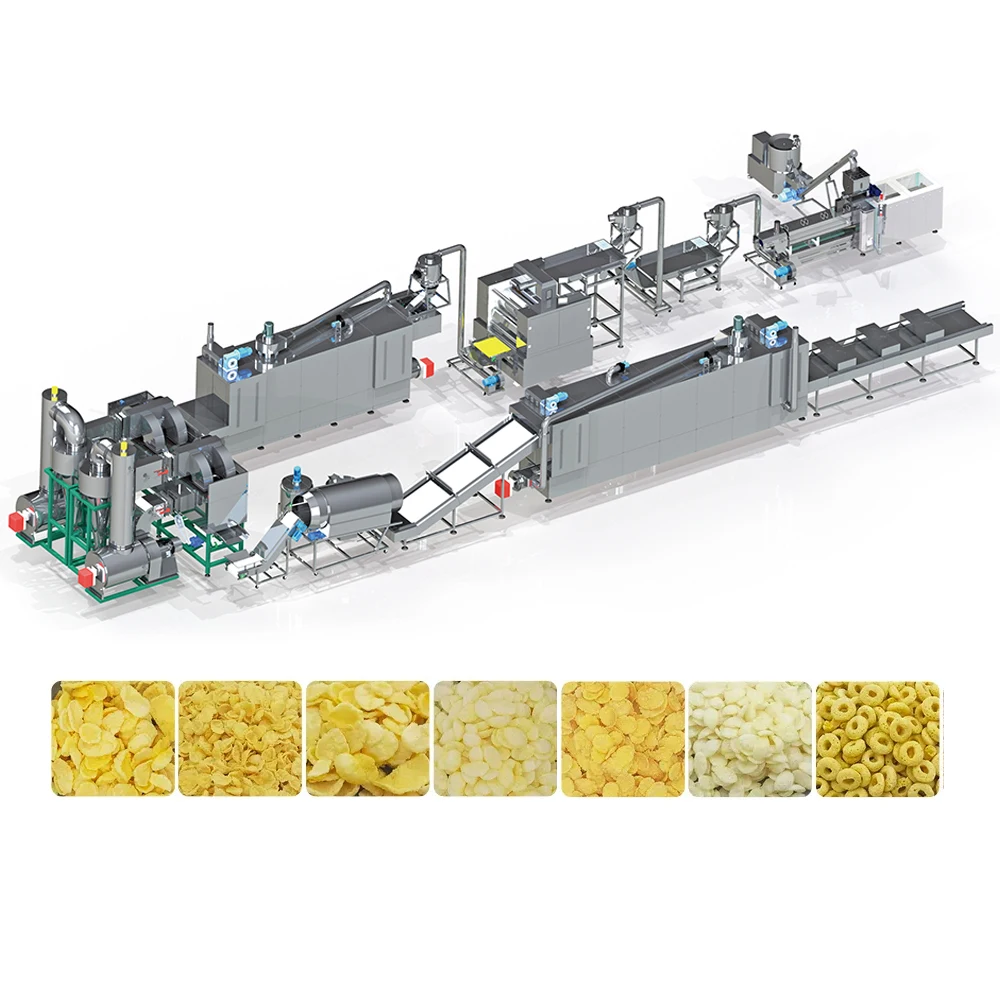
Screw configuration matched to formulation — Every MT70 / MT85 / MT75 corn flakes line we ship carries a screw profile and die record generated from the buyer’s actual corn, rice, or oat blend, not a generic catalogue build.
Technical Specifications
| Parameter | Value |
|---|---|
| Product Type | Corn Flakes Production Line |
| Model | MT70 / MT85 / MT75 |
| Extruder Type | Twin Screw |
| MT70 Installed Power | 160 kW |
| MT70 Power Consumption | 120 kW |
| MT70 Capacity | 150–200 kg/hr (basis not stated in source — confirm raw material, moisture, and product format) |
| MT70 Overall Dimensions | 41 × 1.5 × 2.2 m |
| MT85 Installed Power | 190 kW |
| MT85 Power Consumption | 140 kW |
| MT85 Capacity | 300–400 kg/hr (basis not stated in source — confirm raw material, moisture, and product format) |
| MT85 Overall Dimensions | 43 × 1.5 × 3.2 m |
| MT75 Installed Power | 210 kW |
| MT75 Power Consumption | 150 kW |
| MT75 Capacity | 300–500 kg/hr (basis not stated in source — confirm raw material, moisture, and product format) |
| MT75 Overall Dimensions | 45 × 1.5 × 3.5 m |
| Flaking Machine Control | PLC control system |
| Flaking Machine Drive | Double motors with hydraulic system for double rollers |
| Flaking Machine Temperature Control | Infrared sensor |
| Dryer Heating Source | Gas, Electric |
| Roasting Oven | Hot air roasting with vibrating pan, dual circulating fans, cyclone dust removal |
| Coating System | Double tumble for sugar melting, elevator, coating drum, spraying nozzle |
| Control System | PLC and MCC |
| Extruder Features | Automatic lubricating, cooling function |
| Standards | CE, ISO |
Application Suitability
| Application | Material or Output |
|---|---|
| Natural corn flakes | Corn grits, corn flour |
| Sugar-coated corn flakes | Corn base with sugar or honey glaze |
| Multigrain breakfast cereal | Rice, wheat, oat, barley powder blends |
| Shaped cereal snacks | Ball, tube, stick, ring, fruit loop, star, wheel, flower, heart via die exchange |
Why Nominal Capacity Figures Mislead Breakfast Cereal Buyers
A corn flakes extrusion production line turnkey proposal that quotes throughput without naming the raw material, moisture content, and target flake density is quoting a number that may not survive your first production shift. Real throughput is a function of screw profile, barrel zones, and die geometry working together on your specific formulation.
I have stood beside lines where the extruder was rated for a certain hourly output on plain corn grits, yet the buyer’s recipe included molasses and whey powder. The screw combination was never adjusted for those sticky components, so material caramelised inside the barrel, expansion collapsed, and the flaking station received an inconsistent sheet. The entire run had to be discarded. [NEED_CITE: starch gelatinisation behaviour with high-sugar formulations in twin-screw extrusion]
Barrel Temperature Profile and Starch Gelatinisation
Corn starch requires a precise thermal and mechanical history to gelatinise fully before the die. The twin-screw extruder in this corn flakes extrusion production line turnkey setup uses multiple independent heating zones along the barrel, allowing operators to build a gradual temperature ramp. Too low a temperature in the early zones leaves raw starch granules intact, producing a gritty flake that fractures during roasting. Too high a temperature too early causes premature expansion inside the barrel, dropping pressure at the die and yielding a soft, under-expanded pellet.
Screw Element Sequencing for Flake Density Control
The arrangement of conveying, kneading, and reverse elements along the screw shaft determines how much shear energy the dough receives. A corn flakes extrusion production line turnkey build aimed at a dense, crunchy flake will use a higher proportion of kneading blocks to develop a tightly cross-linked starch matrix. A lighter, more porous flake calls for more conveying elements and a shorter residence time. This sequencing is recorded per buyer and stored as a configuration file so future screw rebuilds stay consistent. [NEED_CITE: twin-screw element sequencing influence on cereal pellet density]
Reading the Power and Dimension Data
Installed power on the MT75 reaches 210 kW, while actual consumption sits around 150 kW — the gap reflects motor headroom for start-up torque and viscous dough peaks rather than continuous draw. Overall line length stretches to 45 m for the MT75 configuration, which includes mixing, extruding, flaking, drying, roasting, cooling, and packing stations. Buyers planning floor layout should add clearance for maintenance access on both sides of the extruder barrel and the hydraulic flaking rollers. The PLC-controlled flaking station uses infrared sensing to monitor roller surface temperature, preventing sheet sticking when ambient humidity fluctuates between seasons.
The Cost of Skipping Formulation-Specific Screw Design
When a line is configured from a default screw build, the first sign of trouble usually appears at the flaking station. Pellets that have not gelatinised uniformly produce sheets with hard centres and soft edges, and the rollers cannot compress them to a consistent thickness. Downstream, the hot air roasting oven then over-dries the thin edges while the thick centres remain doughy. Operators compensate by slowing the line, which means actual output falls well below the quoted figure while energy cost per kilogram climbs. [NEED_CITE: impact of incomplete gelatinisation on cereal flake breakage rate]
Why Procurement Through This Channel Works
Complete throughput matching from mixing through extrusion, flaking, drying, roasting, coating, and cooling eliminates the bottleneck risk that arises when stations come from separate vendors. Screw configuration and die design are specified to the buyer’s raw material before production begins, not guessed from a generic chart. An in-house testing workshop runs your actual formulation through the extruder, generating a trial report that documents expansion ratio, pellet density, and flake thickness before the line ships. PLC and MCC controls are programmed to the buyer’s voltage, frequency, and language requirements, so commissioning starts with the correct parameters already loaded. Twin-screw expertise spans corn flakes alongside pet food, aquatic feed, and modified starch, meaning the engineering team recognises how small recipe changes propagate through the barrel.
Documentation & Verification
- Screw and die configuration record matched to your corn or multigrain formulation
- Trial run report on your raw material from the in-house testing workshop
- Line layout and capacity calculation showing throughput balance across every station
- Electrical schematic with voltage and frequency confirmed for your facility
- CE declaration of conformity and ISO certificate for export documentation
- Operation and maintenance manual covering extruder, flaking unit, and roasting oven
Installation, Commissioning & Support
- Foundation leveling for the MT75 line footprint of up to 45 m in length
- Dedicated power circuit sized for 210 kW installed load on the MT75 extruder
- Barrel and screw assembly aligned on-site after transport in modular sections
- PLC parameters loaded and verified against your local voltage and frequency
- Operator training on screw element inspection and hydraulic roller adjustment
- Wear parts list with replacement intervals for screws, dies, and flaking rollers
What to Include in Your Next Inquiry
To configure the right extrusion platform, share your raw material formulation including any sugar, fat, or fibre additions, your target flake density and crunch profile, and the daily output you need to meet market commitments. Specify your factory voltage, frequency, and preferred control language so the electrical schematic matches from day one. If you are evaluating multiple cereal shapes on one line, list the die geometries you plan to run so the extruder drive and cutting system can be sized accordingly.
Frequently Asked Questions
Q: How is screw configuration and die design determined for my raw material and target flake density?
A: We start with your exact formulation — base grain, moisture, sugar, fat, and fibre ratios. Screw elements are then sequenced to deliver the shear and residence time your starch profile needs, and the die orifice is sized to produce the pellet diameter that flakes to your target thickness. A trial run on your material validates the setup before shipment.
Q: What barrel temperature profile and moisture range are needed for proper starch gelatinisation in corn flakes?
A: Corn starch typically gelatinises between 62 °C and 72 °C, but the barrel zones must ramp gradually while moisture is held within a narrow band to prevent premature expansion. The exact profile depends on your corn variety and particle size, which is why we document zone temperatures during the trial run and provide them in the commissioning manual.
Q: How do you verify that expansion and density match market expectations before shipment?
A: The in-house testing workshop runs your raw material through the configured extruder and measures pellet density, expansion ratio, and post-flake thickness. We compare these figures against the specification you provide, adjust screw elements or die geometry if needed, and issue a trial report so you can review results before the line is crated.
Q: Can the same extrusion platform produce multiple cereal shapes, and what die changes are required?
A: Yes. The twin-screw extruder accepts interchangeable die plates that shape the extrudate into ball, tube, ring, star, and other profiles. Changing a die takes roughly one shift break, and the PLC recipe stores the screw speed, barrel temperatures, and cutter timing for each shape so operators can switch without manual recalibration.