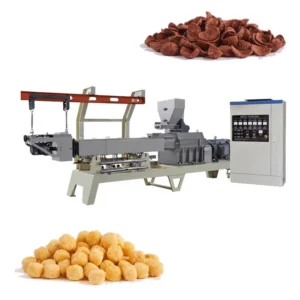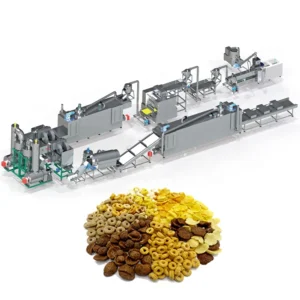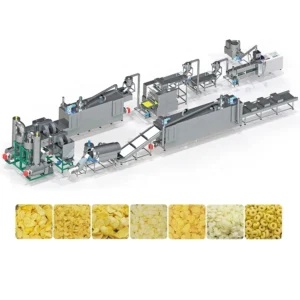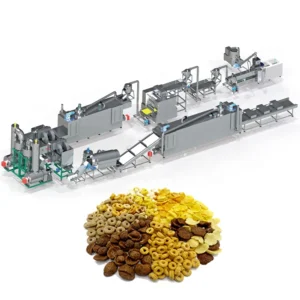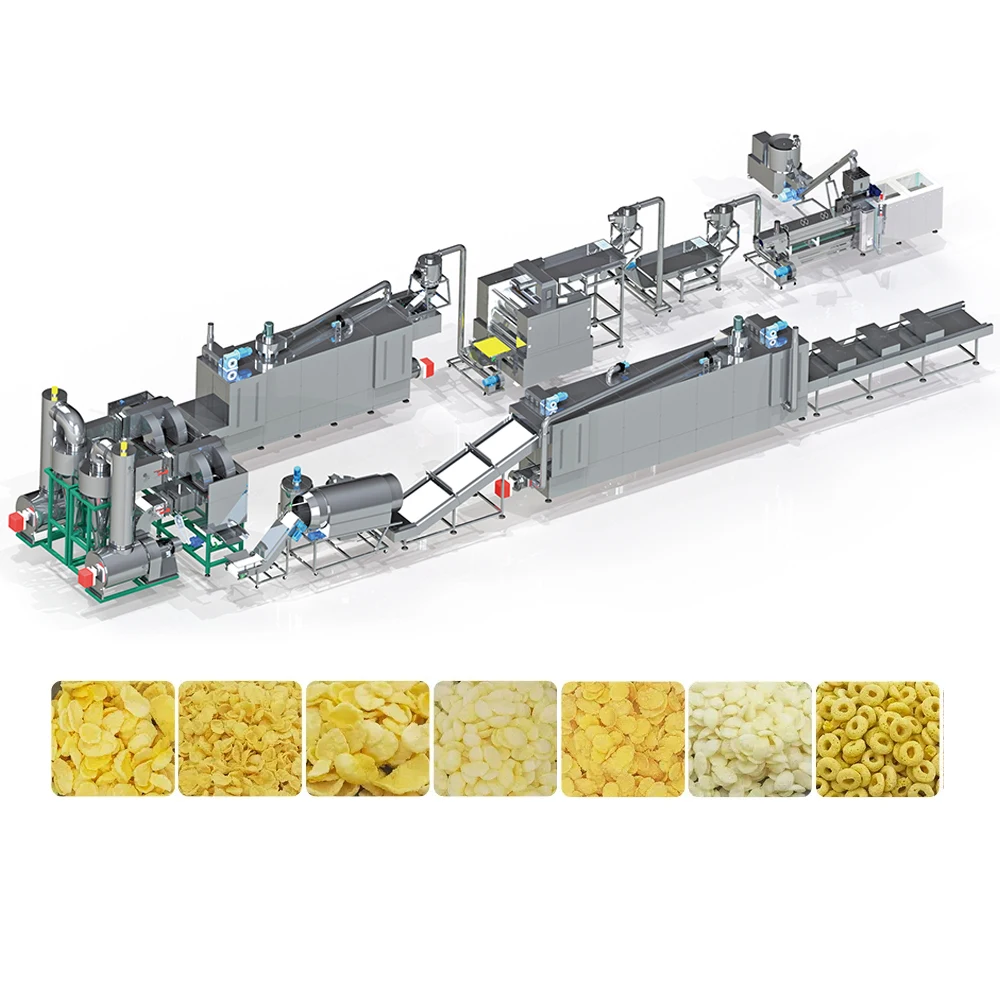
Screw Profile Matched to Your Grain — we configure the twin-screw extruder barrel zones and die geometry against your exact corn grits formulation before the line ships, not after.
Technical Specifications
| Parameter | Value |
|---|---|
| Model | MT75 |
| Product Type | Corn Flakes Production Line |
| Extruder Type | Twin Screw |
| Installed Power | 210 kW |
| Power Consumption | 150 kW |
| Output Capacity | 300–500 kg/h (basis not stated in source — confirm raw material and moisture content) |
| Overall Dimensions (L×W×H) | 45 × 1.5 × 3.5 m |
| Extruder Systems | Feeding, extruding, cutting, heating, gearing, controlling |
| Lubrication & Cooling | Automatic lubricating and cooling function |
| Flaking Machine Control | PLC with hydraulic system for double rollers |
| Flaking Roller Drive | Double motors for separate roller driving |
| Flaking Temperature Monitoring | Infrared sensor for temperature pipe control |
| Dryer Heating Source | Gas or Electric (configurable) |
| Roasting Oven Configuration | Vibrating pan, high-temperature spraying tubes, reconciliation burner, dual circulating fans, cyclone dust removal |
| Coating System | Double tumble for sugar melting, elevator, coating drum, spraying nozzle |
| Control System | PLC |
| Material Compatibility | Corn, rice, wheat, oat, barley (powder form) |
| Production Procedure | Mixing → Extruding → Flaking → Drying → Hot Air Roasting → Sugar Coating → Drying → Cooling → Packing |
| Standards | CE, ISO |
Application Suitability
| Application | Material or Output |
|---|---|
| Natural corn flakes production | Corn grits or corn flour |
| Sugar-coated corn flakes | Corn base with sugar glaze application |
| Multi-grain breakfast flakes | Rice, wheat, oat, and barley blends |
| Shape-variety cereals | Ball, tube, stick, ring, fruit loop, star, wheel, flower, heart via extruder die changes |
What "500 kg/h" Leaves Out About Corn Flakes Extrusion Line Specifications How to Choose
Nominal throughput means nothing if the screw profile cannot gelatinise your specific corn grits at their actual moisture level.
I once spent two weeks tearing down a corn flakes line because the trial used standard corn flour while the buyer ran de-germed corn grits with completely different particle size and moisture. The starch never reached proper gelatinisation, and the flakes came off the roaster hard and flat instead of blistered and crisp. When buyers evaluate corn flakes extrusion line specifications how to choose the right configuration, the question should never be "what is the rated output" but rather "what is the rated output on my raw material at my moisture content." Capacity figures printed in a brochure assume conditions that rarely match a real production floor. [NEED_CITE: starch gelatinisation temperature thresholds for varying grain particle sizes]
Barrel Temperature Profiling and Starch Gelatinisation
The MT75 twin-screw extruder divides the barrel into independently controlled heating zones, each contributing to a specific stage of the corn flakes extrusion line specifications how to choose process. Feed intake, compression, gelatinisation, and metering each demand a different thermal profile. When corn grits enter the barrel at a moisture content that differs from the trial baseline, the temperature curve must shift to compensate — otherwise the starch granules either rupture prematurely or fail to swell, and the downstream flaking roller cannot produce a uniform sheet.
Hydraulic Flaking with Independent Roller Drive
The flaking station uses a hydraulic system to press double rollers together, with separate motors driving each roller independently. This arrangement prevents the slip and drag marks that appear when both rollers share a single shaft. The infrared sensor monitors the temperature pipe continuously, so the roller surface stays within the range where the extrudate flattens without tearing. Flake thickness directly controls how the hot air roasting oven achieves surface blistering, so this station must hold tight tolerances at full line speed.
Decoding Installed Power, Dimensions, and Heating Configuration
The 210 kW installed power on the MT75 covers the extruder main drive, feeding system, and heating zones combined; actual consumption settles around 150 kW during steady-state operation. [NEED_CITE: typical load factor for twin-screw food extruders in cereal applications] The 45-meter line length reflects the sequential nature of corn flake production — extrusion, flaking, drying, roasting, coating, and cooling each need physical dwell space that cannot be compressed. The roasting oven’s reconciliation burner and dual circulating fans create a cross-flow hot air pattern that toasts flakes evenly, while the cyclone dust removal captures fines before they scorch on the vibrating pan. Buyers choosing between gas and electric dryer heating sources should factor in local energy costs and available utility infrastructure.
The Hidden Cost of Mismatched Station Throughput
When an extruder runs at full output but the flaking unit cannot keep pace, half-cooked extrudate piles up and cools below the temperature needed for clean flattening. The flakes then enter the roaster with inconsistent thickness, and some emerge over-toasted while others remain doughy inside. This mismatch rarely shows up during a short factory test — it appears after the first full production shift, when accumulation exposes the weakest station. Re-balancing after installation costs far more than specifying throughput margins during the layout stage. [NEED_CITE: throughput balancing methodology for sequential food processing lines]
Why Source This Line From a Single Supplier
Every station from the batching mixer through the coating drum is specified under one engineering responsibility, so throughput calculations account for the actual material flow between stages rather than relying on nominal ratings from separate vendors. The screw configuration and die design are documented against your grain formulation before production starts. The in-house testing workshop runs your raw material through the extruder and records gelatinisation, expansion, and flake density data before the line is crated. PLC control language, voltage, and frequency are confirmed against your site electrical specification. On-site installation covers mechanical assembly, electrical termination, and first-run parameter tuning with your operators present.
Documentation & Verification
- Screw and die configuration record matched to your corn grits particle size and moisture
- Trial run report on your actual grain formulation produced in the testing workshop before shipment
- Line layout with capacity calculation showing throughput balance across all stations
- Electrical schematic confirming voltage, frequency, and PLC language for your site
- CE declaration of conformity and ISO certificate for customs and regulatory filing
- Operation and maintenance manual with wear parts list and replacement intervals
Installation, Commissioning & Support
- Foundation plan accounts for the 45 × 1.5 × 3.5 m footprint and vibrating roaster pan loads
- Dedicated electrical circuit sized for 210 kW installed capacity with appropriate breaker rating
- Extruder barrel segments and flaking rollers ship separately and require on-site alignment
- First-run commissioning includes screw speed, barrel zone temperatures, and roller gap calibration
- Operator training covers PLC interface navigation, recipe storage, and alarm response procedures
- Wear parts list specifies screw elements, die plates, and flaking roller surfaces with part numbers
Preparing Your Inquiry
To move from general interest to a workable line proposal, share your primary grain type and its typical moisture content at the point of extrusion. Include your target daily output and the number of production shifts you plan to run. Confirm the voltage, frequency, and phase available at your facility, along with your preferred PLC interface language. If you are integrating this line with existing upstream mixers or downstream packing equipment, provide their throughput ratings so the connecting conveyors can be matched.
Frequently Asked Questions
Q: How is extruder capacity verified on my specific grain blend and moisture level?
A: We run your actual corn grits or grain blend through the extruder in the testing workshop before shipment. The trial records screw speed, barrel temperature profile, moisture at the die face, and resulting expansion ratio. You receive a written report with these parameters so capacity expectations are based on your material, not a generic datasheet.
Q: How is screw and die configuration specified to achieve the correct flake density and texture?
A: The screw element sequence — conveying, kneading, and reverse-pitch sections — is arranged based on your grain’s starch content and particle size. The die opening geometry controls extrudate shape and expansion before flaking. Both are documented in a configuration record you can reference for future reorder or adjustment.
Q: What voltage, frequency, and PLC language options are confirmed before commissioning?
A: Your site electrical specification is collected during the proposal stage and written into the electrical schematic. The PLC interface language is set to match your operator team. These parameters are verified again during the factory test so no re-wiring or re-programming is needed on arrival.
Q: Is a trial run on my raw material conducted before shipment, and what does the report cover?
A: Yes. The trial uses your grain formulation in the in-house testing workshop. The report covers throughput achieved, barrel temperature settings, starch gelatinisation assessment, extrudate density, and flake thickness after the flaking unit. Any screw or die adjustments made during the trial are noted with before-and-after readings.
Q: How are flaking, drying, and roasting station capacities matched to the extruder output?
A: Each station is selected so its maximum throughput exceeds the extruder’s verified output on your material. The flaking roller width, dryer belt length, and roasting oven pan area are all calculated against the extruder’s mass flow rate. This prevents accumulation at any single point during continuous production.