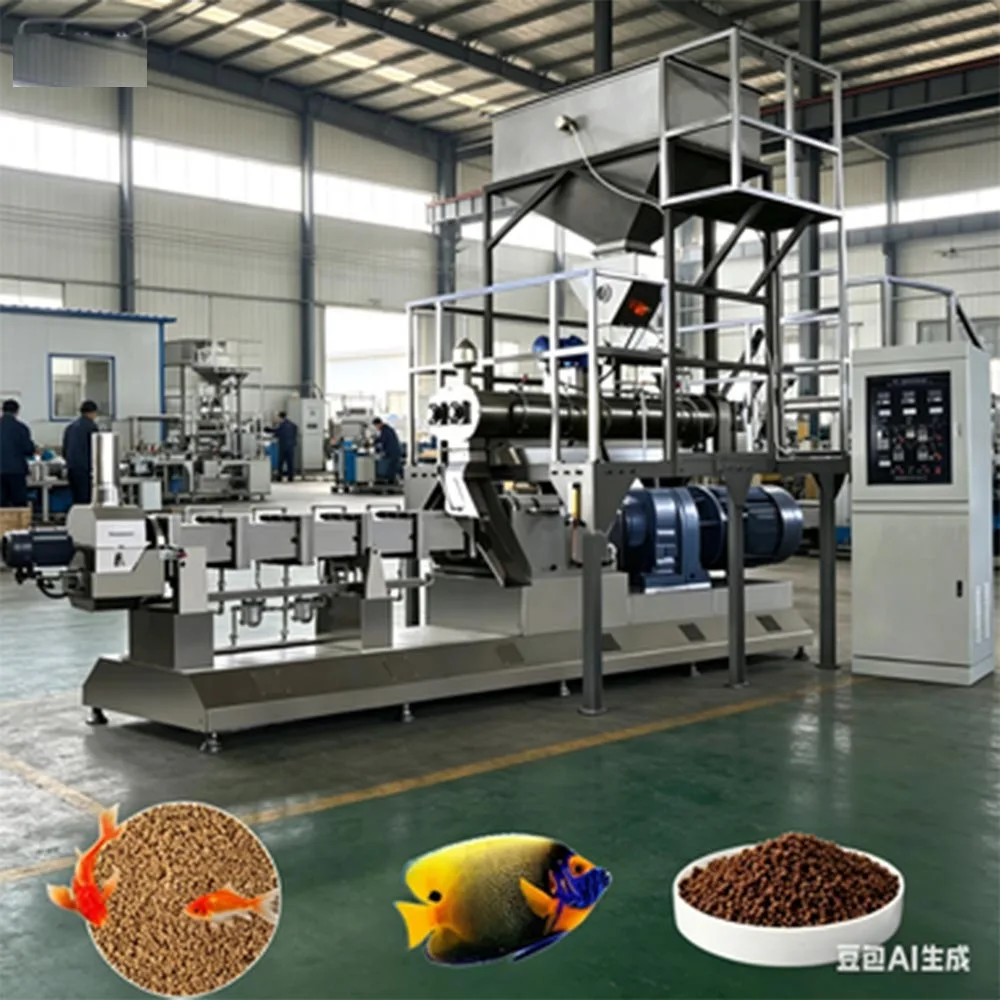
Customized Extrusion Parameters — screw configuration, barrel temperature profile and die geometry are matched to the buyer’s aquatic feed formulation through in-house trial runs before shipment, ensuring the twin screw fish feed extrusion line technology produces floating pellets at the density the market expects.
Technical Specifications
| Parameter | Value |
|---|---|
| Product Type | Twin Screw Fish Feed Extrusion Line |
| Screw Type | Twin screw |
| Output Capacity | 500 kg/h (based on floating fish feed pellets — raw material and moisture basis not stated in source, confirm) |
| Pellet Diameter Range | 0.5 mm – 12 mm |
| Pellet Buoyancy | Floating type (sinking capability to confirm) |
| Main Structure Material | Stainless steel, food-grade contact surfaces |
| Line Stations Integrated | Feeding, mixing, extruding, pelletizing |
| Automation Level | Fully automatic, continuous operation |
| Control System | Simple control panel (PLC / MCC option to confirm) |
| Rated Power | To confirm with manufacturer |
| Voltage & Frequency | To confirm with manufacturer |
| L:D Ratio | To confirm with manufacturer |
| Screw Diameter | To confirm with manufacturer |
| Barrel Zones | To confirm with manufacturer |
| Die Configuration | To confirm with manufacturer |
| Steam or Water Injection | To confirm with manufacturer |
| Overall Dimensions | To confirm with manufacturer |
| Standards | CE certified, ISO certified (per company profile) |
Application Suitability
| Application | Material or Output |
|---|---|
| Floating pellets for catfish and tilapia aquaculture | Fish meal, soybean meal, corn flour, wheat flour, vitamin and mineral premix |
| Fry-stage micro pellets (0.5 mm – 2 mm) | Fine-ground protein and starch blends requiring high expansion control |
| Grow-out pellets (3 mm – 6 mm) | Standard aquaculture formulations with moderate fat inclusion |
| Adult-stage large pellets (8 mm – 12 mm) | Coarser ingredient blends targeting surface-feeding species |
| Small to medium-scale continuous feed processing | Formulations transitioning from batch mixing to continuous extrusion |
Why Floating Feed Sinks When Extrusion Parameters Are Never Calibrated
Buoyancy failure almost always traces back to shear, moisture and residence time settings that were never tested against the buyer’s actual raw material blend before the machine left the factory.
I have seen this play out on site more than once. A producer invests in a floating fish feed line, the equipment arrives, and the first production run yields pellets that sink within seconds. The extruder is mechanically sound — the problem is that the twin screw fish feed extrusion line technology was configured with a generic screw profile and barrel temperature map that does not match the buyer’s specific starch-to-protein ratio or fat content. Four days of on-site adjustment is not uncommon when parameters are guessed rather than documented [NEED_CITE: typical on-site troubleshooting duration for uncalibrated extrusion lines]. The cost is not just lost production time; it is the raw material wasted during trial-and-error runs and the credibility lost with downstream buyers who expect consistent pellet buoyancy.
Shear Control and Starch Gelatinisation Inside the Barrel
The twin-screw configuration generates uniform shear across the barrel cross-section, which is critical when aquatic feed formulations contain a mix of protein concentrates and starch sources that gelatinise at different rates. Consistent shear ensures that starch granules rupture evenly, producing the internal matrix structure that traps air and enables flotation. When the screw element arrangement is selected specifically for the buyer’s formulation — rather than copied from a generic build — the gelatinisation degree becomes repeatable across production batches.
Barrel Temperature Zoning and Moisture Injection
Each barrel zone contributes a distinct thermal stage to the extrusion process, and the temperature profile must align with the raw material’s gelatinisation window. Moisture injection — whether steam or liquid water — interacts directly with barrel heat to determine expansion ratio at the die face [NEED_CITE: relationship between barrel temperature profile and pellet expansion ratio in twin-screw extrusion]. For floating pellets targeting catfish or tilapia, the moisture level and thermal gradient must produce sufficient expansion without over-cooking the protein fraction, which would collapse the internal cell structure and cause sinking.
How Die Aperture and Face Geometry Determine Pellet Density
The die is where expansion ratio and final pellet density are locked in. Aperture diameter, die thickness and face-cutting geometry together govern how much the extrudate expands as it exits the high-pressure barrel environment into atmospheric conditions. For pellets in the 0.5 mm to 12 mm range, die selection must account for the formulation’s expansion potential — a high-starch blend will expand more aggressively than a high-fat formulation through the same die opening. Selecting die geometry based on the buyer’s target species and pellet size, rather than a one-size-fits-all approach, is what separates a line that produces spec-compliant floating feed from one that requires constant manual intervention.
What Happens When Screw and Die Configuration Is Guesswork
A generic screw build might produce acceptable pellets on the supplier’s test material, but aquatic feed formulations vary widely in fat content, fibre level and starch source. When the screw element sequence and die geometry are not matched to the buyer’s actual blend, the result is unpredictable expansion — some batches float, others sink, and the producer spends hours adjusting feed rate and barrel temperatures to compensate [NEED_CITE: impact of uncalibrated screw configuration on pellet density variation]. Over time, this inconsistency erodes buyer confidence and can lead to rejected shipments from aquaculture operations that measure buoyancy as a contractual specification.
Why Sourcing This Line Here Makes Sense for Process Engineers
The screw configuration and die design are specified to the buyer’s raw material and target pellet size, not pulled from a generic catalogue. An in-house testing workshop allows trial runs on the customer’s actual formulation before shipment, so extrusion parameters are documented and locked rather than discovered during commissioning. Complete line integration from feeding through pelletizing means throughput is matched across stations, avoiding the bottleneck that occurs when an extruder is paired with an undersized dryer or cooler. The twin screw fish feed extrusion line technology is supported by food-grade stainless steel construction throughout the contact path, which matters in high-moisture, high-salt aquatic feed environments where corrosion degrades sanitation quickly. Pre-sales consultation extends through engineer design, on-site installation and operator training, so the team that configured the line is the same team that helps start it up.
Documentation & Verification
- Screw and die configuration record matched to your aquatic feed formulation
- Trial run report on your raw material verifying pellet buoyancy and expansion
- Electrical schematic with voltage and frequency confirmed for your market
- Line layout drawing showing station throughput matching across the full line
- Factory test record documenting output capacity under verified conditions
- CE declaration of conformity for machinery safety compliance
Installation, Commissioning & Support
- Foundation and floor space planning based on confirmed overall line dimensions
- Dedicated electrical circuit sized to the extruder’s rated power and voltage specification
- Assembly verification and barrel alignment check during on-site installation
- First-run parameter setting using documented screw speed and barrel zone temperatures
- Operator training covering die changeover across the 0.5 mm to 12 mm pellet range
- Wear parts list with recommended replacement intervals for screw elements and dies
What We Need to Configure Your Line
To move from inquiry to line configuration, we need your target pellet diameter range and the species you are producing for, along with a detailed ingredient list including approximate fat and starch percentages. Share your local voltage and frequency standard, and whether your control panel operators require a specific language interface. If you have existing upstream mixing or downstream drying equipment, let us know the model and throughput so we can confirm station-to-station matching.
Frequently Asked Questions
Q: How is the 500 kg/h output capacity verified for this twin screw fish feed extrusion line technology?
A: The stated capacity is based on floating fish feed pellet production, but the specific raw material formulation and moisture basis behind that figure should be confirmed before ordering. We recommend requesting a pre-shipment trial run on your own formulation so that actual throughput, pellet buoyancy and expansion ratio are documented under realistic conditions rather than assumed from generic test data.
Q: How does screw configuration affect whether the pellet floats or sinks?
A: The screw element sequence determines shear intensity and residence time inside the barrel, which directly controls the degree of starch gelatinisation. Properly gelatinised starch forms an internal matrix that traps air during expansion at the die, producing a pellet light enough to float. If the screw profile is too aggressive or too mild for your formulation’s starch content, the cell structure collapses and the pellet sinks.
Q: What barrel temperature and moisture settings work for my aquatic feed formulation?
A: There is no universal setting — barrel zone temperatures and moisture injection rates must be matched to your specific blend of protein, starch and fat. During the pre-shipment trial run, we establish a temperature profile and moisture level that produce consistent expansion for your formulation, and these parameters are documented so your operators can reproduce them from the first production day.
Q: Can you run a trial on my raw material before the machine ships?
A: Yes, the in-house testing workshop is set up for exactly this purpose. You send a representative sample of your formulation, and we run the extruder with the screw and die configuration specified for your line. The trial run report includes pellet buoyancy measurements, expansion ratio data, actual throughput and the parameter settings that produced the results, so there are no surprises during commissioning.