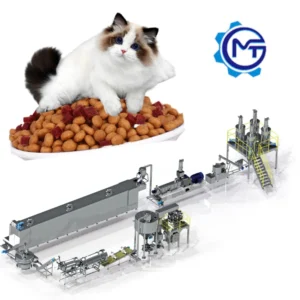
Screw configuration matched to formulation — Every twin-screw build starts with your raw material analysis, not a catalog default, ensuring expansion and density targets are met before the line ships.
Technical Specifications
| Parameter | Value |
|---|---|
| Product Type | Fish Feed Production Line |
| Output Capacity | Up to 3t/h (basis not stated in source — confirm raw material formulation, moisture content, pellet size) |
| Extruder Type | Twin-screw extruder |
| Contact Material | 304 stainless steel |
| Control System | PLC and MCC control |
| Line Scope | Batching, extrusion, drying, coating, cooling, packing |
| Screw Configuration | Matched to raw material and target pellet specification |
| Die Design | Configured for target pellet size and density |
| Certification | CE, ISO |
Application Suitability
| Application | Material or Output |
|---|---|
| Floating feed for tilapia and catfish | Starch-rich formulations requiring high expansion and low bulk density |
| Sinking feed for trout and salmon | High-protein formulations requiring controlled gelatinisation and minimal expansion |
| Shrimp feed pellets | Fine aquatic meal blends demanding tight die geometry and uniform cut |
| Multi-species aquaculture facilities | Rapid die changeover and screw reconfiguration between production runs |
Why Extruder Specs Alone Cannot Guarantee Float Rate
A rated output figure means nothing if the screw profile was never tested on your actual meal blend.
When an aquaculture feed producer buys a line based only on a nominal capacity, the first week of commissioning often reveals the real problem: pellets that should float are sinking, or the texture falls outside what the market accepts. I saw this firsthand when a line shipped to Southeast Asia produced perfectly buoyant pellets on standard corn starch during factory testing, but the customer’s high-protein formulation collapsed the cell structure on site, requiring four days of screw and barrel adjustments to recover floatability. [NEED_CITE: starch gelatinisation thresholds across different protein-to-starch ratios in aquatic feed]
Barrel Temperature Profile and Starch Gelatinisation
The twin-screw extrusion fish feed production line relies on segmented barrel zones, each with independent heating and cooling, to control the thermal history of the dough. A high-protein salmon feed needs lower peak temperatures to avoid protein denaturation before the die, while a tilapia floating pellet demands aggressive heat input to achieve full starch gelatinisation and the gas retention necessary for buoyancy. Matching the barrel profile to the formulation is not optional; it is the primary lever for expansion control.
Die Geometry and Pellet Density Targets
Die land length and orifice diameter directly govern the pressure drop at the barrel exit, which in turn dictates how much superheated moisture flashes off and expands the pellet. For a 3 mm sinking trout pellet, a longer die land maintains backpressure and suppresses expansion. For a 6 mm floating catfish pellet, a shorter die land allows rapid decompression and maximum volume gain. The twin-screw extrusion fish feed production line must ship with a die plate matched to your target size, not a generic insert left from the previous build. [NEED_CITE: relationship between die land length and expansion ratio in twin-screw extrusion of aquatic feed]
Screw Configuration: The Real Capacity Determinant
Motor power and barrel diameter set the mechanical ceiling, but screw element arrangement—conveying sections, kneading blocks, reverse elements—determines how much shear and residence time the material actually experiences. A screw profile designed for 60 % starch will fail to gelatinise a 35 % starch, 45 % fish meal blend, resulting in undercooked centres and poor water stability. Every configuration on this twin-screw extrusion fish feed production line is documented in a build record that travels with the machine.
The Cost of Skipping a Pre-Shipment Trial
When a line goes to site without a documented trial run on the buyer’s own raw material, the entire product development cycle shifts to the customer’s factory floor. Downtime, wasted ingredient batches, and delayed market entry compound quickly. I watched a producer lose an entire aquaculture season because the feed mill could not hit the floating specification promised at purchase; the extruder had simply never been tested on their high-fat salmon meal. [NEED_CITE: economic impact of delayed commissioning in aquaculture feed operations]
Why the Engineering Conversation Starts Here
The screw and die record for your twin-screw extrusion fish feed production line is finalised before fabrication begins, not retrofitted later. The in-house testing workshop runs your exact formulation, generating a trial report that documents expansion ratio, bulk density, and water stability. Line throughput is balanced across mixing, extrusion, drying, and coating so that no single station creates a bottleneck. Electrical schematics confirm voltage, frequency, and control language before the panel is wired. CE and ISO documentation ships with the crate, satisfying port and customs requirements without delay.
Documentation & Verification
- Screw and die configuration record tied to your raw material trial
- Trial run report showing expansion ratio and bulk density on your formulation
- Line layout drawing with throughput matching across every station
- Electrical schematic confirming voltage, frequency, and PLC language
- CE declaration of conformity and ISO certificate for customs clearance
Installation, Commissioning & Support
- Foundation plan aligned to extruder and dryer footprint and dynamic loads
- Dedicated power circuit sized for PLC and MCC control panel amperage
- Barrel and screw assembly verified on site against the configuration record
- First-run parameter tuning using your actual raw material and target pellet size
- Operator training covering die changeover between floating and sinking runs
- Wear parts list with reorder codes for screw elements and die plates
What We Need to Configure Your Line
Before quoting, I need your raw material formulation including protein, starch, and fat percentages, the target pellet diameter and whether each SKU floats or sinks, and the daily output you plan to sustain. Confirm the voltage and frequency at your facility and the preferred language for the PLC interface. If you have an existing dryer or coater that must integrate with the new extruder, share its throughput rating so the line balance is accurate from the start.
Frequently Asked Questions
Q: How is output capacity verified, and what formulation is it based on?
A: The rated figure is validated during a trial run on your specific raw material, moisture level, and pellet size. We document the actual throughput achieved under those conditions in a written report, rather than quoting a generic number that may not hold when your formulation enters the barrel.
Q: How do you select screw and die design for floating versus sinking pellets?
A: Floating pellets need a screw profile that maximises shear and a die that allows rapid pressure release for expansion. Sinking pellets use conveying-heavy screws with longer die lands to suppress expansion. Both configurations are tested in the workshop before the machine leaves the factory.
Q: What barrel temperature and moisture range are needed for proper gelatinisation?
A: Typical aquatic feed blends require barrel zones between 80 °C and 150 °C with moisture adjusted to 22–28 %, but the exact profile depends on starch source and protein content. We map the curve during the trial run and record it in the operating manual supplied with the line.
Q: Is a trial run performed before shipment, and what does the report cover?
A: Yes. We run your raw material through the configured extruder and record expansion ratio, bulk density, water stability, and achieved throughput. The report ships with the machine so your team can replicate the results at commissioning without repeating the development cycle.
Q: How are voltage and control language confirmed before commissioning?
A: During the specification review, we collect your facility voltage, frequency, and preferred PLC language. These values are locked into the electrical schematic and panel build, eliminating wiring delays and interface confusion when the line is powered up on site.