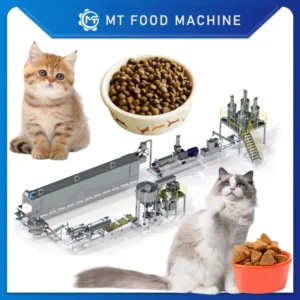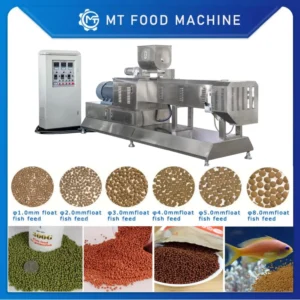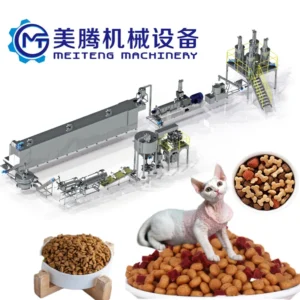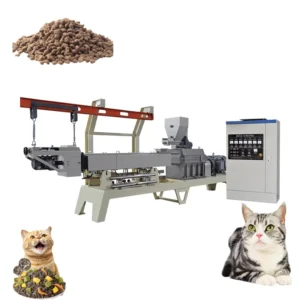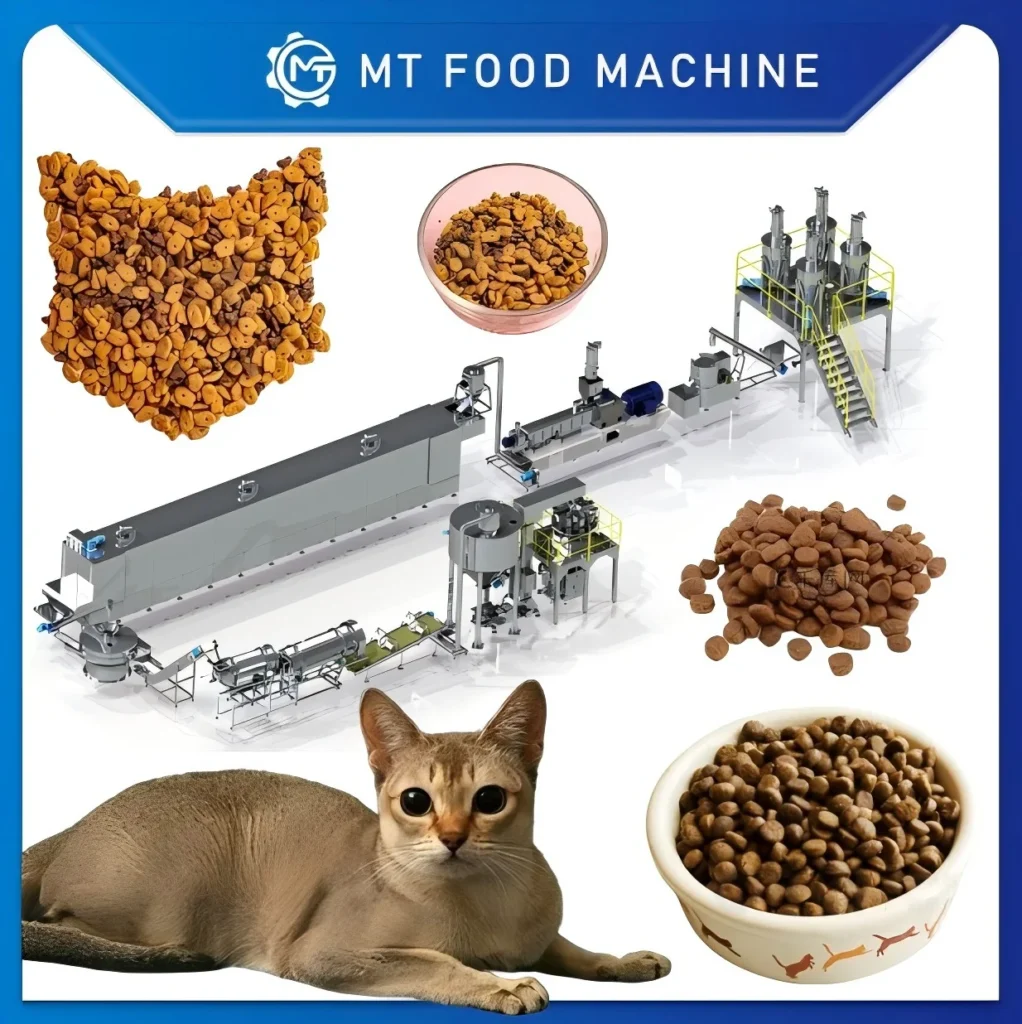
Screw Geometry Matched to Formulation — MT-70 barrel sections and die orifices are reconfigured after trial runs on the buyer’s actual meat meal ratio and starch blend, not copied from a generic pet food build.
Technical Specifications
| Parameter | Value |
|---|---|
| Model | MT-70 |
| Product Type | Twin Screw Pet Food Extrusion Line |
| Output Capacity | 200-250 kg/h (basis not stated in source — confirm raw material / moisture / kibble size) |
| Screw Type | Twin screw, configurable segment arrangement |
| Control System | PLC controlled with HMI interface |
| Line Configuration | Complete processing line (process drawing available) |
| Applications | Dry dog food, cat food, aquatic feed |
| Certification | CE, ISO |
| Warranty | 1 year |
Application Suitability
| Application | Material or Output |
|---|---|
| Premium dry kibble for adult dogs | Corn, rice, meat meal, poultry by-product at varying protein ratios |
| Cat food pellets with high palatability | Fish meal, animal fat, starch with flavor coating downstream |
| Floating and sinking aquaculture feed | Soybean meal, wheat flour, fish meal at adjusted moisture for density control |
| Multi-species production on a single line | Recipe changeover between dog, cat, and fish formulations with die and screw adjustment |
What "200 kg/h" Actually Means on Your Recipe
Nominal capacity is measured on a reference starch — your high-protein formulation will behave differently.
I once specified an extruder for a client running a 30% meat meal dog food blend. The machine was rated for a clean starch recipe and performed well on paper. When their actual raw material hit the barrel, the dough viscosity spiked, throughput dropped, and the line rhythm fell apart downstream at the dryer. The mismatch between rated output and real output is one of the most common reasons new pet food lines disappoint in the first six months [NEED_CITE: throughput variance between starch-based and meat-meal-based extrusion formulations]. That gap is why screw configuration and trial validation matter more than the number on the nameplate.
How Shear Profile Shapes Kibble Density
The twin screw pet food extrusion line PLC controlled configuration on the MT-70 allows the screw segment arrangement to be adjusted for different shear and residence time profiles. High-protein formulations require a gentler shear zone to prevent over-gelatinisation of the starch fraction, which would collapse the cellular structure and produce dense, hard kibble that dogs reject. Forward kneading blocks, reverse elements, and conveying segments are arranged in sequence to control how mechanical energy transfers into the dough at each barrel zone.
Barrel Temperature Zoning and Moisture Management
Each barrel section on this extruder can be independently heated or cooled, giving the operator control over the temperature gradient from feed inlet to die face. Moisture injection points along the barrel let water or steam enter at precise stages — early injection promotes starch gelatinisation while late injection controls expansion at the die. Getting this profile wrong on a high-fat cat food recipe can cause oil to separate out before the kibble reaches the dryer, leaving an uneven surface that resists flavor coating [NEED_CITE: fat migration during twin-screw extrusion of high-lipid pet food formulations]. The PLC logs every zone temperature and moisture rate so the recipe is repeatable across production runs.
Reading the Capacity Number Correctly
The 200-250 kg/h output range is meaningful only when tied to a specific raw material composition, moisture level, and target kibble diameter. A low-protein corn-based puppy kibble at 22% moisture will extrude faster than a senior dog formula loaded with joint-support supplements and 28% meat meal. The screw speed, die orifice count, and cutter frequency all shift with each recipe. When comparing this line to alternatives, ask whether the quoted capacity was measured on your formulation or on a generic test flour — the difference in real daily output can be substantial. The MT-70 documentation package includes a screw and die configuration record that ties the installed hardware to your specific recipe.
The Cost of Skipping the Trial Run
Shipping an extrusion line without first running the buyer’s raw material through the machine is a risk that compounds through every downstream station. If the extruder produces kibble at a lower density than expected, the dryer will over-dry the product, wasting energy and scorching the surface. If the throughput is lower than the conveyor and cooler were sized for, the entire line runs below its designed rhythm, and the packing station sits idle between batches [NEED_CITE: downstream bottleneck effects when extruder actual output deviates from line design capacity]. These mismatches are expensive to correct after installation because they often require replacing or re-engineering multiple stations rather than adjusting one.
Why This Line Is Configured Before It Ships
The extruder screw and die combination is specified to the buyer’s raw material and target product rather than pulled from a standard catalog build. The in-house testing workshop runs customer-supplied ingredients through the machine before shipment, producing a trial run report that documents actual throughput, kibble density, and expansion ratio. Every downstream station — dryer, flavoring drum, cooler — is matched to the verified output rather than to a nominal figure. PLC parameters are set and recorded during the trial, so the recipe transfers directly to the buyer’s floor. Electrical schematics are confirmed against the target market’s voltage and frequency before the panel is wired.
Documentation & Verification
- Line layout drawing showing throughput match between extruder, dryer, and packing stations
- Screw and die configuration record tied to your raw material formulation and kibble size
- Trial run report on your ingredients documenting actual output and product density
- Electrical schematic with voltage, frequency, and PLC language confirmed for your market
- CE declaration of conformity and ISO certificate for customs and local compliance
- Operation manual with recipe parameters and wear parts replacement intervals
Installation, Commissioning & Support
- Foundation plan specifying load points for the MT-70 extruder, dryer, and cooler footprint
- Dedicated electrical circuit sized to the confirmed motor power and PLC control panel draw
- Barrel and screw assembly verified on site after transport to confirm segment alignment
- First-run commissioning with your raw material to replicate the factory trial run results
- Operator training covering PLC recipe entry, screw speed adjustment, and die changeover
- Wear parts list with lead times for screw segments, barrel liners, and die plates
What to Include With Your Inquiry
Send the specific raw material formula you intend to run, including protein and fat percentages, so the screw configuration can be matched before quotation. Specify your target kibble diameter and density range for each product variant in your line-up. Confirm the local voltage, frequency, and preferred PLC interface language so the control panel is built correctly the first time. If you have existing upstream mixing or downstream packing equipment, share the throughput and connection details so the line integrates without bottlenecks.
Frequently Asked Questions
Q: How is the 200-250 kg/h capacity verified on my specific raw material formulation?
A: We run your actual ingredients through the MT-70 in our testing workshop before the line ships. The trial documents real throughput, expansion ratio, and kibble density on your recipe. If output differs from the nominal range, we adjust screw segments and die orifices until the target is met, and the results are recorded in a trial run report you receive before dispatch.
Q: What screw configuration and die design is specified for my target kibble density and species?
A: The screw segment arrangement — conveying, kneading, and reverse elements — is selected based on your formulation’s protein, fat, and starch ratios. Die orifice diameter and count are matched to your target kibble size and desired expansion. A configuration record documents the exact setup so you can reorder wear parts or replicate the setup on future lines.
Q: How are voltage, frequency, and PLC control language confirmed before shipment?
A: During the specification stage, we collect your local power supply details and operator language preference. The electrical schematic is drawn and reviewed with your team before the control panel is wired. The PLC interface, HMI labels, and alarm messages are set to your chosen language so commissioning on your floor starts without translation delays.
Q: Can I conduct a trial run with my raw material before the line ships?
A: Yes. Our testing workshop is equipped to run customer-supplied ingredients on the exact machine configuration being shipped to you. You receive a trial run report covering throughput, product texture, moisture levels at each stage, and kibble density. This report becomes the baseline for your production recipes once the line is installed.