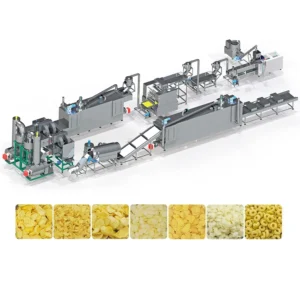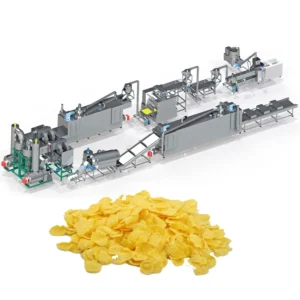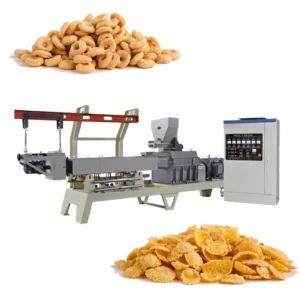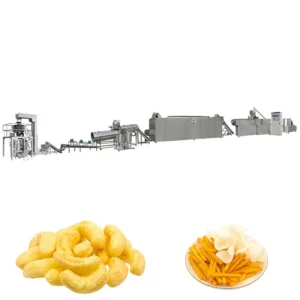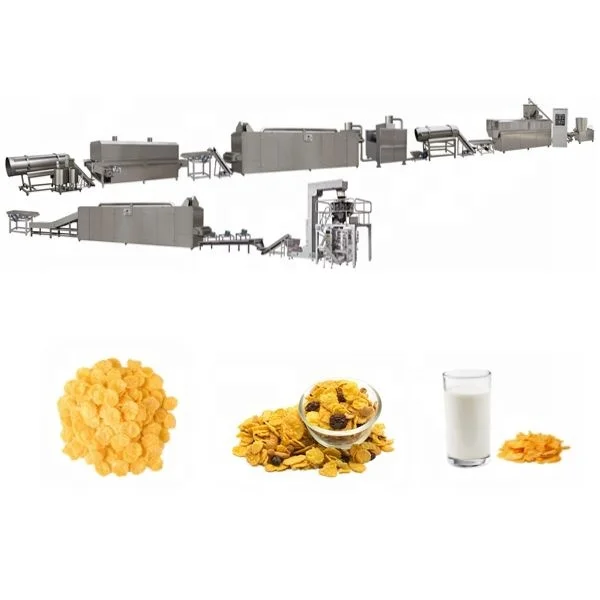
Precision-engineered twin-screw extrusion systems — MT Machinery configures screw geometry and thermal profiling to match your specific grain formulation, ensuring predictable starch gelatinization and consistent flake texture across every production run.
Technical Specifications
| Parameter | Value |
|---|---|
| Model | MT65 / MT70 / MT85 |
| Product Type | Corn Flakes Production Line |
| Screw Configuration | Twin screw (co-rotating, sectional modules) |
| Screw Material | Alloy 38CrMoAL, nitriding process |
| Installed Power | MT65: 70 kW / MT70: 100 kW / MT85: 200 kW |
| Real Power Consumption | MT65: 40 kW / MT70: 70 kW / MT85: 150 kW |
| Output Capacity | MT65: 100–150 kg/h (basis not stated in source) / MT70: 200–240 kg/h (basis not stated in source) / MT85: 300–400 kg/h (basis not stated in source) |
| Overall Dimensions (L×W×H) | MT65: 20,000×1,200×2,200 mm / MT70: 25,000×1,500×2,200 mm / MT85: 30,000×3,500×4,300 mm |
| Motor & Drive | SIEMENS (China) motor, Delta inverter |
| Control System | Automated control box (PLC / MCC available) |
| Feeding System | Food-grade stainless steel twin screw feeder with speed-adjusted converter |
| Press Station | 16.12 kW, Roller 510×310×1,050 mm, adjustable roller gap |
| High-Temperature Oven | 4.5×1.4×1.8 m, 3.75 kW, gas-fired, dual-side baking |
| Dryer Options | 3-layer 5 m to 7-layer 11 m; electric (0–200 °C) or steam |
| Standards | CE, ISO |
Application Suitability
| Application | Material or Output |
|---|---|
| Traditional Corn Flakes | Maize grits (de-germed), high-temperature gelatinization |
| Multi-Grain Flakes | Oat, rye, wheat, and rice blends for varied bowl-life targets |
| Fortified Breakfast Cereals | Grain bases mixed with vitamin and mineral premixes |
| Extruded Snack Pellets | Direct expansion into round, triangle, square, or star shapes via die mould changes |
Why "Nominal Capacity" Fails in the Cereal Aisle
A line quoted on nominal capacity that cannot hold that output on the buyer’s actual raw material is a common failure point in breakfast cereal manufacturing. The true throughput of a corn flakes extrusion line depends entirely on the starch composition and particle size of your specific grain blend.
When you purchase a system based solely on a brochure number, you risk installing an extruder that starves the downstream dryer or produces flakes that shatter during packaging. The corn flakes extrusion line specifications must be validated against the exact moisture content and grit size you intend to run [NEED_CITE: starch gelatinization kinetics in twin-screw extrusion]. If the screw profile is too aggressive for a delicate oat blend, the flakes will be dense; if it is too passive for coarse maize, the product will lack the necessary expansion. This mismatch often leads to significant downtime as process engineers attempt to reconfigure the barrel zones and screw elements on-site, long after the installation team has departed.
Thermal Profiling and Starch Gelatinization
The core of breakfast cereal quality lies in the degree of starch gelatinization achieved within the extruder barrel. Our MT series utilizes sectional screw modules that allow us to build a specific screw profile matched to the gelatinization temperature of your grain. By controlling the shear rate and residence time across the five distinct barrel zones, we ensure that the starch granules are fully hydrated and expanded without degrading the protein structure. This precise control over the thermal history of the dough is what separates a premium, crisp flake from one that becomes soggy within seconds of hitting the milk.
The Role of the Press Station in Density Control
While the extruder creates the cooked dough pellet, the press station defines the final physical architecture of the flake. The adjustable roller gap on the 16.12 kW press unit allows operators to dial in the exact thickness required for your market. A thinner flake offers a faster moisture release in the oven but may break easily; a thicker flake requires more energy to bake but provides a sturdier texture. This mechanical reduction step is independent of the extrusion expansion, giving you a second layer of control over the bulk density and bowl-life of the finished cereal [NEED_CITE: mechanical reduction influence on cereal bowl-life].
Decoding the Extrusion Parameters
For a process engineer, the relationship between the 38CrMoAL nitrided screw elements and the barrel temperature curve is the primary lever for product consistency. The use of a SIEMENS motor paired with a Delta inverter ensures that the screw speed remains stable even when the viscosity of the dough changes due to minor fluctuations in raw material moisture. In the context of corn flakes extrusion line specifications, the "L/D ratio" (length to diameter) of the screw determines how much time the material spends under heat and pressure. A longer residence time allows for more complete cooking of coarse grits, whereas a shorter profile is better suited for fine flours that cook rapidly. Understanding this balance is critical for maintaining a uniform color and texture across the entire production batch.
The Hidden Cost of Generic Screw Configurations
Selecting a machine with a generic screw build often results in a texture that fails to meet consumer expectations. If the screw elements are not designed to handle the specific lipid content of your grain blend, you may experience surging at the die face, leading to irregular pellet sizes. This inconsistency forces the downstream sifter to reject a higher percentage of the output, effectively lowering your real-world yield. Furthermore, a mismatch in the die design can cause the pellets to stick to the press rollers, requiring frequent line stoppages for cleaning [NEED_CITE: twin-screw extrusion surging causes and solutions]. These micro-stoppings accumulate, causing the high-temperature oven to run empty or over-bake the remaining product, which increases energy consumption and waste.
Engineering Alignment for Breakfast Cereal Projects
We approach every project by starting with the raw material rather than the machine catalog. Our in-house testing workshop allows us to run your actual grain blend through the MT65 or MT85 extruder before the line is finalized, ensuring the screw configuration and die design are optimized for your target flake density. We match the throughput of the mixer and the capacity of the gas-fired oven to the extruder’s real-world output, preventing bottlenecks that plague lines assembled from disparate vendors. Our documentation includes a comprehensive trial run report on your specific formula, providing a baseline for your quality control team. By aligning the mechanical design with your process requirements, we deliver a system that performs predictably from the first day of commissioning.
Documentation & Verification
- Line layout and capacity calculation matched to your specific grain blend moisture content.
- Screw and die configuration record detailing element arrangement for your target gelatinization.
- Trial run report on customer-supplied raw material demonstrating achieved texture and density.
- Electrical schematic with voltage and frequency confirmation for your local industrial grid.
- Factory test record and CE declaration of conformity for international machinery import standards.
Installation, Commissioning & Support
- Foundation planning for the 30-meter MT85 line footprint and heavy press station load-bearing.
- Dedicated circuit requirements for the 200 kW installed power and gas-fired oven utility connections.
- On-site assembly of the multi-layer dryer and sugar spraying system to ensure belt alignment.
- First-run parameter setting for barrel zones and press roller gap based on your local ambient conditions.
- Wear parts inventory list for 38CrMoAL screws and die plates to minimize future maintenance lead times.
Project Specification Inquiry
To provide an accurate layout and quotation, we require a sample of your intended grain formulation (maize, oat, or multi-grain) and the target moisture content of the finished flake. Please specify the available industrial voltage and frequency at your facility, as this dictates the motor and control box configuration. Additionally, providing the dimensions of your production hall and the location of existing utility points allows us to design a line that integrates efficiently with your material handling and packaging infrastructure.
Frequently Asked Questions
Q: How is the screw configuration determined for my specific grain blend?
A: We conduct in-house trial runs using your actual raw material to map the starch gelatinization curve. This allows us to adjust the sectional screw modules and barrel heating zones to achieve the correct expansion and texture before the machine is shipped.
Q: How does the press roller gap impact the final flake quality?
A: The adjustable gap on the press station controls the thickness and density of the flake. A precise gap setting ensures uniform baking in the high-temperature oven and determines the "bowl-life" or how long the flake remains crisp in milk.
Q: What is the difference between the electric and steam dryer options?
A: The electric dryer offers precise temperature control from 0–200 °C, which is ideal for smaller batches or facilities without boiler infrastructure. The steam dryer is generally more energy-efficient for high-capacity MT85 lines running continuous multi-shift schedules.
Q: Can the line handle high-sugar or fortified recipes?
A: Yes, the twin-screw design and specialized sugar spraying system are engineered to handle high-viscosity coatings and vitamin premixes. We validate the screw profile to prevent sugar buildup or scorching within the extruder barrel.