Precision Extrusion Engineering — screw configuration and barrel temperature zones are matched to the starch gelatinisation window of your specific grain blend, verified by in-house trial runs before shipment.
Technical Specifications
| Parameter | Value |
|---|---|
| Model | MT70 / MT85 / MT75 |
| Product Type | Twin Screw Extruder Corn Flakes Production Line |
| Screw Type | Twin-screw |
| Installed Power | 160 kW (MT70), 190 kW (MT85), 210 kW (MT75) |
| Power Consumption | 120 kW (MT70), 140 kW (MT85), 150 kW (MT75) |
| Output Capacity | 150–200 kg/h (MT70), 300–400 kg/h (MT85), 300–500 kg/h (MT75) (basis to be confirmed on raw material and moisture) |
| Overall Dimensions | 41 × 1.5 × 2.2 m (MT70), 43 × 1.5 × 3.2 m (MT85), 45 × 1.5 × 3.5 m (MT75) |
| Control System | PLC (flaking machinery); MCC (extruder) |
| Basic Material | Powder of corn, rice, wheat, oat, barley, etc. |
| Heating Source (Dryer) | Gas or Electric |
| Flaking Machine Drive | Double motors for separate roller driving; hydraulic system for double rollers |
| Flaking Machine Temperature Control | Infrared sensor for even pipe temperature |
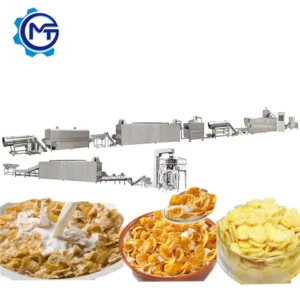
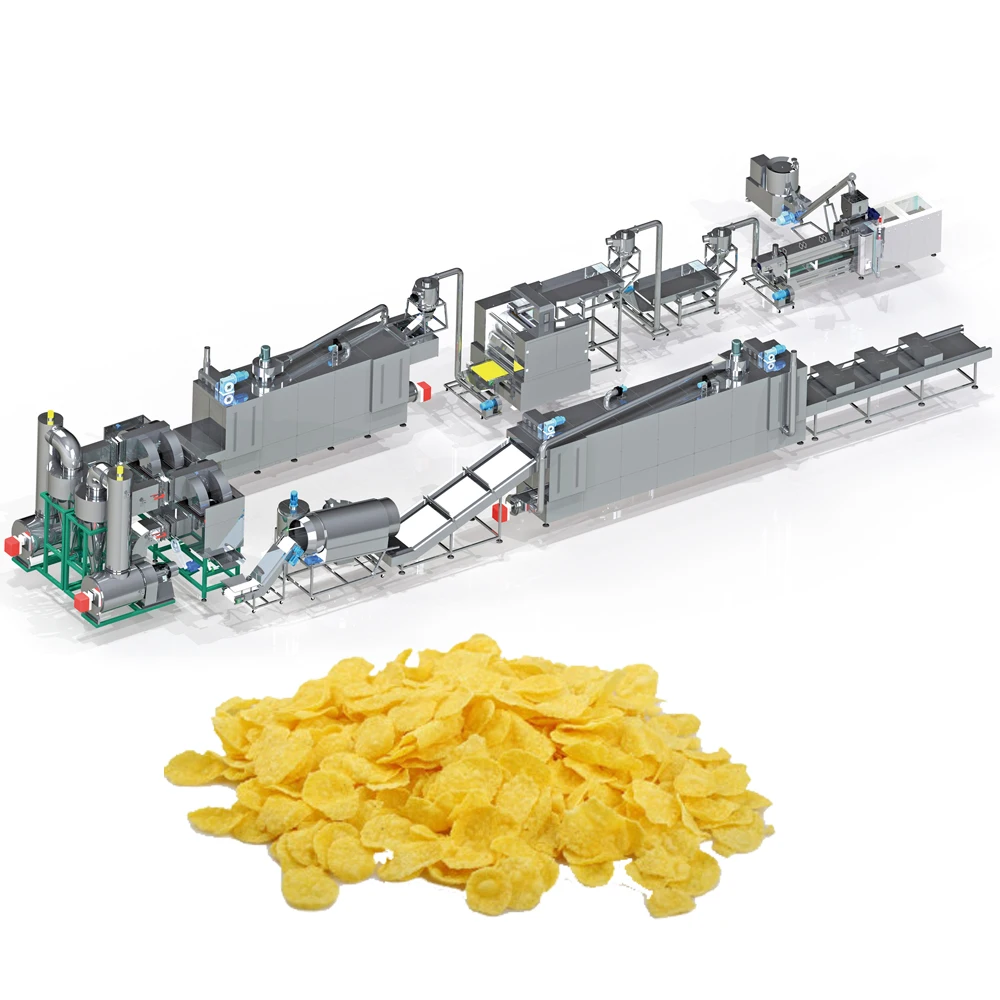
| Roasting Oven Features | Vibrating pan with high-temperature spraying tubes; conciliation burner; two separate circulating fans; cyclone dust removal device |
| Standards | CE |
Application Suitability
| Application | Material or Output |
|---|---|
| Natural corn flakes production | De-germinated corn grits or powder |
| Sugar-coated breakfast cereals | Corn, rice, or wheat base with syrup coating |
| Multi-grain cereal formats | Blends of oat, barley, wheat, and rice powder |
| Fortified cereal substrates | Grain powder blended with nutritional additives |
Why Corn Flake Density Fails When the Screw Profile Is Wrong
The extrusion geometry must match the grain’s gelatinisation temperature and moisture threshold, not a generic snack-food build.
I once watched a line designed for standard de-germinated corn flour produce dense, sinking flakes when the buyer switched to whole-grain grits with higher fat content. The expansion collapsed. The barrel temperature zones and screw pitch that worked perfectly on low-fat material could not manage the different starch behaviour [NEED_CITE: starch gelatinisation behaviour across grain formulations]. Corn flakes extrusion technology twin screw systems are particularly sensitive to this mismatch because the twin-screw configuration controls both shear intensity and residence time through each barrel zone. When those parameters are not tuned to the actual formulation, the pellet density drifts outside the range that produces a crisp, properly blistered flake after roasting.
Mapping Barrel Zones to Starch Behaviour
The barrel is divided into multiple heating and cooling zones, each governing a specific phase of starch transformation. Early zones handle hydration and initial gelatinisation, while later zones control melt viscosity and expansion at the die face. Corn flakes extrusion technology twin screw architecture allows operators to adjust the screw element sequence — mixing blocks, conveying elements, reverse-flight sections — to hold the material in the gelatinisation window long enough without over-shearing it.
Die Geometry and Flake Expansion Control
The die opening determines pellet shape and initial thickness before flaking. For corn flakes, a narrow slot die produces the flat pellet that the flaking rollers then compress to final gauge. If the die land length is too short, the pellet expands unevenly and the resulting flake blisters inconsistently during hot-air roasting. Die design must account for the moisture content at the die face, the melt temperature, and the target expansion ratio [NEED_CITE: die design principles for breakfast cereal extrusion]. Getting this wrong means flakes that are either too dense to crisp properly or too fragile to survive coating and packing.
Reading the Specs That Actually Matter
Installed power across the MT70, MT85, and MT75 models ranges from 160 kW to 210 kW, but the more relevant figure is power consumption during steady-state running — 120 kW to 150 kW — which reflects the actual mechanical and thermal energy delivered into the barrel. The PLC-controlled flaking station uses a hydraulic double-roller system with infrared temperature monitoring, keeping the roller gap and surface temperature stable across long production runs. The hot-air roasting oven employs a vibrating pan with two independent circulating fans and a cyclone dust removal device, which together maintain even heat distribution and remove fines that would otherwise scorch. Control language and voltage can be configured for the destination market before the line leaves the factory, preventing commissioning delays that typically arise when electrical schematics and local supply standards are misaligned.
The Cost of Skipping the Trial Run
Lines shipped without a test run on the buyer’s actual raw material carry hidden risks. Screw configurations copied from a generic build may produce the correct pellet shape but fail on density or surface texture. When the flaking rollers compress an incorrectly gelatinised pellet, the resulting flake cracks instead of flattening uniformly. Coating adhesion suffers, roasting blister is uneven, and the final product does not meet the crispness standard the market expects [NEED_CITE: quality standards for commercial breakfast cereal flakes]. Correcting these issues on-site takes days of screw reconfiguration and barrel profile adjustment — time that delays production start-up and strains the commissioning schedule.
What This Approach to Extrusion Engineering Delivers
Every screw configuration and die combination is documented against the buyer’s specific raw material formulation, not adapted from a generic template. The in-house testing workshop runs the buyer’s actual grain blend before shipment, generating a trial run report that records expansion ratio, pellet density, and flake texture under controlled conditions. Throughput across every station — mixing, extruding, flaking, drying, roasting, coating, cooling, and packing — is calculated and matched so no single point bottlenecks the line. Electrical schematics and voltage specifications are confirmed against the target market’s supply standards before production begins. The roasting oven and coating system are engineered as part of the same line, ensuring that flake substrate quality and downstream finishing are compatible.
Documentation & Verification
- Screw and die configuration record specific to your grain formulation
- Trial run report on buyer-supplied raw material before dispatch
- Line layout with matched throughput calculation for every station
- Electrical schematic and voltage confirmation for destination market
- CE declaration of conformity with machine directive compliance
Installation, Commissioning & Support
- Foundation plan accounts for the 45 m line length and vibration isolation at the roasting oven
- Dedicated electrical circuit sized for the 210 kW installed power peak on the MT75 extruder
- MCC and PLC panels configured to local voltage and operator language before shipping
- On-site barrel temperature profiling and screw adjustment using the buyer’s production material
- Wear parts inventory including replacement screw elements and die plates for the first maintenance cycle
Preparing a Technical Inquiry
To move from a general specification to a matched line configuration, the useful starting information includes your grain formulation and moisture content, target hourly output, and the voltage and frequency at your facility. If you are running multi-grain blends, noting the proportion of each component helps determine the screw element sequence and barrel zone settings. Specifying whether sugar coating or fortification is part of the format ensures the downstream stations are included in the initial layout.
Frequently Asked Questions
Q: How is screw configuration selected for corn versus multi-grain cereal formulations?
A: Each grain has a different starch gelatinisation temperature and moisture absorption rate. Corn requires a specific residence time and shear profile compared to oat or barley blends. The screw element sequence — mixing blocks, conveying flights, and reverse sections — is arranged to hold the material in the correct thermal window for the specific formulation being run.
Q: What barrel temperature profile produces correct gelatinisation for corn flakes?
A: Corn starch gelatinises within a defined temperature and moisture range. The barrel zones are set to progressively hydrate, gelatinise, and then stabilise the melt before the die. Infrared sensors and independent heating elements per zone allow adjustment when raw material moisture or ambient conditions shift during production.
Q: How is expansion density verified during the trial run?
A: Pellets are sampled at the die face and measured for diameter, length, and bulk density. Flakes produced from those pellets are then roasted and checked for crispness, surface blister pattern, and final bulk density to confirm they meet the target specification before the line ships.
Q: How does die design affect flake thickness and blister after roasting?
A: The die slot width and land length control the initial pellet geometry and moisture retention at the exit. A pellet that is too thick or too dry will not flatten uniformly under the flaking rollers, leading to inconsistent thickness and uneven blister formation during hot-air roasting.