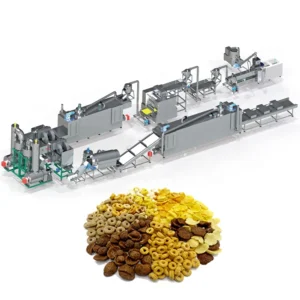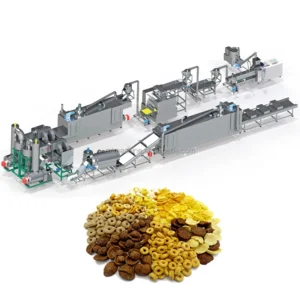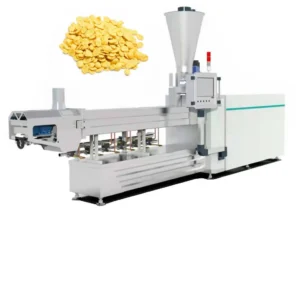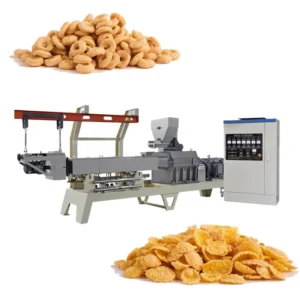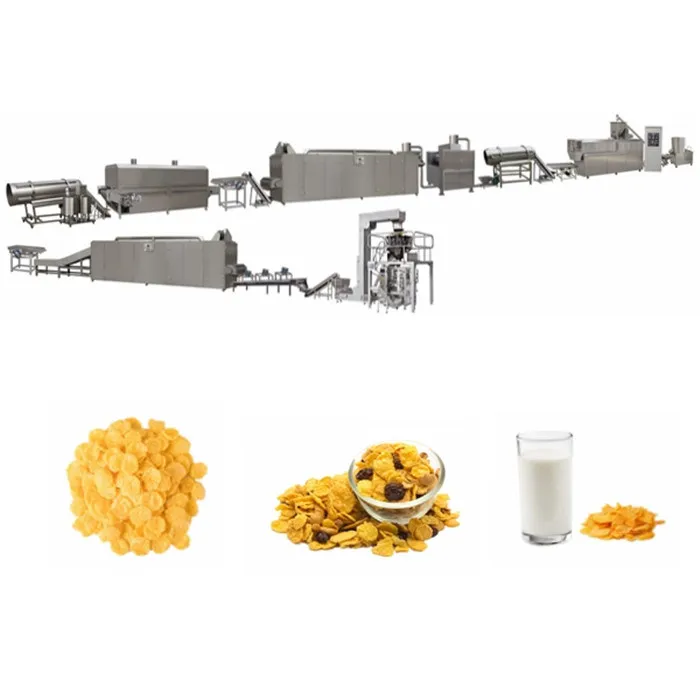
Screw and die configuration matched to your raw material — We configure the twin-screw extrusion parameters specifically for your cereal blend, ensuring proper starch gelatinisation and flake texture rather than relying on generic machine builds.
Technical Specifications
| Parameter | Value |
|---|---|
| Product Type | Corn Flakes Extrusion Production Line |
| Model Options | MT70 / MT75 / MT85 |
| Screw Type | Twin Screw |
| Installed Power | MT70: 160 kW; MT75: 210 kW; MT85: 190 kW |
| Power Consumption | MT70: 120 kW; MT75: 150 kW; MT85: 140 kW |
| Output Capacity | MT70: 150–200 kg/h; MT75: 300–500 kg/h; MT85: 300–400 kg/h (basis to be confirmed with raw material and moisture) |
| Overall Dimensions (L×W×H) | MT70: 41 × 1.5 × 2.2 m; MT75: 45 × 1.5 × 3.5 m; MT85: 43 × 1.5 × 3.2 m |
| Flaking Station | Hydraulic double-roller system, dual motors, infrared temperature control |
| Dryer Heating Source | Gas or Electric |
| Roasting Oven | Hot-air circulation, conciliation burner, dual fans, cyclone dust removal |
| Coating System | Double tumble drum, elevator, sugar spraying nozzle |
| Control System | PLC and MCC available |
Application Suitability
| Application | Material or Output |
|---|---|
| Natural corn flakes | Corn grits, corn flour |
| Sugar-coated corn flakes | Corn, rice, or wheat base with sugar coating |
| Multi-grain breakfast cereals | Blends of rice, wheat, oat, barley |
| Shaped cereal formats | Ball, tube, stick, ring, star, wheel, flower, heart via die adjustment |
Why the Extrudate Density Matters More Than the Nameplate Capacity
A corn flakes extrusion line only performs as well as its screw configuration allows on your actual raw material.
When buyers specify a breakfast cereal line, the focus often lands on rated throughput. But during field installations, I have watched extruders produce dense, unexpanded pellet material because the screw flighting and die geometry were never adjusted for the specific starch composition of the feedstock. The line ran at full speed — producing material that would never crisp properly in the roaster. A breakfast cereal extrusion line must be tuned from the screw forward [NEED_CITE: twin-screw extrusion starch gelatinisation principles]. Without that matching, capacity numbers mean nothing on the production floor.
Barrel Temperature Profile and Moisture Balance
The degree of starch gelatinisation inside the extruder barrel determines whether your corn flakes will develop the surface micro-blisters expected in the final product. Barrel temperature zones must be sequenced to gradually build pressure and heat while moisture is injected at precise rates. Too little gelatinisation and the flake remains dense after rolling; too much and the extrudate becomes sticky and impossible to flake cleanly. Getting this balance right requires screw element selection that matches your specific corn variety and moisture content entering the barrel.
Die Geometry and Granule Consistency
The die at the extruder outlet shapes the extrudate into small pellets that feed directly into the flaking rollers. If die holes are incorrectly sized or spaced, the granules arriving at the flaking station vary in mass and density. This variation translates into uneven flake thickness across the production run — some flakes over-roast while others remain doughy inside. Proper die design, matched to your target corn flakes extrusion technology parameters, ensures each granule enters the hydraulic double-roller system with identical geometry for uniform compression.
Reading the Installed Power and Flaking Specifications
The installed power across the MT70, MT75, and MT85 models reflects the combined mechanical work of driving the twin screws under load while maintaining barrel pressure. Higher power models accommodate greater throughput volumes and denser cereal blends. The hydraulic flaking station uses separate motors for each roller, which allows independent speed adjustment — critical when switching between a standard corn blend and a multi-grain formula with different elasticity characteristics. The infrared sensor on the flaking station monitors roller temperature to prevent surface sticking during continuous operation. Hot-air roasting with dual circulating fans and a cyclone dust removal device ensures even heat distribution and captures fine particulate before it can scorch inside the oven chamber [NEED_CITE: cereal roasting temperature uniformity standards].
The Cost of Running a Generic Screw Configuration
Operators who inherit a line with a default screw build often spend weeks adjusting downstream parameters to compensate for poor extrudate quality. The roaster temperature gets pushed higher to force crispness into under-gelatinised flakes. The sugar coating drum runs longer to mask texture defects. These workarounds increase energy consumption and wear on downstream equipment without addressing the root cause [NEED_CITE: extrusion process troubleshooting in breakfast cereal plants]. When the screw configuration is specified from the start to match your raw material formula, these downstream compensations disappear and the line runs at its intended process parameters.
Why Engineers Source This Line Here
Complete throughput matching across every station — the extruder, flaking rollers, dryer, roasting oven, and coating drum are sized together so no single station bottlenecks the corn flakes extrusion technology output.
Screw configuration and die geometry are documented to your specific cereal formulation before the machine enters production.
An in-house testing workshop allows trial runs on your actual raw material, producing flake samples for density and crispness verification before the line ships.
Twin-screw engineering covers the full range of breakfast cereal applications, from plain corn flakes to multi-grain blends with different starch behaviour profiles.
Pre-sales engineering covers line layout, utility planning, and capacity calculation rather than simply quoting a model number from a catalog.
Documentation & Verification
- Screw and die configuration record matched to your cereal raw material formula
- Trial run report on your actual grain blend confirming flake density and texture
- Line layout drawing with capacity calculation across extrusion, flaking, and roasting stations
- Electrical schematic with confirmed voltage, frequency, and control language specifications
- CE declaration of conformity for the complete production line assembly
Installation, Commissioning & Support
- Foundation planning accommodates the full line length up to 45 metres depending on model selection
- Power supply must support the installed load from 160 kW to 210 kW with dedicated circuit breakers
- Line arrives in sectioned modules requiring sequential assembly from extruder through packing station
- First-run commissioning includes barrel temperature profiling and screw speed calibration on your raw material
- Operator training covers PLC parameter adjustment for switching between natural and sugar-coated production
- Wear parts inventory covers screws, die plates, and flaking roller surfaces for the first replacement cycle
What to Include With Your Inquiry
To move forward with a line configuration, provide the specific grain or grain blend you intend to process, your target flake format and thickness, and the daily output volume your facility requires. Include your local voltage and frequency standard so the electrical system can be confirmed before fabrication [NEED_CITE: industrial voltage and frequency standards by region]. If you have existing upstream mixing or downstream packing equipment, note the connection interface requirements so the line layout integrates cleanly.
Frequently Asked Questions
Q: How is screw configuration determined for different cereal raw materials?
A: Each cereal grain — corn, wheat, rice, oat, or barley — has a distinct starch composition and gelatinisation temperature. The screw element arrangement, including conveying, kneading, and reverse-flight sections, is selected to match your specific raw material blend. This ensures the correct residence time and shear profile inside the barrel for consistent extrudate quality.
Q: What barrel temperature and moisture range produce the right starch gelatinisation?
A: The target range depends on your grain formula and the desired flake density. Typically, barrel zones are staged from moderate to high heat while moisture is introduced through steam or water injection. The goal is partial to full gelatinisation without over-plasticising the extrudate, which would make flaking difficult and reduce final crispness after roasting.
Q: How does die design affect flake thickness consistency?
A: The die produces small granules of uniform mass that feed into the hydraulic flaking rollers. Consistent granule size ensures each flake is compressed to the same thickness. Irregular granules create a mixed batch where some flakes overcook in the roaster while others remain under-processed, reducing product quality and increasing sorting waste downstream.
Q: Can a trial run confirm flake density before shipment?
A: Yes. Raw material samples are processed through the extruder in the testing workshop, and the resulting extrudate is flaked, dried, and roasted under production-matched conditions. The trial confirms whether the selected screw configuration and die geometry produce flakes meeting your density, crispness, and bowl-life specifications before the line leaves the factory.