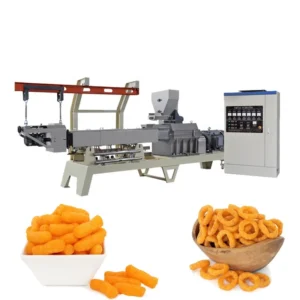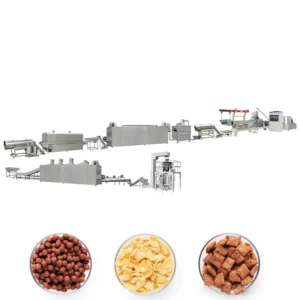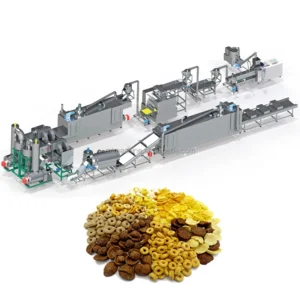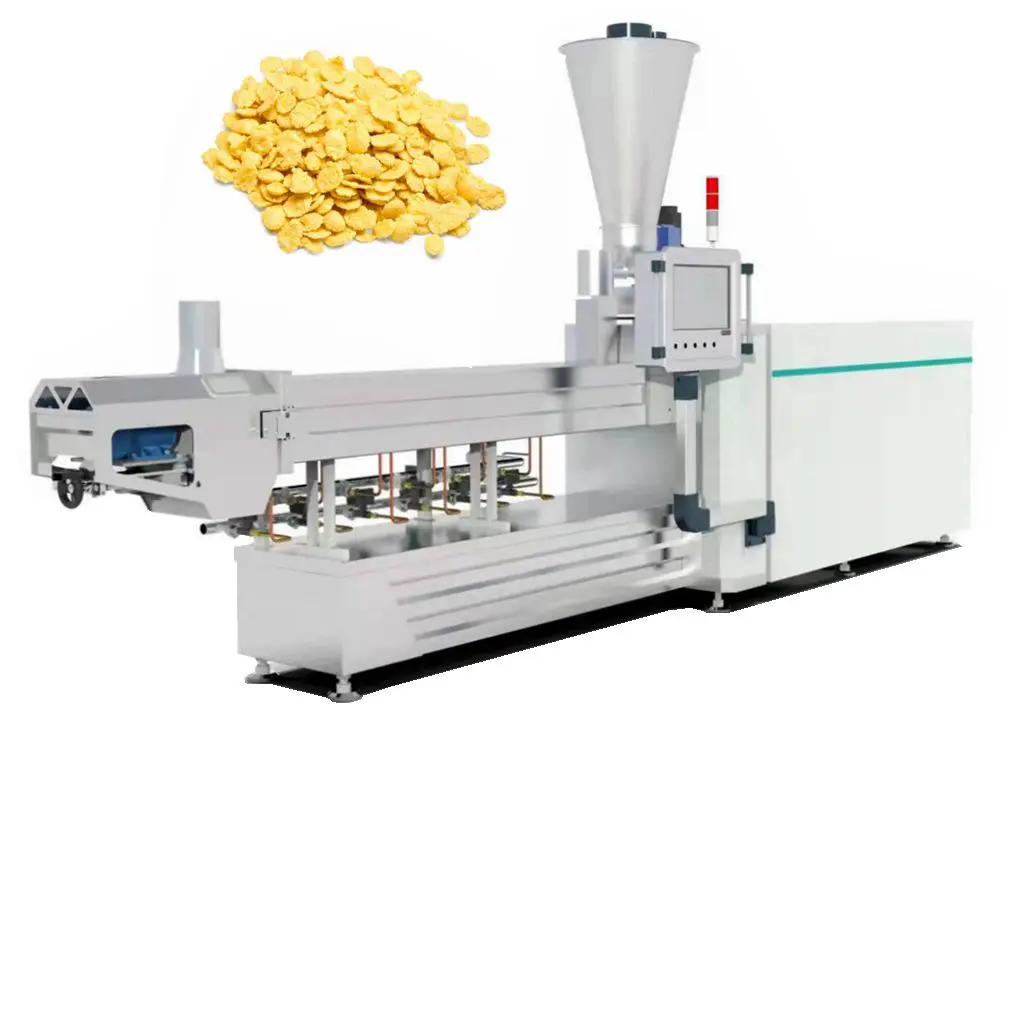
Matched Screw Configuration — Every MT75 extruder is set up with screw elements and die geometry tested against the buyer’s actual cereal formulation before shipment.
Technical Specifications
| Parameter | Value |
|---|---|
| Model | MT75 (also available: MT70, MT85) |
| Product Type | Twin Screw Extruder for Corn Flakes Breakfast Cereal Production Line |
| Screw Type | Twin-screw |
| Installed Power | 210 kW (MT75); 160 kW (MT70); 190 kW (MT85) |
| Power Consumption | 150 kW (MT75); 120 kW (MT70); 140 kW (MT85) |
| Output Capacity | 300–500 kg/hr (MT75, basis not stated in source — confirm raw material, moisture content and product format); 150–200 kg/hr (MT70); 300–400 kg/hr (MT85) |
| Overall Dimensions (L×W×H) | 45 × 1.5 × 3.5 m (MT75); 41 × 1.5 × 2.2 m (MT70); 43 × 1.5 × 3.2 m (MT85) |
| Control System | PLC and MCC |
| Screw Feature | Automatic lubricating and cooling function; wear-resistant manufacturing technology |
| Flaking Machine | Hydraulic double-roller system; separate roller driving via double motors; infrared temperature sensor control |
| Dryer Heating Source | Gas or Electric |
| Roasting Oven | Hot air roasting with high-temperature spraying tubes, conciliation burner, dual circulating fans, cyclone dust removal |
| Coating System | Double tumble for sugar melting, elevator, coating drum, spraying nozzle |
| Raw Materials | Corn, rice, wheat, oat, barley powder |
| Final Products | Natural and sugar-coated corn flakes, shaped cereals (ball, tube, stick, ring, fruit loop, star, wheel, flower, heart) |
| Assembly State | Complete turnkey line |
| Certification | CE, ISO |
Application Suitability
| Application | Material or Output |
|---|---|
| Natural corn flake production | Corn grits and corn powder blended at controlled moisture |
| Sugar-coated breakfast cereal | Corn, rice, or wheat base with syrup coating |
| Multi-grain flake processing | Blends of oat, barley, wheat, and rice powder |
| Shaped cereal formats | Die changes producing rings, balls, stars, and fruit loops on the same line |
| Fortified cereal runs | Vitamin- or mineral-enriched grain blends requiring controlled expansion |
Why "300 kg/hr" Means Nothing Without Your Raw Material
Capacity is only real when the extruder screw profile and barrel heating match what you actually put into the hopper.
I have watched buyers sign off on a breakfast cereal corn flakes extrusion line specifications sheet quoting a round number, only to find during commissioning that their local corn variety — higher oil, different starch profile — gelatinises at a different temperature and produces a denser, harder flake. The line runs, but the product does not meet market expectations for crispness. We now run every formulation through our testing workshop before the extruder is shipped [NEED_CITE: starch gelatinisation behaviour across corn varieties].
How Extrusion Shear Shapes Your Corn Flake Texture
The twin-screw design in the MT75 allows operators to adjust screw element sequencing along the barrel — mixing zones, kneading blocks, and conveying sections — to control shear intensity. Higher shear breaks down starch granules more aggressively, increasing gelatinisation and producing a lighter, more expanded flake after roasting. Lower shear preserves more granular structure, yielding a denser bite. The breakfast cereal corn flakes extrusion line specifications must document which screw configuration was validated for your target texture.
Barrel Temperature Profile and Moisture Control
Each barrel zone has independent heating and cooling circuits. Corn flakes require a gradual temperature rise: the feed zone stays cool to prevent premature gelatinisation and bridging, while the metering and high-shear zones climb to drive starch conversion. Moisture injection points allow fine-tuning of dough plasticity. If the breakfast cereal corn flakes extrusion line specifications do not include a zone-by-zone temperature map validated on your grain blend, the flaking station downstream will receive inconsistently cooked pellets [NEED_CITE: barrel zone temperature mapping for cereal extrusion].
Reading the Specs That Actually Matter
Installed power of 210 kW on the MT75 reflects the combined demand of the main drive motor, barrel heaters, and feeding system; power consumption of 150 kW indicates typical running load under normal cereal formulations. The hydraulic flaking station uses double motors for independent roller speed control — this prevents differential wear and allows micro-adjustment of flake thickness, typically between 0.3 mm and 1.2 mm depending on the cereal format. The roasting oven’s dual circulating fans and cyclone dust removal are specified to maintain even heat distribution and prevent fines accumulation, both of which affect surface blistering consistency on the final flake.
The Cost of Skipping the Trial Run
A buyer who skips the pre-shipment trial on their actual raw material risks discovering at commissioning that the die opening, screw speed, and barrel profile produce a pellet that flakes unevenly or roasts to the wrong colour. Reworking screw configuration on-site takes days of downtime and consumes raw material that cannot be sold [NEED_CITE: extruder reconfiguration downtime during commissioning].
Why Procurement Starts With the Formulation
We match screw element profiles and die geometry to the buyer’s specific grain blend and target flake density, rather than shipping a generic screw build. Every station — mixing, extruding, flaking, drying, roasting, coating, cooling — is capacity-matched so the extruder output does not bottleneck at the dryer or overwhelm the coating drum. The in-house testing workshop runs the buyer’s raw material through the MT75 before dispatch, generating a documented trial run report. PLC and MCC controls are configured to the facility’s voltage and frequency before wiring, avoiding on-site rewiring delays. CE and ISO certification documentation is included for customs and local regulatory compliance.
Documentation & Verification
- Line layout with capacity calculation matching every station from mixer to packer
- Screw and die configuration record specific to your grain blend and target flake density
- Trial run report on your raw material from our testing workshop before dispatch
- Electrical schematic with confirmed voltage and frequency for your facility
- Operation and maintenance manual with illustrated wear parts replacement procedures
- CE declaration of conformity and ISO certificate for import and compliance
Installation, Commissioning & Support
- MT75 line footprint of 45 m length requires level concrete foundation with drainage provision
- 210 kW installed power needs dedicated circuit with voltage confirmed before panel wiring
- Twin-screw extruder ships partially assembled; barrel sections and screw shafts installed on-site
- First-run commissioning includes barrel zone temperature mapping and flaking roller gap calibration
- Operator training covers PLC interface, screw speed adjustment, and moisture control parameters
- Wear parts list with replacement lead times for screws, dies, and flaking rollers
What to Include in Your Inquiry
Provide your target cereal format — natural flake, sugar-coated, or shaped — along with the grain types and approximate blend ratios you plan to run. Include your facility’s voltage, frequency, and available floor space so the line layout and electrical schematic can be prepared before quotation. If you have a specific flake density, crispness target, or packaging format in mind, share those details so the screw configuration and die design can be matched accordingly.
Frequently Asked Questions
Q: How is output capacity verified against my specific cereal raw material blend and moisture level?
A: We run your exact formulation through the extruder in our testing workshop before shipment. The trial uses your grain blend at the moisture content you specify, and we document the throughput, pellet density, and flake quality achieved. This report travels with the machine and becomes the baseline for commissioning parameters at your facility.
Q: What screw configuration and die design are specified for my target flake density and texture?
A: Screw element sequencing — the arrangement of conveying, kneading, and mixing sections — is selected based on your grain blend’s starch behaviour and the flake texture your market expects. Die opening diameter and land length are matched to the pellet size required by the flaking station. Both are recorded in the configuration document provided with your line.
Q: How is voltage, frequency, and control language confirmed before commissioning?
A: During the specification confirmation stage, we collect your facility’s power supply details and preferred PLC interface language. The MCC panel is wired to your voltage and frequency before shipping, and the PLC program is loaded with your language set. This avoids rewiring and reprogramming delays when our engineers arrive for installation.
Q: Can I run a trial on my raw material in the testing workshop before shipment?
A: Yes. Send us a representative sample of your grain blend — typically several hundred kilograms is sufficient. We run it through the MT75, document the extrusion parameters, flake the output, and evaluate density and texture. You receive the trial report before the machine leaves the factory.
Q: What spare wear parts are included, and what is the replacement lead time?
A: The initial shipment includes a set of replacement screw elements, die plates, and flaking roller wear rings. The wear parts list specifies expected service life under your formulation. Replacement parts are manufactured to the same configuration and shipped within typical multi-week lead times once the order is placed.