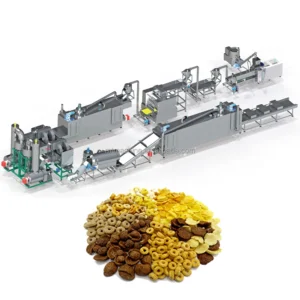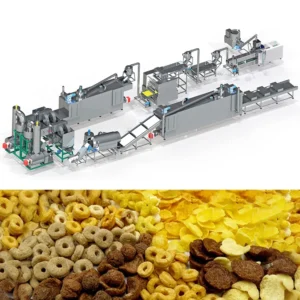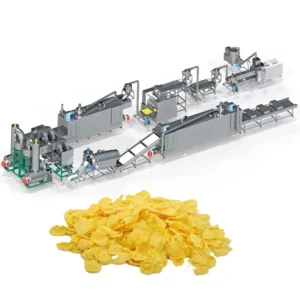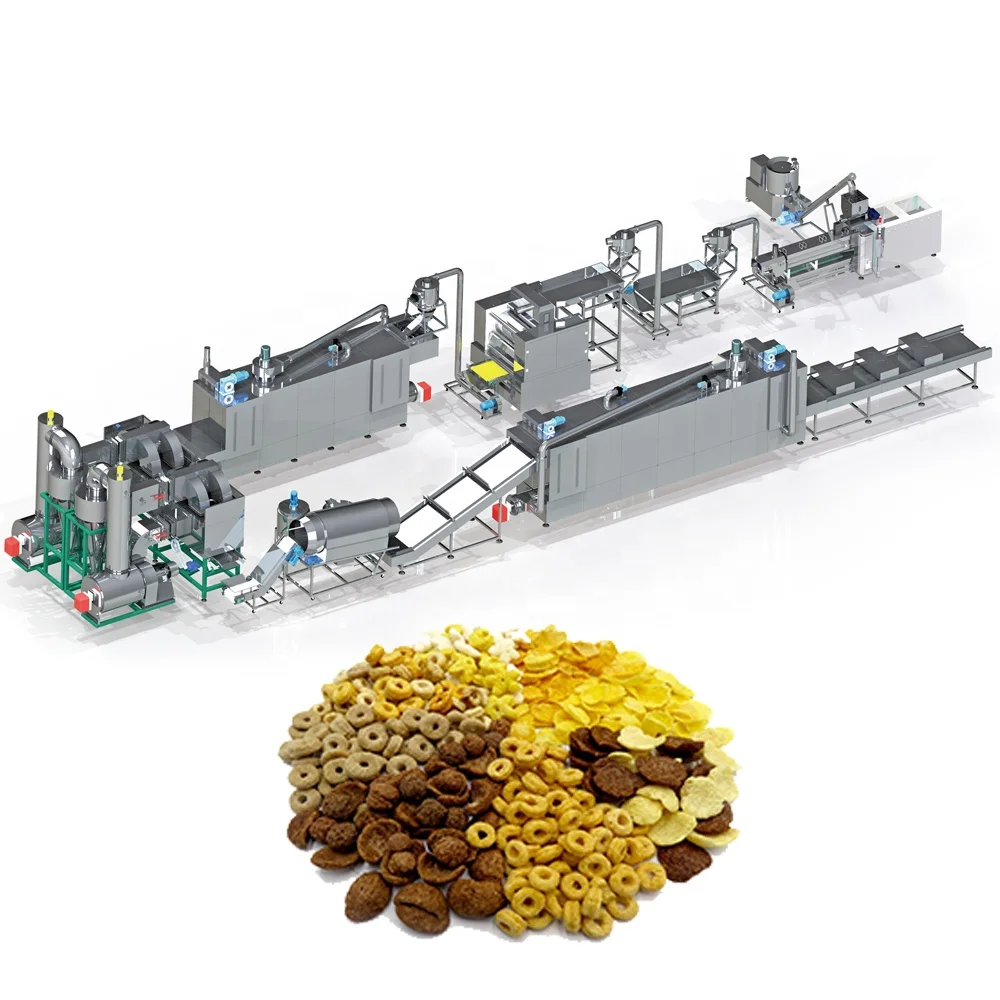
Precise Extrusion Control — Every screw element and barrel zone is configured around the buyer’s grain formulation to hold target density across production runs.
Technical Specifications
| Parameter | Value |
|---|---|
| Model | MT-65 |
| Product Type | Twin Screw Extruder Corn Flakes Production Line |
| Screw Type | Co-rotating twin screw, sectional modules |
| Line Sequence | Flour Mixer → Screw Elevator → Extruder → Flaking Press → High-temp Oven → Coating → Second Dryer → Cooling |
| Mixer Capacity | 10–30 kg per load |
| Mixer Power | 4 kW |
| Flaking Press Roller | 510 × 310 mm, with cooling and adjustable gap |
| Flaking Press Power | 16.12 kW |
| High-temperature Oven | 4.5 × 1.4 × 1.8 m, gas-heated both-side baking |
| Sugar Spraying System | 28.75 kW, Ø600 × 2700 mm drum |
| Control System | PLC and MCC |
| Contact Materials | Food-grade stainless steel |
| Standards | CE, ISO |
Application Suitability
| Application | Material or Output |
|---|---|
| Traditional corn flakes | Corn grits or corn flour, pressed and toasted for bowl-stable crispness |
| Multi-grain breakfast cereals | Blends of oat, rice, and wheat flour requiring adjusted gelatinisation profiles |
| Fortified cereal production | Grain bases with added vitamin and mineral premixes affecting starch behaviour |
| Sugar or honey coated variants | Flakes or shaped pieces (rings, balls, stars) run through the coating drum |
Why Density Fails Before the Line Ever Ships
A corn flakes extrusion line screw configuration die design that works on one corn source may collapse on another — and this mismatch is rarely caught until the machine is bolted to your factory floor. Get the moisture window and screw profile wrong at the extruder, and flakes either shatter in milk or stay dense and chewy.
I’ve watched a line in Jordan run perfectly on standard corn grits during factory acceptance, then produce flat, under-expanded flakes once the customer switched to a local coarse-ground grain. The starch gelatinisation temperature shifted, the die pressure dropped, and the entire texture spec was missed. This is the kind of failure that a corn flakes extrusion line screw configuration die design built only on generic assumptions will always produce [NEED_CITE: starch gelatinisation behaviour across grain varieties].
Barrel Temperature Zones and Starch Behaviour
The MT-65 barrel is segmented into independently heated and cooled zones, each governing a different stage of the dough’s journey — hydration, cooking, de-gassing, and forming. For corn-based formulations, the transition from the cooking zone to the metering zone must hold a narrow temperature band so that starch reaches full gelatinisation without over-shearing the protein matrix. When multi-grain blends enter the picture, those setpoints shift, and the corn flakes extrusion line screw configuration die design must be revalidated for each new formulation.
Die Geometry and Expansion Control
The die plate is the final gate before the extrudate becomes a pellet ready for flaking. Orifice diameter, land length, and face pattern together decide how much the dough expands the instant it exits into ambient pressure. A longer land restrains expansion and yields a denser pellet, which the flaking press then flattens into a thicker, slower-to-sog flake. A shorter land gives a lighter pellet that toasts faster but may lack the bowl life that cereal brands in certain markets demand [NEED_CITE: die land length effects on extrudate expansion in cereal processing].
Screw Module Selection and L:D Ratio
The co-rotating twin-screw design uses sectional modules — forwarding elements, kneading blocks, and reverse-flight sections — assembled onto splined shafts. The arrangement determines residence time, shear intensity, and mixing uniformity inside the barrel. For a standard corn flake with high bowl-life requirements, a longer cooking section with moderate shear keeps the dough plastic without breaking down the starch granules too early. Adjusting the module sequence is how the line adapts from corn to oat-heavy or rice-heavy recipes without changing the extruder frame.
What the Specs Actually Mean on the Floor
The flaking press carries a 510 mm roller with an integrated cooling system, which matters because hot pellets stick and tear if the roller surface isn’t kept below the starch glass-transition range. The adjustable roller gap lets operators dial in flake thickness — thinner for quick-toast markets, thicker for premium bowl-stable formats. The gas-fired high-temperature oven at 4.5 metres long provides enough residence time to drive moisture down to the shelf-stable zone without surface scorching, and the both-side baking arrangement prevents the curl that single-side heat causes. The sugar spraying system’s 28.75 kW drive and Ø600 mm drum handle viscous coatings that smaller drums cannot distribute evenly across a full batch.
When the Extruder Arrives Without the Right Support
A common failure mode I’ve seen is an extruder quoted at a nominal throughput while the dryer downstream is sized for a lower volume — creating a bottleneck that forces the extruder to idle or the product to back up and over-dry. The same risk applies to the coating station: if the drum volume doesn’t match the oven output, sugar-coated batches cool unevenly and clump in the packing hopper. These mismatches are the hidden cost of sourcing stations from different vendors without a single entity responsible for throughput balance across the line [NEED_CITE: throughput balancing in multi-station food processing lines].
Why Source the Full Extrusion Technology Package Here
Screw configuration and die design are specified to the buyer’s actual grain flour and target flake texture — not copied from a generic build. The in-house testing workshop runs your raw material on the extruder before the line ships, so expansion behaviour and pellet density are validated before the machines leave Jinan. Every station — mixer, extruder, flaking press, oven, coating drum, cooler — is sized to the same throughput target, eliminating the bottleneck risk that comes from assembling a line piecemeal. PLC and MCC control means the barrel temperature profile and screw speed can be stored as recipes, so shift changes don’t drift the product spec. Food-grade stainless steel contact materials and CE documentation support regulatory submissions in export markets without last-minute scramble [NEED_CITE: CE declaration requirements for food extrusion machinery].
Documentation & Verification
- Screw and die configuration record matched to your grain flour blend and target flake density
- Trial run report conducted on your raw material in the testing workshop before shipment
- Line layout drawing with throughput calculations linking extruder output to dryer and coating capacity
- Electrical schematic with voltage, frequency, and PLC language confirmed for your site
- Factory test record covering barrel temperature profile and flaking press roller gap settings
Installation, Commissioning & Support
- Foundation plan accounts for the 4.5 m oven length and flaking press vibration isolation
- Dedicated electrical circuit sized for the combined 28.75 kW coating system and 16.12 kW press load
- PLC interface configured in the operator’s language before the control cabinet ships
- Flaking press roller gap calibrated on-site to the agreed flake thickness tolerance
- Wear parts list covering screw modules, die plates, and press roller surfaces for first-year spares
- Barrel zone thermocouple calibration verified during commissioning to hold gelatinisation setpoints
What to Prepare Before Requesting a Quote
Share the exact grain flour or grit specification you intend to run — including particle size distribution and source — along with the target flake density and bowl-life expectation for your market. Confirm your site voltage, frequency, and preferred PLC display language so the control cabinet is wired correctly before dispatch. If you have an existing drying or packing station you want to integrate, provide its throughput rating so the line layout can be matched.
Frequently Asked Questions
Q: How is screw configuration matched to my raw material and target flake density?
A: We start with your grain flour sample and the density spec your market expects. The screw modules — forwarding, kneading, and reverse elements — are arranged on the shafts to deliver the residence time and shear profile that your starch type needs. The die orifice and land length are then selected to control expansion at exit, and the full combination is documented before production.
Q: What barrel temperature profile and moisture range does the line support?
A: The barrel zones are independently heated and cooled, allowing different profiles for corn, oat, rice, or multi-grain blends. Moisture addition at the preconditioner is adjustable to suit each formulation’s gelatinisation window. The exact setpoints are established during the trial run on your raw material and recorded in the configuration file.
Q: Can I run a trial on my own raw material before the line ships?
A: Yes. Our testing workshop has extruders available for customer trials. You send a batch of your actual grain flour, and we run it through the configured screw and die setup, measuring pellet expansion, moisture, and flake density. The trial report is shared for your approval before the production line is dispatched.
Q: How does die design affect flake expansion and final texture?
A: Die orifice diameter and land length determine how much the extrudate expands when it exits the barrel. A restricted die yields a dense pellet that flakes into a thicker, crunchier product with longer bowl life. A more open die produces a lighter pellet suited to quick-toast or children’s cereal formats. We select the die based on your target texture.
Q: What documentation verifies the extrusion parameters were set correctly?
A: You receive a screw and die configuration record, a barrel temperature profile sheet, and a trial run report — all specific to your raw material and target product. The electrical schematic confirms voltage and control language, and the CE declaration of conformity supports regulatory filing in your market.