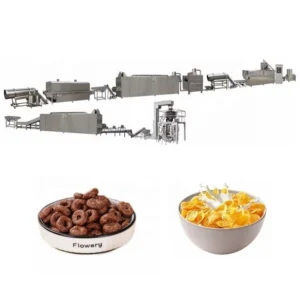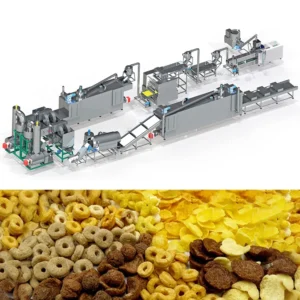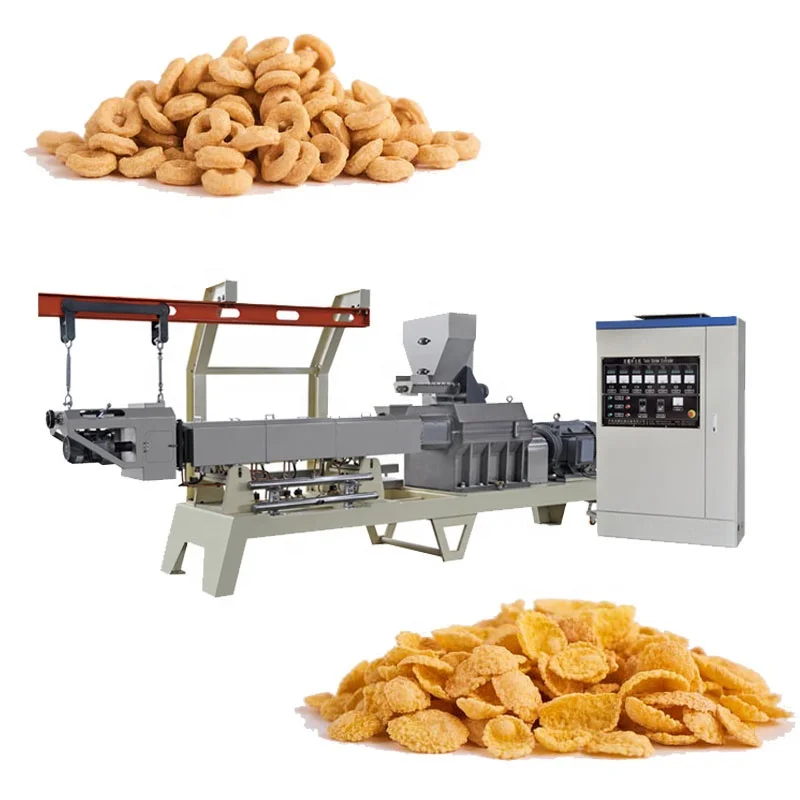
Matched System Throughput — From the twin-screw extruder through flake pressing, high-temperature toasting, and sugar coating, every station in the MT-65 corn flakes line is sized to hold the same output rate on your specific grain formulation, preventing the bottlenecks that arise when stations are sourced separately.
Technical Specifications
| Parameter | Value |
|---|---|
| Model | MT-65 (also available: MT-70, MT-75, MT-85) |
| Product Type | Corn Flakes Production Line |
| Extruder Type | Twin screw (co-rotating, sectional modules) |
| Installed Power | 84 kW |
| Real Power Consumption | 59 kW |
| Output Capacity | 120–150 kg/h (basis not stated in source — confirm raw material and moisture content) |
| Overall Dimensions | 12000 × 1200 × 2200 mm |
| Gear Box Lubrication | Oil forced automatic lubrication system |
| Cutting System | Non-stop cutting system |
| Mixer Output | 10–30 kg/load |
| Mixer Power | 4 kW |
| Corn Flakes Press Machine Power | 16.12 kW |
| Press Roller Size | 510 × 310 × 1050 mm |
| High-Temperature Oven Size | 4500 × 1400 × 1800 mm |
| Oven Heating Source | Gas-fired, dual-side baking system |
| Sugar Spraying System Total Power | 28.75 kW |
| Control System | Separate controller boxes per station (PLC/MCC level to be confirmed) |
| Contact Materials | Stainless steel (food-grade parts contacting raw material or product) |
| Standards | CE certified |
Application Suitability
| Application | Material or Output |
|---|---|
| Traditional Corn Flakes | Corn grits, corn flour at controlled moisture for breakfast cereal |
| Multi-Grain Flakes | Rice flour, wheat flour, soya bean blends for fortified breakfast cereals |
| Sugar-Coated Flakes | Corn or multi-grain base with sugar spraying and flavoring post-toasting |
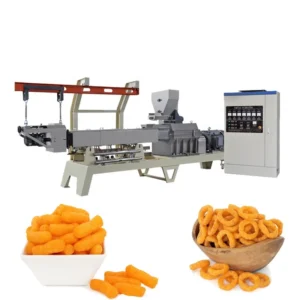
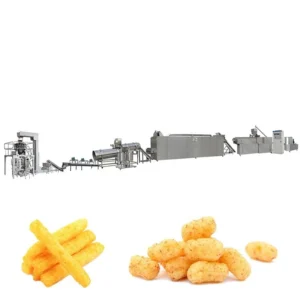
| Puffed Corn Snacks | Line variant producing extruded puffed snacks from corn and peanut formulations |
| Nutrition Programme Cereal | Fortified grain bases including soya, walnut, and vitamin premixes |
What "150 kg/h" Really Means on Your Corn Grits
Capacity only exists relative to your specific raw material formulation and moisture profile.
A corn flakes extrusion production line specifications sheet listing a peak throughput figure without naming the raw material, particle size, or moisture content is describing a best-case scenario, not a working guarantee. I have watched buyers sign off on line capacity, only to discover during commissioning that their local corn grits — slightly higher in fiber, slightly different in starch behavior — cause the extruder to surge and the press rollers to slip, dropping actual output well below the quoted number. The extrusion process is fundamentally a chemical reaction under heat and shear; changing the input changes the output. This is why corn flakes extrusion production line specifications must always be validated against the buyer’s own formulation before the line enters manufacturing [NEED_CITE: starch gelatinisation behaviour varies across corn cultivars and milling grades].
How Screw Configuration Controls Flake Integrity
The MT-65 uses co-rotating twin-screw sectional modules that perform transport, mixing, de-gassing, cooking, and forming in a single continuous pass. Each module can be rearranged to adjust the shear profile and residence time, which directly determines the degree of starch gelatinisation achieved before the material reaches the die. Under-gelatinised corn mass will crack and shatter at the press rollers; over-gelatinised mass will stick and produce uneven flake thickness. The screw configuration record is specified to the buyer’s raw material, not copied from a generic build.
Why the Oven and Press Must Be Sized Together
A gas-fired high-temperature oven with dual-side baking measures 4500 × 1400 × 1800 mm on this line, and that dimension is not arbitrary — it is calculated against the belt loading rate coming off the press machine. If the oven is too short for the throughput, flakes exit under-toasted, retaining moisture that causes them to go limp in the bag. If the press machine delivers a thicker flake than the oven’s thermal profile was designed for, the center remains doughy while the edges burn. These stations are engineered as a matched system so that flake thickness, belt speed, and oven temperature profile align across the full width of production [NEED_CITE: moisture removal rate in cereal toasting ovens relative to belt loading].
Reading the Specs That Actually Matter
The installed power of 84 kW and real consumption of 59 kW on the MT-65 reveal the line’s actual energy draw during continuous operation — the gap between these two figures represents motor starting load and peak transient demand, not steady-state running cost. The oil forced automatic lubrication system on the gear box is critical for twin-screw extruders running abrasive corn grits, as dry gear wear is a leading cause of unplanned stops in cereal extrusion. The non-stop cutting system upstream of the press machine ensures that extrudate is delivered continuously to the press rollers without pause-and-start surges that cause flake density variation. The press machine’s adjustable roller gap with integrated cooling allows operators to set flake thickness precisely while preventing material adhesion to the roller surface, a common failure point on lines where the press runs hot.
The Hidden Cost of Mismatched Line Stations
When a corn flakes line is assembled from unrelated single machines, each vendor quotes their station’s capacity independently, and no one is responsible for the throughput between stations. The extruder may deliver more mass than the press can flatten, creating a backlog that cools and hardens before reaching the rollers. The sugar spraying system may apply coating faster than the oven can set it, resulting in clumped, unsaleable product. These mismatches are not visible on a specification sheet — they emerge only after installation, during the weeks of troubleshooting that the buyer pays for in lost production time and engineer visit costs [NEED_CITE: line integration failures in multi-vendor food processing equipment].
Why This Line Is Built as One Project
Every station from the mixer through the sugar spraying system is supplied under one configuration, meaning throughput is calculated across the entire line before manufacturing begins. The screw and die configuration is specified to the buyer’s actual corn grits or flour blend, not a generic template. An in-house testing workshop conducts trial runs on the buyer’s raw material before shipment, producing a documented trial run report so that product development begins before installation, not after. Electrical schematics include voltage and frequency confirmation matched to the buyer’s facility, and control language is set before the line ships. The CE-certified line is delivered with a complete documentation package covering every station.
Documentation & Verification
- Line layout and capacity calculation showing throughput matching across mixer, extruder, press, oven, and sugar spraying stations
- Screw and die configuration record specified to your corn grits particle size and moisture content
- Trial run report on your actual raw material conducted in the testing workshop before dispatch
- Electrical schematic with voltage, frequency, and control language confirmed to your facility specifications
- CE declaration of conformity and factory test record covering all line stations
Installation, Commissioning & Support
- Overall line length of 12,000 mm requires clear floor space plus access clearance at each station for maintenance
- Gas supply for the high-temperature oven must be sized to the 3.75 kW oven fan load plus burner demand
- Separate controller boxes per station require individual power drops matched to local voltage and frequency
- On-site commissioning includes setting press roller gap, oven temperature profile, and sugar spray rate to your target flake specification
- Operator training covers screw module rearrangement for formulation changes and non-stop cutting system maintenance
- Wear parts list provided at delivery, including screw sections, die plates, and press roller bearings
What We Need to Configure Your Line
To size a corn flakes extrusion production line correctly, we need your target raw material — corn grits, corn flour, rice flour, or a multi-grain blend — along with the moisture content you plan to run. Share your facility voltage and frequency, available floor space and ceiling height, and whether you require PLC automation or relay-based control with your preferred operating language. If you have existing upstream mixing or downstream packing equipment, specify the interface points so the line throughput can be matched to your full process.
Frequently Asked Questions
Q: How is output capacity verified against my specific corn flour or corn grits formulation?
A: Before the line enters production, your raw material is run through the twin-screw extruder in the in-house testing workshop. The trial run confirms throughput, flake texture, and press behavior at your actual moisture content. A documented report is provided before shipment, so the capacity figure is tied to your formulation, not a generic benchmark.
Q: What screw configuration is selected for corn flakes versus other breakfast cereal formats?
A: Corn flakes require a specific degree of starch gelatinisation achieved through screw module arrangement and barrel temperature zones. The sectional co-rotating modules on the MT-65 are rearranged for flakes versus, for example, puffed cereal or core-filled variants. The configuration record is documented and provided with the machine specification sheet.
Q: How is voltage, frequency, and control language confirmed before production begins?
A: During the line configuration stage, your facility electrical specifications are collected and cross-referenced against motor ratings, heater elements, and control panel components. The electrical schematic is produced with your voltage and frequency, and control language is set on the separate controller boxes before the line ships.
Q: What happens during the in-house trial run on my raw material?
A: Your supplied corn grits or flour blend is mixed, extruded, pressed, and toasted through the complete line in the testing workshop. Flake thickness, crispness, color, and sugar coating adhesion are evaluated against your target specification. The trial run report documents all parameters and is included in the shipment documentation package.
Q: How are press roller gap, oven temperature, and sugar spray rate set to target flake thickness?
A: The press machine features adjustable roller distance with integrated cooling to set and hold flake thickness. Oven temperature profile across the 4500 mm baking zone is calibrated to the belt loading rate. Sugar spraying system parameters are matched to the toasted flake surface temperature for proper coating adhesion without clumping.