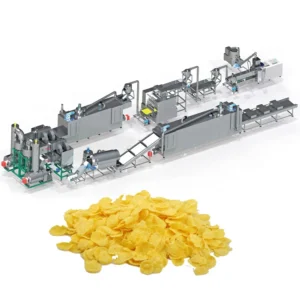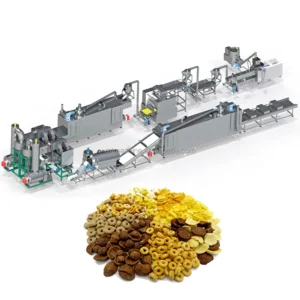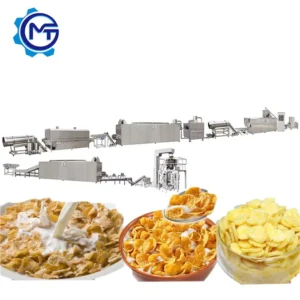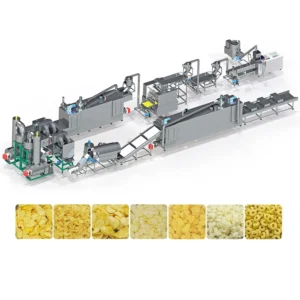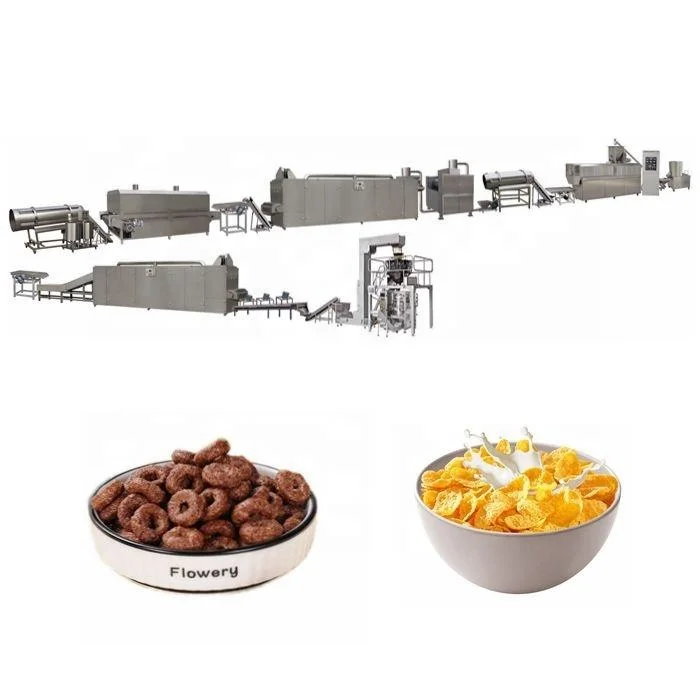
Screw Geometry Tuned to Your Cereal Formula — MT-75 Twin Screw Extruder configurations are mapped against buyer-supplied corn, wheat, oat, and barley blends to set gelatinisation targets before the line ships.
Technical Specifications
| Parameter | Value |
|---|---|
| Model | MT-75 Twin Screw Extruder |
| Product Type | Corn Flakes and Breakfast Cereals Extrusion Production Line |
| Screw Type | Twin-screw |
| Installed Power (MT75) | 210 kW |
| Power Consumption (MT75) | 150 kW |
| Output Capacity (MT75) | 300–500 kg/hr (basis not stated in source — confirm raw material, moisture, and product format) |
| Overall Dimensions (MT75) | 45 × 1.5 × 3.5 m |
| Installed Power (MT85) | 190 kW |
| Power Consumption (MT85) | 140 kW |
| Output Capacity (MT85) | 300–400 kg/hr (basis not stated in source — confirm raw material, moisture, and product format) |
| Overall Dimensions (MT85) | 43 × 1.5 × 3.2 m |
| Installed Power (MT70) | 160 kW |
| Power Consumption (MT70) | 120 kW |
| Output Capacity (MT70) | 150–200 kg/hr (basis not stated in source — confirm raw material, moisture, and product format) |
| Overall Dimensions (MT70) | 41 × 1.5 × 2.2 m |
| Control System | PLC and MCC |
| Flaking Machinery | Hydraulic double-roller system, separate roller motors, infrared sensor temperature control |
| Dryer Heating Source | Gas or Electric |
| Roasting Oven | Hot air roasting, vibrating pan, two circulating fans, cyclone dust removal |
| Coating System | Double tumble sugar melting, elevator, coating drum, spraying nozzle |
| Lubrication | Automatic lubricating and cooling function |
| Line Sequence (Natural) | Mixing → Extruding → Flaking → Drying → Hot Air Roasting → Cooling → Packing |
| Line Sequence (Sugar Coated) | Mixing → Extruding → Flaking → Drying → Roasting → Sugar Spraying → Coating → Drying → Cooling → Packing |
| Die Shapes Available | Ball, tube, stick, ring, fruit loop, star, wheel, flower, heart |
| Accepted Raw Materials | Corn, rice, wheat, oat, barley powder |
| Standards | CE, ISO |
Application Suitability
| Application | Material or Output |
|---|---|
| Natural corn flake production | Corn grits and corn flour blends, toasted for milk-bowl crispness |
| Sugar-coated breakfast cereals | Extruded corn or multi-grain pellets passed through sugar spray and tumble coating |
| Shaped cereal formats | Rings, loops, stars, and wheels from corn, rice, or oat-based dough via interchangeable dies |
| Multi-grain flake lines | Blends of wheat, barley, oat, and rice requiring screw profile adjustment per grain ratio |
| High-fibre cereal runs | Bran-enriched or wholegrain formulations demanding higher shear and adjusted moisture windows |
What the Nameplate Capacity Ignores About Corn Flake Extrusion
A rated throughput figure means nothing until it is tested against your specific cereal blend at your target moisture.
I spent a week troubleshooting a line in Scandinavia where the extruder was rated for a certain hourly output on standard corn grits, but the buyer was running a high-fibre wholegrain mix. The corn flakes came out dense, lacked surface blistering, and sank in milk. The problem was never the motor size — it was that the screw elements and barrel temperature zones were configured for a completely different starch behaviour. When processors evaluate corn flakes extrusion technology twin screw systems, the first question should not be about the plate rating but about what the machine actually produces on their recipe [NEED_CITE: cereal starch gelatinisation behaviour across grain varieties].
How Screw Element Sequencing Controls Flake Density
The twin-screw configuration allows operators to rearrange conveying, kneading, and reverse elements along the shaft to match how a particular cereal blend responds to shear and heat. A high-corn formula gelatinises differently from an oat-heavy blend, and the screw profile must account for that variation to maintain uniform expansion. Die geometry then determines the pellet shape and wall thickness before the flaking rollers compress it into the final sheet. Getting this sequence wrong produces corn flakes that either shatter during roasting or remain too dense to achieve the expected crunch.
Barrel Temperature Zones and Moisture Management
Each barrel section on the MT-75 can be independently heated and cooled, which is critical because starch gelatinisation in corn flakes extrusion technology twin screw processing occurs within a narrow temperature and moisture window. Too little heat in the early zones and the starch remains raw, resulting in a floury texture; too much heat and the dough skins over before reaching the die, trapping moisture that causes uneven blistering later. Operators set preconditioning moisture before the feed inlet and then fine-tune barrel zones to hold the dough at the correct consistency through the final metering section [NEED_CITE: barrel temperature profiling for cereal extrusion lines].
Reading the Spec Sheet for Production Reality
The installed power figures across the MT70, MT75, and MT85 variants — ranging from 160 kW to 210 kW — reflect the mechanical energy available for shear and conveying, but actual power consumption sits noticeably lower at 120 kW to 150 kW under normal running conditions. The overall line footprint spans 41 to 45 metres in length, which tells a buyer that space planning must account for the full sequence from mixing through cooling, not just the extruder itself. The hydraulic double-roller flaking station with infrared temperature monitoring ensures that sheet thickness entering the roasting oven stays consistent, because even slight variation at that stage translates to uneven blistering and colour across the final corn flake batch.
The Hidden Cost of Generic Screw Configurations
When a line ships with a screw build copied from a standard reference rather than matched to the buyer’s raw material, the consequences surface during commissioning. Flakes may fail to achieve the target expansion, forcing the operator to slow the line and run below nameplate output. The roasting oven then receives a product with incorrect moisture content, creating a bottleneck that backs up through the dryer. I have watched entire startup weeks get consumed by reconfiguring screw elements that should have been specified correctly before the machine left the factory [NEED_CITE: extrusion commissioning delays from mismatched screw profiles].
Why This Line Is Configured Before It Ships
Every screw and die combination is documented against the buyer’s raw material formula and target flake specification. The in-house testing workshop runs trial production on customer-supplied cereal blends before dispatch, generating a report that covers expansion ratio, pellet density, and flake thickness. Line layout and capacity calculations match throughput across every station — mixing, extruding, flaking, drying, roasting, and packing — so no single stage bottlenecks another. Electrical schematics confirm voltage, frequency, and control language for the installation site before the panels are wired. The PLC and MCC control architecture allows recipe storage so operators can switch between natural corn flake and sugar-coated runs without manual recalibration of every parameter.
Documentation & Verification
- Screw and die configuration record matched to your cereal blend and target flake density
- Trial run report from in-house testing on your raw material before dispatch
- Line layout and throughput calculation covering every station from mixer to packer
- Electrical schematic with voltage and frequency confirmed for your installation site
- CE declaration of conformity and ISO certificate for import compliance
- Operation and maintenance manual with wear parts list for screw elements and dies
Installation, Commissioning & Support
- Foundation plan accounts for the 45-metre line length and vibrating pan loads at the roasting oven
- Dedicated electrical circuit sized for the MT-75 installed power of 210 kW with confirmed voltage and frequency
- Extruder and flaking station arrive modular; barrel sections and roller assemblies bolt together on-site
- First-run commissioning includes barrel zone tuning and die swap trials across your target cereal shapes
- Operator training covers PLC recipe management for switching between natural and sugar-coated formats
- Wear parts list identifies screw elements, die plates, and roller surfaces with reorder intervals
What to Include in Your Enquiry
To size the line and configure the screw profile accurately, share the cereal blend ratios you plan to run, the target flake thickness and density, and your daily production volume. Confirm the voltage and frequency at your facility, the available floor space and ceiling height, and whether you need the sugar coating station included. If you can send a sample of your raw material, the testing workshop can run trials and include the results with the proposal.
Frequently Asked Questions
Q: How are screw elements and die geometry chosen for a specific corn flake recipe?
A: The screw sequence — conveying, kneading, and reverse elements — is arranged based on your cereal blend’s starch behaviour and target expansion ratio. Die geometry is then matched to the pellet shape and wall thickness required before flaking. Each configuration is recorded and tested on your raw material in the workshop before the extruder ships.
Q: What moisture and temperature conditions are needed for proper starch gelatinisation?
A: Preconditioning moisture is set before the feed inlet, and individual barrel zones are then adjusted to hold the dough within a narrow temperature band where starch fully gelatinises without skinning over. The exact range depends on your grain blend — corn-dominant formulas behave differently from oat or wheat-heavy mixes.
Q: How is extruder output verified against the actual raw material?
A: Before shipment, the testing workshop runs the extruder on your supplied cereal blend and documents actual throughput, expansion ratio, and flake density in a trial report. This confirms whether the line holds its rated capacity on your specific formula rather than relying on generic nameplate figures.
Q: How does the flaking-to-roasting sequence affect surface blistering?
A: The hydraulic double-roller flaking station compresses extruded pellets to a target sheet thickness under infrared-monitored temperature. Consistent thickness entering the hot air roasting oven is what produces even surface blistering and final crispness — variation at the flaking stage causes irregular colour and texture in the finished corn flake.
Q: What does the pre-shipment trial run report cover?
A: The report documents screw configuration, die selection, barrel temperature settings, moisture levels, expansion ratio, pellet density, and flake thickness achieved on your raw material. It serves as the baseline reference when your operators begin production after installation and commissioning.