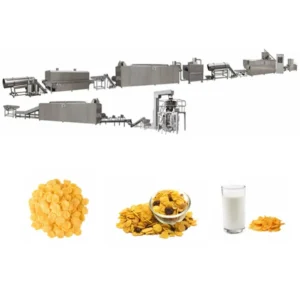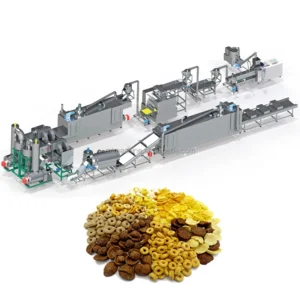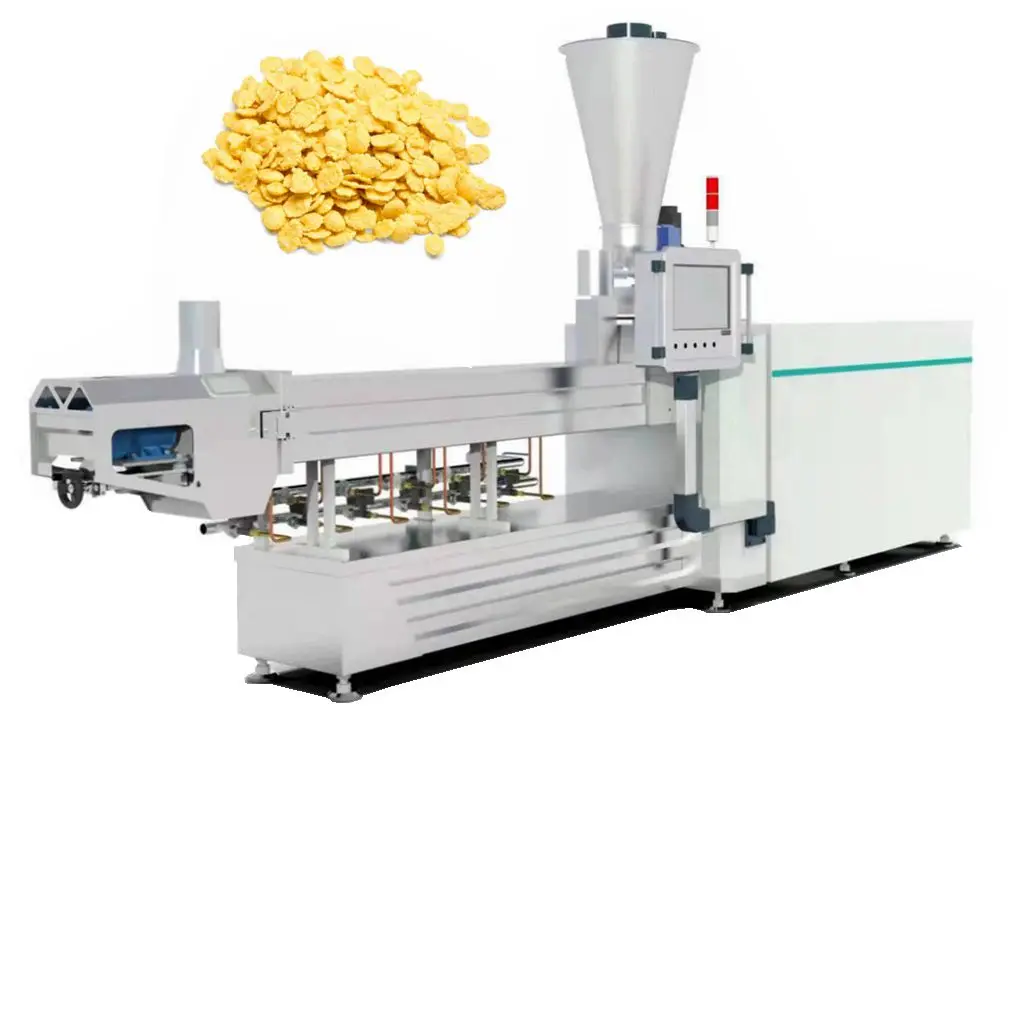
Engineered Screw Geometry — Every barrel section and screw element on this corn flakes extrusion technology production line is selected after trial runs on the buyer’s actual cereal formulation, preventing density collapse when switching from refined corn grits to high-fibre whole-grain blends.
Technical Specifications
| Parameter | Value |
|---|---|
| Product Type | Corn Flakes Breakfast Cereal Production Line (Twin-Screw Extrusion) |
| Line Stations | Mixing, Extruding, Flaking, Drying, Hot Air Roasting, Sugar Coating (optional), Cooling, Packing |
| Extruder Type | Twin-Screw |
| Models Available | MT70, MT85, MT75 |
| MT70 Installed Power | 160 kW |
| MT70 Power Consumption | 120 kW |
| MT70 Output Capacity | 150–200 kg/h (basis not stated in source — confirm raw material formulation and moisture content) |
| MT70 Overall Dimensions | 41 × 1.5 × 2.2 m |
| MT85 Installed Power | 190 kW |
| MT85 Power Consumption | 140 kW |
| MT85 Output Capacity | 300–400 kg/h (basis not stated in source — confirm raw material formulation and moisture content) |
| MT85 Overall Dimensions | 43 × 1.5 × 3.2 m |
| MT75 Installed Power | 210 kW |
| MT75 Power Consumption | 150 kW |
| MT75 Output Capacity | 300–500 kg/h (basis not stated in source — confirm raw material formulation and moisture content) |
| MT75 Overall Dimensions | 45 × 1.5 × 3.5 m |
| Flaking Machinery Control | PLC with hydraulic double rollers, infrared temperature sensing |
| Dryer Heating Source | Gas or Electric (configurable) |
| Hot Air Roasting Oven | Vibrating pan, dual circulating fans, cyclone dust removal, conciliation burner |
| Coating System | Double tumble sugar melting, elevator, coating drum, spraying nozzle |
| Raw Materials | Corn, rice, wheat, oat, barley powder |
| Control System | PLC |
| Assembly State | Complete turnkey line |
| Certifications | CE, ISO |
Application Suitability
| Application | Material or Output |
|---|---|
| Natural corn flakes production | Degerminated corn grits, controlled moisture feed |
| Sugar-coated corn flakes | Extruded corn pellets with sugar syrup glazing |
| Multi-grain breakfast cereals | Blends of corn, wheat, oat, and barley powder |
| Fortified breakfast cereals | Cereal base with added vitamin and mineral premix |
| Shaped cereal variants | Rings, stars, fruit loops, balls, tubes via die adjustment |
| Puffed cereal snacks | Rice and corn blends for direct-expanded formats |
What Your Raw Material Formulation Decides Before the Extruder Starts
Screw configuration must follow the recipe, not the other way around.
I spent weeks in a Saudi Arabian plant watching an otherwise capable corn flakes extrusion technology production line choke on a whole-grain formula. The supplier had configured the screws for refined corn grits — low fibre, predictable gelatinisation. When the buyer ran a high-fibre blend, shear dropped, expansion collapsed, and flake thickness swung wildly across the batch. The problem was not the machine. It was a screw profile that had never seen the actual raw material [NEED_CITE: twin-screw extrusion behaviour on high-fibre cereal formulations].
A process engineer reviewing this line should focus on whether the screw element arrangement — conveying, kneading, and reverse sections — has been matched to the specific starch source and moisture window. Without that match, no amount of barrel temperature adjustment will recover consistent density.
Barrel Temperature Profiling and Starch Gelatinisation
Corn starch gelatinises within a narrow temperature band, and the barrel zones must hold that band across varying throughput rates. This line uses independent heating zones along the barrel, allowing the operator to set a gradient that starts with gentle hydration in the feed section and builds toward full gelatinisation before the die. When the profile is correct, the extrudate exits with uniform internal moisture — a prerequisite for consistent flake density downstream. The corn flakes extrusion technology production line relies on this thermal precision because any under-gelatinised core will resist flattening at the flaking rolls.
Die Geometry and Its Role in Expansion Control
The die plate determines more than shape. Land length, orifice diameter, and flow channel design together govern the pressure drop at exit, which directly controls the expansion ratio of the extrudate. A short land on a high-moisture formula causes over-expansion and fragile pellets that shatter at the flaker. A long land on a dry formulation restricts flow and raises motor load. Each die on this line is specified to the target cereal format — whether flat flakes, rings, or fruit loops — so that the expansion window stays within tolerance [NEED_CITE: die land length effects on extrudate expansion in cereal processing].
Reading the Power and Capacity Data Across Models
The MT70 draws 120 kW in operation and occupies roughly 41 metres of line length, making it suitable for pilot-scale or mid-volume cereal plants. The MT85 moves to 140 kW consumption and stretches to 43 metres, reflecting the longer dryer and roasting sections needed at higher throughput. The MT75, at 150 kW and 45 metres, extends further into continuous production territory. Installed power figures run higher than consumption because motor start-up peaks and heating element ramp-up draw additional current. When sizing electrical infrastructure, use the installed power value for breaker and cable calculations, and the consumption figure for operating cost estimates. Output capacity values across all three models carry a note: basis not stated in source — confirm raw material formulation and moisture content. This is deliberate. A line running degerminated corn grits at 14% moisture will deliver different throughput than one running a whole-wheat blend at 18% moisture, and no single number covers both.
The Cost of Skipping the Trial Run
Buyers who approve a generic screw build and skip pre-shipment trials often discover formulation mismatches after installation. The extruder may run, but expansion ratios drift, flake thickness varies, and the roasting oven cannot compensate for density inconsistency upstream. In my experience across Middle Eastern installations, the lines that failed early almost always trace back to a configuration that was never tested against the buyer’s specific cereal blend [NEED_CITE: pre-shipment trial run impact on commissioning time for extrusion lines]. Reworking screw elements on-site costs production days and wastes raw material in volumes that add up quickly.
Why Sourcing This Line Here Makes Sense for Process Engineers
Screw element configuration and die design on this corn flakes extrusion technology production line are not pulled from a catalogue default. They are specified after reviewing the buyer’s raw material data sheet and confirmed through in-house trial runs before the equipment leaves the factory. Every station — from the mixer through the flaker, dryer, and hot air roasting oven — is throughput-matched so that no single unit bottlenecks the line at rated output. The testing workshop runs the buyer’s actual formulation, generating a trial report that documents expansion ratio, flake density, and texture before shipment. PLC control across the flaking machinery and roasting oven provides repeatable parameter storage for each product variant [NEED_CITE: PLC parameter storage benefits in multi-SKU cereal production]. The hot air roasting oven uses dual circulating fans and a conciliation burner for even surface blistering, which is where final crispness and bowl-life are decided.
Documentation & Verification
- Screw and die configuration record matched to your cereal formulation
- Trial run report on buyer-supplied raw material before dispatch
- Line capacity calculation across all stations with formulation assumptions stated
- Electrical schematic with voltage and frequency confirmed for destination market
- CE declaration of conformity and ISO certificate included in shipment package
Installation, Commissioning & Support
- Foundation must accommodate line lengths up to 45 m for the MT75 configuration
- Dedicated electrical circuit sized to 210 kW installed power for MT75 start-up peaks
- Flaking machinery hydraulic system requires initial pressure calibration on-site
- Hot air roasting oven burner tuned to local gas composition during commissioning
- PLC parameter library loaded with trial run settings as baseline for operator training
- Wear parts list covering screws, dies, and flaker roller surfaces supplied at handover
What to Prepare Before Requesting a Quotation
Send the specific cereal formulation — grain types, fibre content, target moisture at the extruder feed, and any vitamin or mineral premix additions. State the intended product format: flat flakes, sugar-coated flakes, or shaped variants like rings and fruit loops. Provide the local voltage, frequency, and preferred control language for the PLC interface. If the plant has an existing dryer or packing system that this line must integrate with, include its throughput rating so that station matching can be verified before the layout is drawn.
Frequently Asked Questions
Q: How is screw configuration matched to different cereal raw materials?
A: The screw element arrangement — conveying, kneading, and reverse sections — is selected based on the starch source, fibre content, and moisture level of your formulation. Trial runs in the testing workshop confirm whether the chosen configuration achieves target expansion and gelatinisation before the extruder ships.
Q: What extrusion parameters control flake density and final crispness?
A: Barrel temperature profile, screw speed, moisture at feed, and die land length together set the expansion ratio of the extrudate. Downstream, flaking roll pressure and hot air roasting temperature determine final density and surface blistering, which directly affect bowl-life and crunch.
Q: How does barrel temperature affect starch gelatinisation?
A: Each barrel zone is independently heated, allowing a gradient from hydration in the feed section through full gelatinisation near the die. If the profile is too cool, starch remains partially raw and resists flattening at the flaker. Too hot, and the extrudate over-expands and becomes fragile.
Q: How is throughput matched between extruder, flaker, dryer, and roasting oven?
A: Each station is sized so that its maximum handling capacity aligns with the extruder output at the confirmed formulation. The line capacity calculation documents these values station by station, preventing scenarios where the flaker or dryer creates a bottleneck during continuous operation.
Q: Can the die be changed to produce different cereal shapes?
A: Yes. The extruder accepts interchangeable die plates configured for flat flake pellets, rings, stars, fruit loops, balls, and tubes. Each die is matched to the formulation so that expansion at exit remains within tolerance regardless of the shape being produced.