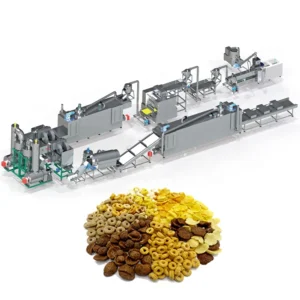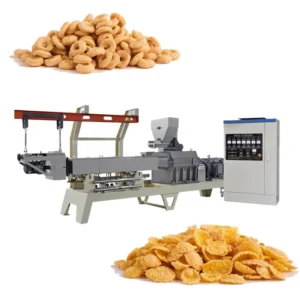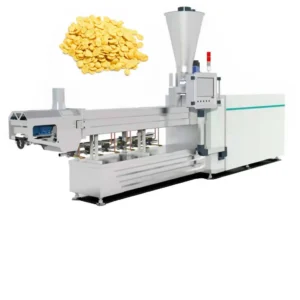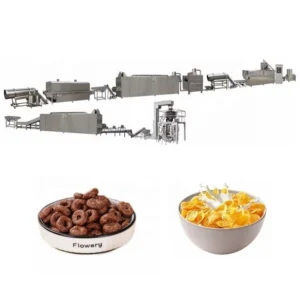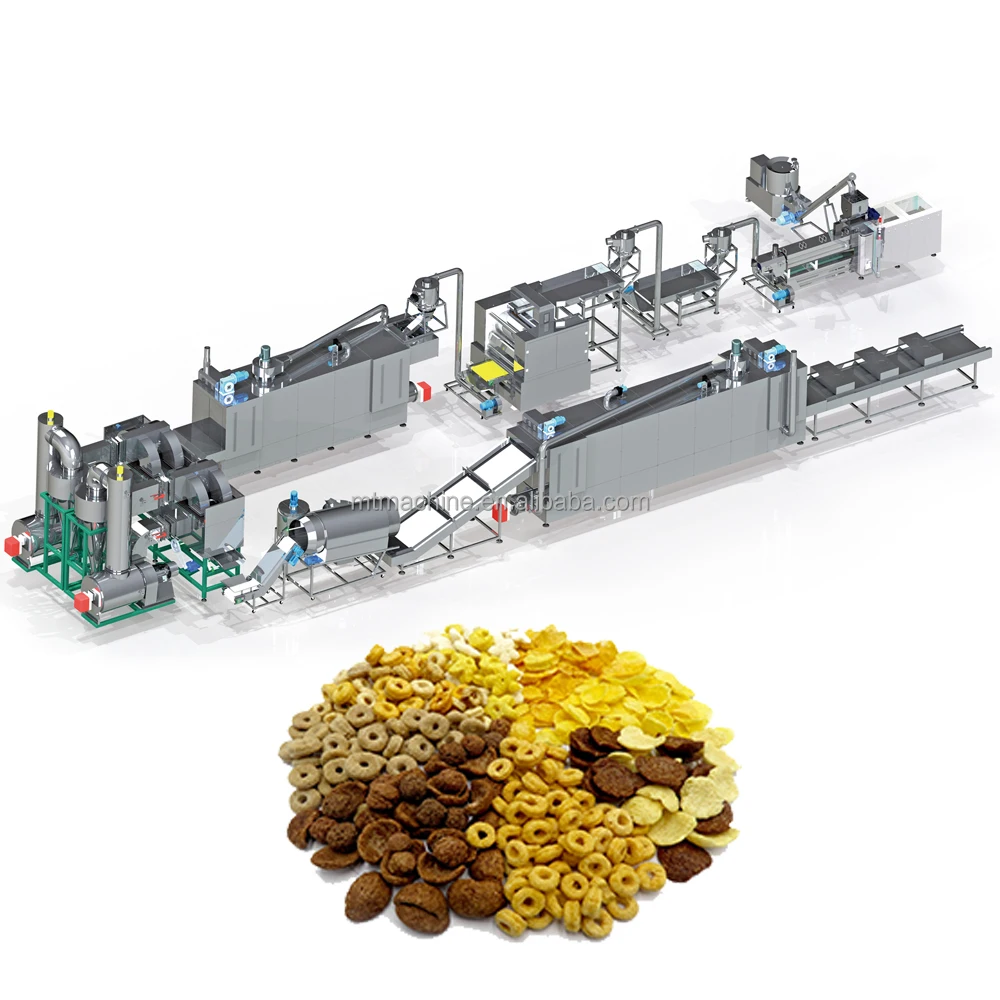
Precision Extrusion Profiling — screw configuration and die geometry are mapped to your cereal formulation and target flake density before the MT75 line is built.
Technical Specifications
| Parameter | Value |
|---|---|
| Model | MT75 (also available: MT70, MT85) |
| Product Type | Corn Flakes Production Line |
| Screw Type | Twin-screw |
| Installed Power (MT75) | 210 kW |
| Power Consumption (MT75) | 150 kW |
| Output Capacity (MT75) | 300–500 kg/h (basis not stated in source — confirm raw material type and moisture content) |
| Overall Dimensions (MT75) | 45 × 1.5 × 3.5 m |
| Control System | PLC (flaking machinery); MCC and PLC available on extruder line |
| Flaking Machinery Features | Hydraulic double-roller system; double motors for separate roller driving; infrared sensor for temperature pipe control |
| Dryer Heating Source | Gas or Electric |
| Roasting Oven | Hot-air roasting with conciliation burner; two separate circulating fans; cyclone dust removal; vibrating pan with high-temperature spraying tubes |
| Coating System | Double tumble for sugar melting; elevator; coating drum; spraying nozzle |
| Line Stations (Natural Corn Flakes) | Mixing → Extruding → Flaking → Drying → Hot Air Roasting → Cooling → Packing |
| Line Stations (Sugar-Coated) | Mixing → Extruding → Flaking → Drying → Hot Air Roasting → Sugar Spraying → Sugar Coating → Drying → Cooling → Packing |
| Voltage & Frequency | Customized to local supply, confirmed before production |
| Assembly State | Complete turnkey line |
| Standards | CE, ISO |
Application Suitability
| Application | Material or Output |
|---|---|
| Natural corn flakes production | De-germed corn grits, corn flour |
| Sugar-coated corn flakes | Corn base with sugar syrup coating |
| Multi-shape breakfast cereals | Corn, rice, wheat, oat, barley powder (rings, balls, stars, tubes, sticks, fruit loops) |
| Fortified breakfast cereals | Cereal blends with added vitamin and mineral premix |
What "Nominal Capacity" Hides from Cereal Buyers
A quoted throughput figure means nothing until it is validated against your specific raw material and moisture target.
I once spent two weeks on a factory floor because the corn flakes line ran perfectly on standard corn flour during the supplier’s trial but fell apart on de-germed corn grits at higher moisture — every flake shattered on the cooling belt. The extruder barrel temperature profile that worked in the showroom was completely wrong for that formulation. This is the gap between a corn flakes extrusion production line turnkey that performs on paper and one that delivers consistent bowl-life in your market. [NEED_CITE: starch gelatinisation behaviour across different cereal particle sizes]
How Barrel Zones Shape the Flake
A corn flakes extrusion production line turnkey depends on getting starch gelatinisation right inside the barrel before the dough ever reaches the flaking rollers. The twin-screw configuration allows independent control over shear, residence time and moisture distribution across multiple heating zones. Each zone is tuned to the gelatinisation window of the cereal blend you are running — corn requires a different thermal profile than an oat or wheat-heavy mix. Get this stage wrong and the dough sheet will tear or stick during flaking, producing uneven thickness and weak flakes that disintegrate in milk.
Die Design and the Density Question
Die geometry determines the shape and initial density of the extruded pellet before it enters the flaking station. For corn flakes, a flat die produces the classic thin sheet; switching to ring, ball or star dies lets the same extrusion platform cover multiple breakfast cereal formats. The die land length and opening diameter control how much the dough expands as it exits — too much expansion means a porous flake with poor crunch, too little means a hard pellet the rollers cannot flatten uniformly. [NEED_CITE: die land length influence on extrudate expansion ratio]
Reading the Specs That Matter for Flake Quality
The MT75’s 210 kW installed power and twin-screw configuration provide the mechanical energy needed to fully gelatinise high-starch cereal doughs at production scale. The hydraulic double-roller flaking system with separate motors for each roller ensures even pressure distribution — critical when flake thickness tolerance directly affects roasting uniformity and final crispness. Infrared temperature sensing on the flaking rollers prevents dough sticking and maintains consistent sheet release. The hot-air roasting oven with conciliation burner and dual circulating fans controls surface blistering independently from core moisture, which is where many lines fail — they over-dry the flake trying to achieve surface colour, sacrificing bowl-life. The PLC control on the flaking machinery and available MCC and PLC on the extruder line maintain batch-to-batch repeatability that manual adjustment cannot hold across long production runs.
The Real Cost of Skipping the Trial Run
When a line ships without a documented trial on your actual raw material, the screw and die configuration is typically a generic build copied from a previous project. The result is not a minor adjustment at commissioning — it is weeks of reformulating, re-profiling barrel temperatures and replacing screws while production stands still. Flakes that sink instead of float, coatings that clump because the surface porosity is wrong, or cereal that turns to mush within seconds of hitting milk all trace back to extrusion parameters that were never matched to the formulation in question. [NEED_CITE: commissioning delays caused by unverified screw configurations]
Why Source This Line from Meiteng
Screw configuration and die design are specified to the buyer’s raw material and target product — not copied from a catalogue. The in-house testing workshop runs your actual cereal formulation before shipment, generating a documented trial report on flake density, texture and roasting behaviour. Complete line stations from mixing through extrusion, flaking, drying, roasting, coating and cooling are throughput-matched so no single station bottlenecks the output. Voltage, frequency and control language are confirmed and documented before production begins, eliminating the commissioning delays that arise from assumptions. Pre-sales consultation carries through to on-site installation, operator training and ongoing wear parts supply.
Documentation & Verification
- Line layout and capacity calculation showing throughput matched across every station
- Screw and die configuration record documenting the build matched to your cereal blend
- Trial run report on your raw material verifying flake density and texture before dispatch
- Electrical schematic with voltage, frequency and control language confirmed in writing
- CE declaration of conformity and ISO certificate included with shipment documentation
- Operation and maintenance manual with wear parts list and replacement intervals
Installation, Commissioning & Support
- Foundation planning based on 45 m line length and station-specific load requirements
- Dedicated power circuit sized for 210 kW installed capacity at your confirmed voltage
- Extruder, flaking rollers and roasting oven arrive as matched modules for sequenced assembly
- First-run parameter setting on your raw material with barrel zone temperatures documented
- Operator training covering die changeover, roller gap adjustment and PLC navigation
- Wear parts list for screws, dies and roller surfaces with initial spare set recommended
- Preventive maintenance schedule aligned to production hours and cereal formulation abrasiveness
What to Include in Your Inquiry
To move from enquiry to line configuration, specify your cereal raw material (corn grits, corn flour, multi-grain blend), target flake type (natural or sugar-coated), and desired output per shift. Confirm your local voltage and frequency, available floor space and ceiling height, and preferred control language. If you plan to produce multiple shapes on the same extrusion platform, list the formats so die tooling is included in the initial build. Request a trial run on your raw material before shipment to validate the configuration against your market specification.
Frequently Asked Questions
Q: How is screw configuration matched to my cereal raw material?
A: The screw elements are selected based on your specific grain blend, particle size and moisture target. Shear intensity, compression ratio and residence time are adjusted zone by zone to achieve the correct gelatinisation degree without over-working the dough, which would produce dense flakes with poor crunch.
Q: How do you verify capacity during the trial run?
A: Your raw material is run through the extruder, flaking rollers and roasting oven in the testing workshop. Output is measured across a sustained run, and flake density, thickness uniformity and bowl-life are checked against your target specification before the configuration is locked in.
Q: What barrel temperature profile is used for different cereals?
A: Corn, wheat and oat blends each have different starch gelatinisation temperatures and moisture absorption rates. The barrel zone profile is set specifically to your formulation — a wheat-heavy mix typically requires lower peak temperatures and longer residence time than a pure corn formulation.
Q: How does the roasting oven control crispness without over-drying?
A: The conciliation burner and dual circulating fans allow independent control of surface temperature and air flow. This creates the characteristic blistered surface and crunch while maintaining enough internal moisture structure to give the flake acceptable bowl-life in milk.
Q: Can the same line produce multiple cereal shapes?
A: Yes. The twin-screw extrusion platform supports die changes to produce rings, balls, stars, tubes and other shapes. Changeover involves swapping the die plate and adjusting cutting parameters — the downstream flaking station is bypassed for direct-cut shapes and routed through flaking for traditional flakes.