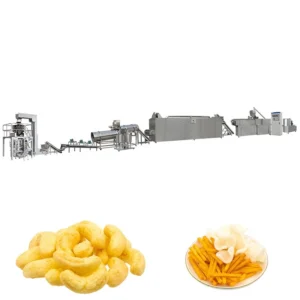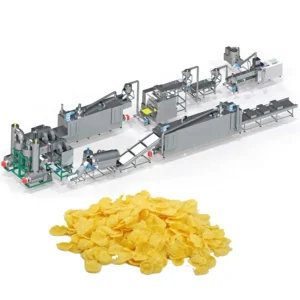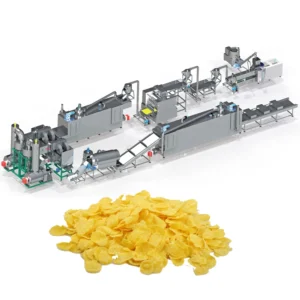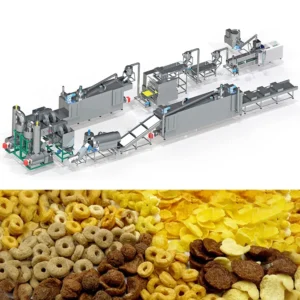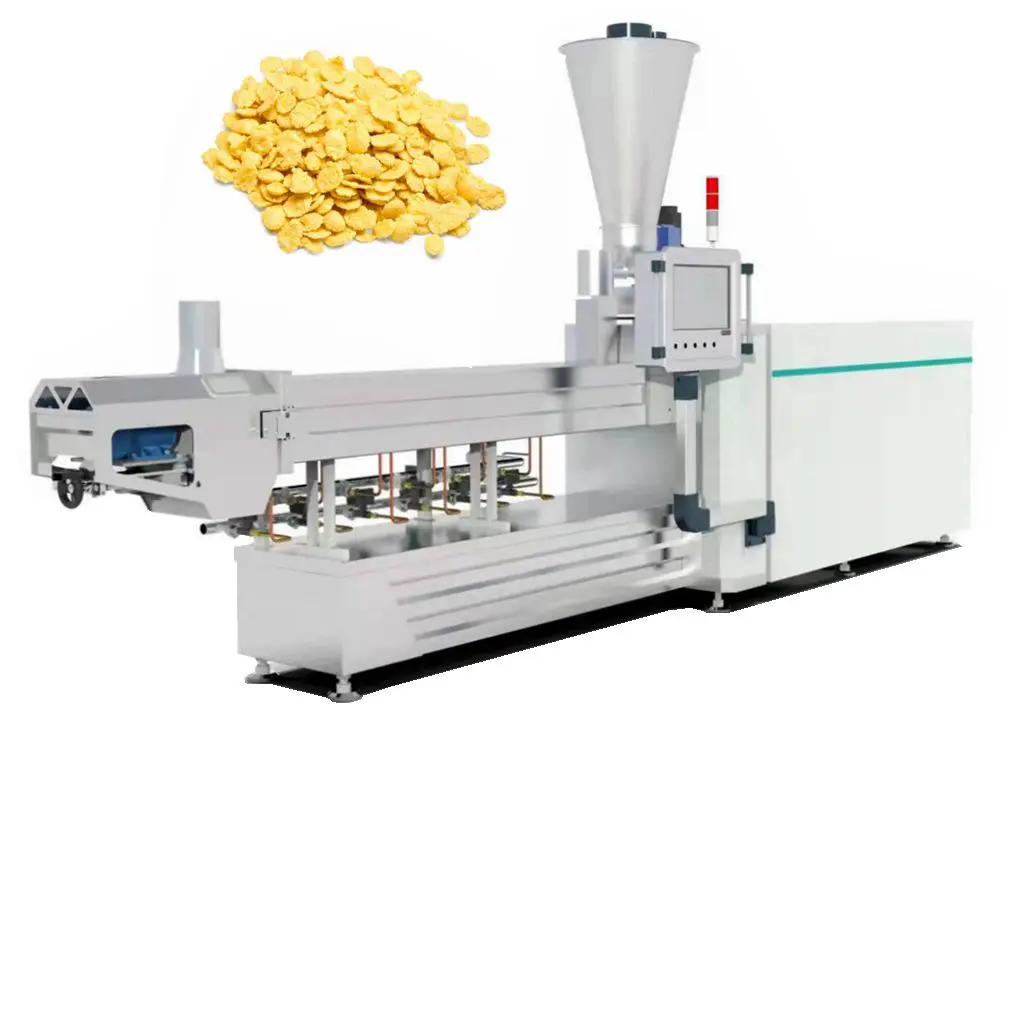
Precision-Matched Barrel Profiles — Each twin-screw extruder’s heating zones and screw configuration are calibrated against the buyer’s specific cereal formulation before the line leaves the factory.
Technical Specifications
| Parameter | Value |
|---|---|
| Product Type | Twin Screw Extruder Production Line for Corn Flakes and Breakfast Cereals |
| Model Options | MT70 / MT85 / MT75 |
| Screw Type | Twin Screw |
| Installed Power (MT70) | 160 kW |
| Installed Power (MT85) | 190 kW |
| Installed Power (MT75) | 210 kW |
| Power Consumption (MT70) | 120 kW |
| Power Consumption (MT85) | 140 kW |
| Power Consumption (MT75) | 150 kW |
| Output Capacity (MT70) | 150–200 kg/h (basis not stated in source) |
| Output Capacity (MT85) | 300–400 kg/h (basis not stated in source) |
| Output Capacity (MT75) | 300–500 kg/h (basis not stated in source) |
| Overall Dimensions (MT70) | 41 × 1.5 × 2.2 m |
| Overall Dimensions (MT85) | 43 × 1.5 × 3.2 m |
| Overall Dimensions (MT75) | 45 × 1.5 × 3.5 m |
| Control System | PLC available |
| Flaking Drive | Double motors, hydraulic system for separate roller driving |
| Flaking Temperature Control | Infrared sensor for even temperature pipe control |
| Dryer Heating Source | Gas or Electric |
| Roasting Oven | Hot air roasting with vibrating pan, cyclone dust removal |
| Key Features | Automatic lubrication and cooling, wear-resistant screw elements, CE and ISO certified |
Application Suitability
| Application | Material or Output |
|---|---|
| Natural Corn Flakes | Corn grits, corn flour |
| Sugar-Coated Corn Flakes | Corn base with sugar syrup coating |
| Multi-Grain Breakfast Cereals | Rice, wheat, oat, barley blends |
| Shaped Cereal Pieces | Ball, tube, ring, fruit loop, star, wheel, flower, heart shapes via die exchange |
When the Raw Material Does Not Match the Machine
A screw profile configured for fine corn flour will fail on coarse grits — and the flakes will either sink or shatter.
The problem surfaces fast on the factory floor. The extruder runs, the dough comes out, but the gelatinisation is incomplete. Flakes crack during pressing, the blister pattern is uneven, and the crunch disappears the moment milk hits the bowl. Process engineers then spend weeks swapping screw elements and adjusting barrel zones while production sits idle [NEED_CITE: common extrusion troubleshooting variables]. The root cause is almost always a configuration that was never matched to the buyer’s actual raw material blend and moisture content.
Barrel Temperature Gradients and Starch Behaviour
The barrel is divided into independent heating zones, each governing a specific phase of starch transformation. Early zones handle hydration and initial gelatinisation, while later zones control melt viscosity and moisture flash-off before the die face. Getting this gradient right determines whether the corn flakes extrusion technology twin screw process yields a dough that sheets cleanly through the flaking rollers or tears and sticks.
Die Geometry and Flake Density Control
Die aperture size and land length interact directly with the flaking roller gap. A wider die orifice paired with a tight roller gap produces thin, dense flakes with long bowl-life crunch. A narrow die with a loose gap yields thicker, more porous flakes that absorb milk faster. The corn flakes extrusion technology twin screw setup must balance these variables against the specific expansion behaviour of the cereal blend being processed [NEED_CITE: die design principles for breakfast cereal extrusion].
Reading the Specs Beyond the Nameplate
Installed power across the MT70, MT85 and MT75 models ranges from 160 kW to 210 kW, but actual consumption during steady-state running is notably lower — between 120 kW and 150 kW. This gap reflects motor sizing for start-up torque and peak load rather than continuous draw. The line length spanning 41 to 45 metres indicates the number of downstream stations: flaking, drying, hot air roasting, sugar coating and cooling are all in-line. The infrared-sensor-controlled flaking rollers maintain even surface temperature, which prevents localised density variation across the flake sheet — a detail that matters when buyers are targeting uniform blister patterns. PLC control allows storage of multiple recipes, so operators can switch between natural and sugar-coated production without manual recalibration of barrel zones.
The Cost of Skipping the Trial Run
Lines shipped without a test run on the buyer’s raw material arrive with generic screw configurations. The consequence is a commissioning period measured in weeks rather than days, with product development starting only after installation. Flakes that sink in milk, inconsistent blister patterns, and coating adhesion failures all trace back to extrusion parameters that were never validated against the actual cereal formulation [NEED_CITE: importance of pre-shipment trial runs in food extrusion].
Why Engineers Specify Lines From This Workshop
Screw configuration and die design are documented against the buyer’s exact raw material formulation, not copied from a standard build. The in-house testing workshop runs trial batches on customer-supplied cereal blends before the line ships, so process parameters are established in advance. Complete lines from mixing through extrusion, flaking, drying, roasting and packing are supplied under one source, meaning throughput is balanced across every station rather than assembled from separate vendors. Barrel zone counts, L:D ratios and screw element breakdowns are recorded and provided as part of the machine specification sheet.
Documentation & Verification
- Screw and die configuration record matched to your cereal formulation
- Trial run report on your raw material conducted before shipment
- Machine specification sheet with barrel zone count and L:D ratio
- Electrical schematic with voltage, frequency and PLC language confirmed
- CE declaration of conformity and ISO certificate for customs clearance
- Wear parts list covering screws, dies and flaking roller components
Installation, Commissioning & Support
- Foundation layout engineered to the MT70/MT85/MT75 overall length of 41–45 metres
- Electrical feed sized to the specific model’s installed power of 160–210 kW
- Line arrives in modular sections for phased assembly within the prepared workshop
- First production run supervised with barrel temperature and screw speed optimisation
- Operator training covers PLC recipe storage for switching between cereal formats
- Spare screw elements and die plates included for the first replacement cycle
Preparing Your Inquiry
To receive a line configuration that matches your production target, share your cereal formulation — whether corn, rice, wheat, oat or a multi-grain blend — along with the particle size and moisture content of your raw material. Specify your target flake shape and whether you need natural or sugar-coated output. Confirm your local voltage and frequency standards, and the available floor space in your facility so the layout can be engineered to fit.
Frequently Asked Questions
Q: How is screw configuration selected for different cereal blends and moisture levels?
A: Each screw element sequence is chosen based on the starch content, particle size and incoming moisture of the buyer’s specific blend. Higher-protein cereals like wheat require different shear profiles than pure corn grits. The configuration is validated during a trial run in the testing workshop before the line ships.
Q: What barrel temperature profile produces the correct blister pattern on corn flakes?
A: The blister pattern forms when residual moisture flashes at the die face and during hot air roasting. Barrel zones are set to achieve target gelatinisation while leaving enough moisture for controlled expansion. Infrared sensors on the flaking rollers then ensure even surface temperature for consistent blistering.
Q: How does die geometry interact with flaking roller gap to control flake density?
A: Die aperture and land length determine the thickness of the extruded dough rope. The flaking roller gap then compresses that rope into the final sheet. Together they set flake density, which directly controls milk absorption rate and crunch duration in the bowl.
Q: Can the line switch between natural and sugar-coated corn flake production?
A: Yes. The sugar coating section — double tumble melting, elevator, coating drum and spraying nozzle — operates as an add-on station after roasting. For natural flakes, product bypasses the coating section and proceeds directly to cooling and packing via PLC recipe selection.