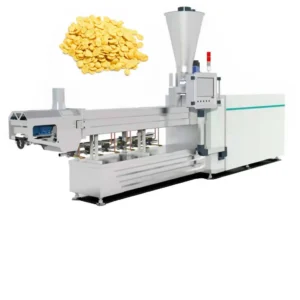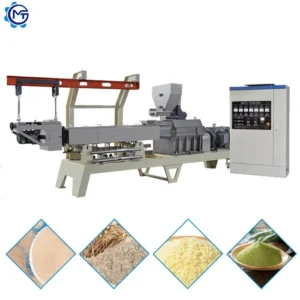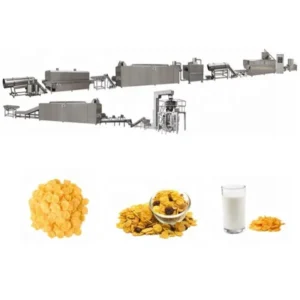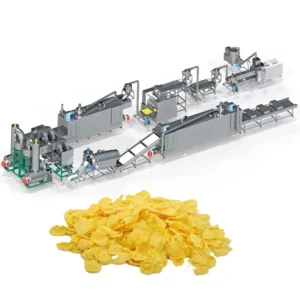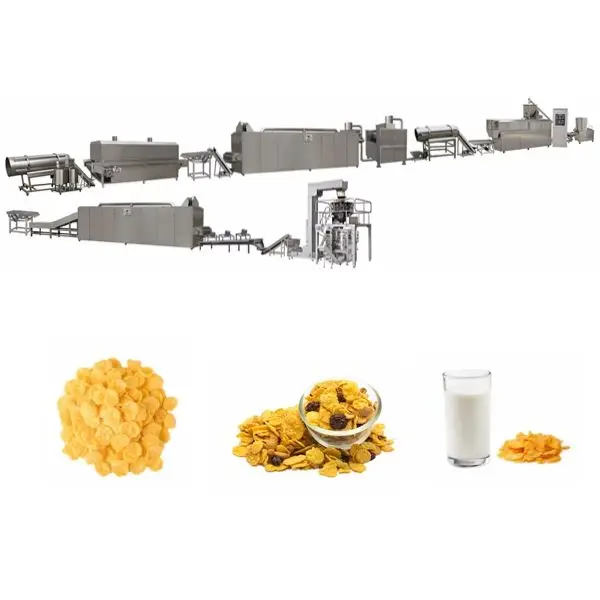
Screw Profile Engineering — Every MT70, MT85, and MT75 barrel zone and die land length is matched to the buyer’s grain blend and target flake density before metal is cut.
Technical Specifications
| Parameter | Value |
|---|---|
| Model | MT70 / MT85 / MT75 |
| Product Type | Corn Flakes Extrusion Production Line |
| Screw Type | Twin Screw |
| Installed Power | MT70 160 kW / MT85 190 kW / MT75 210 kW |
| Power Consumption | MT70 120 kW / MT85 140 kW / MT75 150 kW |
| Output Capacity | MT70 150–200 kg/h, MT85 300–400 kg/h, MT75 300–500 kg/h (basis not stated in source — confirm raw material type, moisture content, and flake thickness before quoting) |
| Overall Dimensions (L×W×H) | MT70 41×1.5×2.2 m / MT85 43×1.5×3.2 m / MT75 45×1.5×3.5 m |
| Extruder Working Principle | Feeding system, extruding system, cutting system, heating system, gearing system, controlling system |
| Screw Feature | Wear-resistant manufacturing, automatic lubricating and cooling function |
| Control System | PLC control on flaking machinery; MCC and PLC available across line |
| Flaking Machinery | Hydraulic double-roller system, independent dual-motor drive, infrared sensor temperature control |
| Dryer Heating Source | Gas or Electric |
| Roasting Oven | Hot air roasting with vibrating pan, high-temperature spraying tubes, conciliation burner, dual circulating fans, cyclone dust removal |
| Coating System | Double tumble for sugar melting, elevator, coating drum, spraying nozzle |
| Line Stations (Natural) | Mixing → Extruding → Flaking → Drying → Hot Air Roasting → Cooling → Packing |
| Line Stations (Sugar Coated) | Mixing → Extruding → Flaking → Drying → Hot Air Roasting → Sugar Spraying → Sugar Coating → Drying → Cooling → Packing |
| Raw Materials | Corn, rice, wheat, oat, barley powder |
| Final Products | Natural corn flakes, sugar-coated corn flakes, multiple shapes via die change |
| Voltage & Frequency | Customized to customer local voltage (value to be confirmed before order) |
| Certification | CE, ISO |
Application Suitability
| Application | Material or Output |
|---|---|
| Natural corn flake production for retail breakfast cereal market | Corn grits and corn flour at controlled moisture |
| Sugar-coated corn flakes for supermarket and food-service channels | Corn base with sugar syrup coating and secondary drying |
| Multi-grain breakfast cereal formats | Blends of rice, wheat, oat, and barley powder |
| Shaped cereal pieces (rings, balls, stars, fruit loops) | Same grain bases with extruder die geometry changes |
| Fortified breakfast cereal lines requiring consistent bowl life | Grain blends with added nutritional premix |
Why Corn Flakes Extrusion Technology Twin Screw Parameters Decide Whether Your Product Sinks or Floats
Bowl life is determined in the first ninety seconds inside the barrel, not at the roasting oven.
A producer I worked with in Southeast Asia ran a trial on standard corn flour and got perfect expansion. When they switched to locally sourced high-moisture cracked corn on-site, the flakes came out dense and sank straight to the bottom of the milk bowl. The screw profile had been configured for a different moisture curve entirely. Corn flakes extrusion technology twin screw systems give you the degrees of freedom to correct this — independently tunable barrel zones, adjustable screw pitch, and die land lengths that together control starch gelatinisation degree and the resulting flake density [NEED_CITE: starch gelatinisation temperature ranges for corn, rice, and wheat substrates]. Guess these values and you ship a line that cannot hold spec on the buyer’s actual raw material.
Barrel Zone Tuning for Grain-Specific Gelatinisation
The twin-screw extruder on this line divides the barrel into independently heated and cooled zones. Each zone targets a different stage of starch modification — hydration in the feed section, shear-driven gelatinisation in the compression zone, and controlled expansion at the die face. Corn requires a different temperature ramp than oat or barley, and the corn flakes extrusion technology twin screw configuration lets the process engineer set that ramp zone by zone rather than relying on a single averaged setpoint.
Die Geometry and the Density Target
Flake density is the single number that determines whether your corn flake stays crisp in milk for three minutes or turns to mush in thirty seconds. The die opening diameter and land length work together with the screw speed and moisture content to set the expansion ratio at the die face. Too much expansion and the flake shatters during roasting; too little and it stays dense. Getting this right requires a screw and die configuration record built around the buyer’s specific grain formulation, not a generic template pulled from a snack extrusion build.
Reading the Specs That Actually Matter for Flaking Downstream
The installed power figures — 160 kW on the MT70, 190 kW on the MT85, 210 kW on the MT75 — tell you how much mechanical and thermal energy is available for shear and gelatinisation inside the barrel. The power consumption numbers, lower across the board, reflect actual running draw once the system reaches steady state. The flaking station downstream uses a hydraulic double-roller system with independent dual-motor drive and infrared temperature monitoring to press the extruded pellets into uniform flakes. If the extruder delivers inconsistent pellets because barrel zones are poorly tuned, the flaking rollers cannot compensate — thickness variation leads directly to uneven roasting and inconsistent bowl life [NEED_CITE: relationship between flake thickness uniformity and roasting consistency in cereal processing].
The Cost of Skipping the Raw Material Trial
I have watched lines get installed and commissioned only to discover during the first production week that the local grain supply behaves nothing like the test material used at the factory. The extruder runs, the flaker presses, but the final product fails density and bowl-life specs. Retrofitting a screw configuration after installation means weeks of downtime, replacement screw elements shipped internationally, and trial-and-error runs burning raw material on the customer’s floor. The corn flakes extrusion technology twin screw setup allows rapid screw element swaps, but doing that under production pressure is a different proposition from getting it right during a pre-shipment trial.
Why This Line Is Configured Differently from a Snack Extruder
Every station on this corn flakes extrusion technology twin screw line is specified around the cereal process rather than borrowed from a puffed snack template. The roasting oven uses a conciliation burner with dual circulating fans and a cyclone dust removal system to create the surface blistering that defines crisp corn flake texture — a thermal profile completely different from a snack dryer. The sugar coating system uses a double tumble melter with a dedicated spraying nozzle and secondary drying stage, sized to match the extruder throughput so coating does not become a bottleneck. Throughput is matched from mixing through packing rather than assembled from independent vendor capacities [NEED_CITE: line throughput balancing principles in multi-stage cereal production].
Documentation & Verification
- Screw and die configuration record matched to your grain blend and target flake density
- Trial run report on your actual raw material confirming expansion, texture, and density before shipment
- Line layout with capacity calculation showing throughput at every station from mixer to packer
- Electrical schematic with voltage and frequency confirmed to your local supply before production starts
- Operation and maintenance manual covering screw element replacement intervals and flaking roller calibration
- CE declaration of conformity and ISO certificate included with shipment documentation
Installation, Commissioning & Support
- Foundation plan accounts for the MT75 line length of up to 45 m with station-by-station utility drops
- Power supply verification against your local voltage and frequency before the MCC panel is wired
- Extruder screw elements and die plates verified against the pre-shipment trial configuration record on arrival
- Flaking roller gap and hydraulic pressure calibrated to your target flake thickness during commissioning
- Roasting oven burner tuned to the temperature profile validated in the factory test
- Wear parts list with reorder codes for screw elements, die plates, and flaking roller surfaces
What to Prepare Before Requesting a Quote
Send a representative sample of the grain or grain blend you plan to run, along with the target flake thickness, final moisture specification, and whether the line will produce natural flakes, sugar-coated variants, or both. Confirm your facility voltage, frequency, and available floor length. If you are replacing an existing extruder, note the current screw configuration and any density or bowl-life issues you are trying to solve so the trial run can target those directly.
Frequently Asked Questions
Q: How is the screw configuration selected for different grain blends and flake densities?
A: The screw element sequence — pitch, kneading block angle, and reverse element placement — is designed around your specific grain formulation and target density. Corn, rice, wheat, oat, and barley each have different starch gelatinisation temperatures and shear sensitivities. The configuration record documents every element position so it can be reproduced or adjusted later.
Q: What trial runs are performed before the line ships?
A: Your raw material is run through the extruder and flaking station in the testing workshop. The trial run report documents expansion ratio, pellet density, flake thickness, and surface texture. If results fall outside your specification, screw elements or die geometry are adjusted and the trial is repeated until the target is met.
Q: How is throughput balanced across all stations on the line?
A: The line layout document calculates throughput at every station — extruder, flaking mill, dryer, roasting oven, coating drum, and cooler — against the stated output capacity. Each station is sized so none becomes a bottleneck that forces upstream equipment to idle or downstream product to accumulate.
Q: What barrel temperature profile works best for corn flake gelatinisation?
A: The profile depends on your grain moisture and blend ratio. Typically, the feed zone holds a lower temperature for hydration, the compression zones ramp through the gelatinisation range, and the metering zone stabilises before the die. Each zone is independently controlled so the profile can be tuned during the trial run.
Q: How are voltage and control language confirmed before production?
A: Your local voltage, frequency, and preferred control language are confirmed during the specification stage, before the MCC and PLC panels are assembled. The electrical schematic reflects these confirmed values so the line powers up correctly on arrival without rewiring or reprogramming delays.