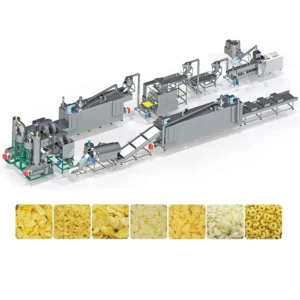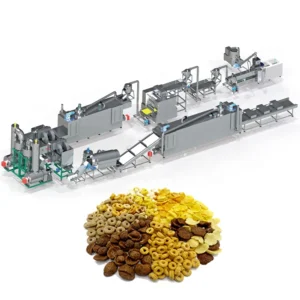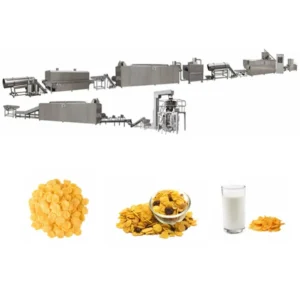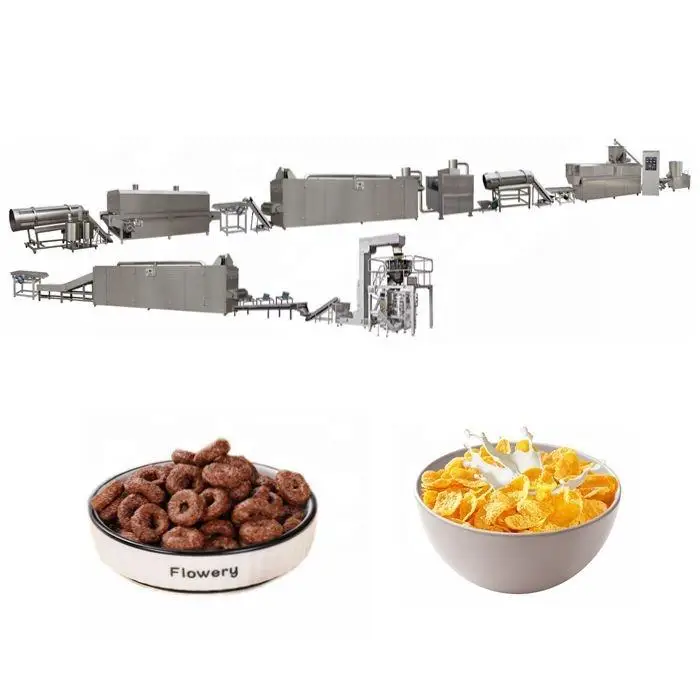
Screw Geometry Dictates Density — Twin-screw corn flake extrusion requires screw elements, barrel zones, and die plates matched to your specific corn blend and moisture level, not a default template carried over from unrelated snack lines.
Technical Specifications
| Parameter | Value |
|---|---|
| Product Type | Corn Flake Production Line / Twin Screw Extruder System |
| Model | MT75 |
| Screw Configuration | Twin Screw |
| Installed Power | 210 kW |
| Power Consumption | 150 kW |
| Output Capacity | 300–500 kg/hr (basis not stated in source — confirm raw material, moisture content, product format) |
| Overall Dimensions | 45 × 1.5 × 3.5 m |
| Control System | MCC and PLC integrated |
| Flaking Unit | Hydraulic double rollers, separate motors, infrared sensor temperature control |
| Dryer Heating Source | Gas or Electric (configurable) |
| Roasting Oven | Hot air roasting, vibrating pan, two circulating fans, cyclone dust removal |
| Coating System | Double tumble sugar melting, elevator, coating drum, spraying nozzle |
| Raw Material Range | Corn, rice, wheat, oat, barley powder |
| Die Shapes Available | Ball, tube, stick, ring, fruit loop, star, wheel, flower, heart |
| Standards | CE, ISO |
Application Suitability
| Application | Material or Output |
|---|---|
| Natural corn flake production for breakfast cereal lines | Degerminated corn grits, corn flour blends |
| Sugar-coated corn flake SKUs requiring base flake porosity control | Corn and rice blends with sugar syrup coating |
| Multi-grain breakfast cereal formats | Wheat, oat, and barley powder combinations |
| Shaped cereal variants on the same extrusion platform | Corn and rice blends using interchangeable die plates |
Why Generic Screw Configurations Ruin Corn Flake Crunch
Corn flakes that sink in milk or turn dense and chewy almost always trace back to a screw and die setup that was never matched to the buyer’s actual raw material.
I remember a line where the customer’s degerminated corn flour had noticeably higher fat content than our trial material. The pellet came out of the extruder looking right, but after flaking and roasting the pieces stayed flat and hard — no blistering, no signature crunch. We spent four days rebuilding the screw element sequence and adjusting barrel temperature zones before we got acceptable output [NEED_CITE: starch gelatinisation behaviour at varying fat content levels in corn blends]. That is what happens when a supplier copies a configuration from a generic snack build and assumes it transfers directly to corn flake production. The twin screw corn flake extruder only delivers consistent expansion when every element — from feed pitch to kneading block angle to die orifice — is specified against your formula.
Mapping Barrel Zones to Starch Gelatinisation
The corn flake extrusion process depends on progressive starch gelatinisation across the barrel length. Each heating zone must be set so that moisture penetrates the corn particle at the right stage — too early and the melt becomes sticky before reaching the die, too late and the pellet exits undercooked with raw centres that collapse during flaking. The PLC control system on this line manages barrel temperature profiles zone by zone, letting process engineers hold specific thermal targets as raw material moisture varies between batches.
Die Geometry and the Blister Pattern on Roasted Flakes
Die orifice diameter and land length determine the pellet’s cross-section and internal structure before it reaches the flaking rollers. A pellet that is too dense will not blister during hot air roasting, producing a flat surface that consumers associate with stale cereal. A pellet that is too expanded will shatter under roller pressure. The die design on the MT75 is selected after trial runs to match the target flake thickness and surface blister pattern that the market expects [NEED_CITE: relationship between extrudate density and surface blistering in flaked cereals].
Reading the Specs That Actually Matter for Cereal Lines
Twin-screw versus single-screw choice determines how well the extruder handles mixed grain formulations — corn blends with oat and barley powder require the self-wiping action and shear control that twin screws provide, while single screws struggle with high-fat or high-fibre recipes. The 210 kW installed power on the MT75 supports the torque demand of dense corn grits at production throughputs, while the separate motor drives on the flaking rollers allow independent speed adjustment to hit target flake thickness. Infrared sensor temperature control on the flaking unit prevents the pellet surface from cooling unevenly between the extruder exit and the roller nip, which would cause thickness variation across the flake width. The hot air roasting oven uses two separate circulating fans and high-temperature spraying tubes to achieve even surface blistering — a single fan setup creates hot and cold zones that produce inconsistent colour and crunch across the batch. Hydraulic pressure on the double rollers must hold steady to maintain flake gauge; any drift sends flakes through the roaster at varying thicknesses, and thinner pieces burn while thicker ones stay doughy.
What Happens When Extruder and Flaker Are Mismatched
An extruder running at full output into a flaking unit that cannot keep pace creates a backlog of cooling pellets. As pellet temperature drops below the threshold for clean deformation, flakes crack at the edges instead of pressing into smooth sheets. Those cracked flakes then break apart in the roasting oven and produce excessive fines in the packing station. This bottleneck is common when buyers source the extruder and flaking machinery from separate vendors without verifying throughput alignment [NEED_CITE: throughput matching between extrusion and flaking stations in cereal production].
Why Buyers Specify This Line for Cereal Projects
Screw configuration and die design are documented against your specific corn blend, moisture level, and target flake density — not carried over from a generic build. The in-house testing workshop runs trial production on your actual raw material before shipment, locking in barrel temperatures and screw element sequences so that commissioning starts from proven parameters. Line layout and capacity calculations show throughput alignment between the extruder, flaker, dryer, and roaster, preventing the station mismatch that causes most start-up failures. Electrical schematics arrive with voltage and frequency confirmed for your facility, and control language set before the panels are wired [NEED_CITE: electrical standards and voltage requirements for industrial food machinery by region]. The CE-certified extrusion platform covers both natural and sugar-coated corn flake production on the same line, with the coating drum and sugar melting system integrated into the station sequence rather than added as an afterthought.
Documentation & Verification
- Screw and die configuration record matched to your corn blend formula and target flake density
- Trial run report on your raw material confirming expansion ratio and flake texture before shipment
- Electrical schematic with voltage, frequency, and control language confirmed for your market
- Line layout showing throughput calculation between extruder, flaking rollers, dryer, and roasting oven
- CE declaration of conformity and ISO certificate with factory test records
Installation, Commissioning & Support
- Foundation planning based on 45 × 1.5 × 3.5 m line footprint with utility connection points mapped
- Power supply verification against 210 kW installed load with dedicated circuit requirements confirmed
- Barrel zone temperature profiles and screw speed parameters loaded from trial run data at first start-up
- Operator training on PLC interface for real-time adjustment of barrel temperatures and roller pressure
- Wear parts list covering screw elements, die plates, and flaking roller surfaces with replacement intervals
- Scheduled maintenance protocol for hydraulic system on flaking unit and circulating fans in roasting oven
Preparing Your Extrusion Line Inquiry
Send your corn blend formulation, target moisture content at the extruder feed, and the flake thickness your market expects. Include your facility voltage and frequency, available floor space, and whether you plan to run sugar-coated SKUs alongside natural flakes. If you have existing upstream milling or downstream packing equipment, share the throughput and interface details so the line layout accounts for those stations.
Frequently Asked Questions
Q: How is screw configuration matched to my specific corn blend and moisture content?
A: We run your raw material through the extruder in our testing workshop, adjusting screw element arrangement and barrel zone temperatures until the pellet density and expansion match your target flake specification. The final configuration is recorded and shipped with the machine.
Q: What barrel temperature profile produces crispy corn flakes versus dense flakes?
A: Crispy flakes require complete starch gelatinisation with controlled expansion at the die. Higher moisture and progressive heating across zones produce lighter, crispier pellets. Dense flakes result from lower barrel temperatures that leave starch partially ungelatinised.
Q: How do you verify flake density and crunch before shipment?
A: During the in-house trial run, we produce flakes from your raw material through the full sequence — extrusion, flaking, drying, and roasting — then measure flake thickness, surface blister pattern, and bowl-life behaviour in milk.
Q: Can the same line produce both natural and sugar-coated corn flakes?
A: Yes. The line includes a sugar melting system, coating drum, and spraying nozzle downstream of the roasting oven. Base flake porosity is controlled during extrusion so that sugar coating adheres evenly without oversaturation.
Q: What starch gelatinisation level is targeted, and how is it controlled?
A: Corn flake production targets near-complete gelatinisation for proper flake structure. This is managed through barrel zone temperatures, screw speed, and moisture addition at the feed stage, all adjustable via the PLC control system.