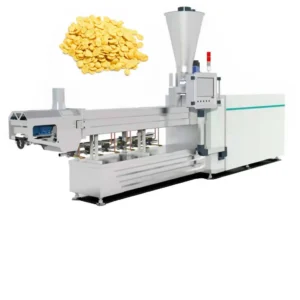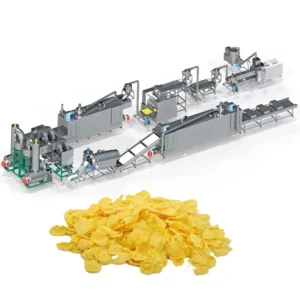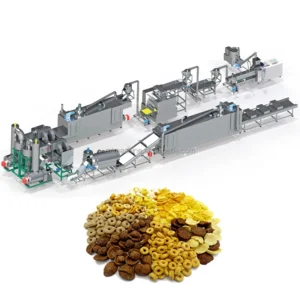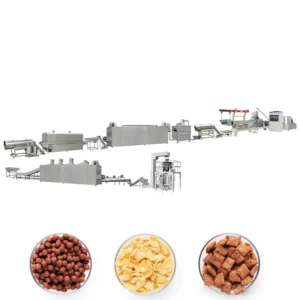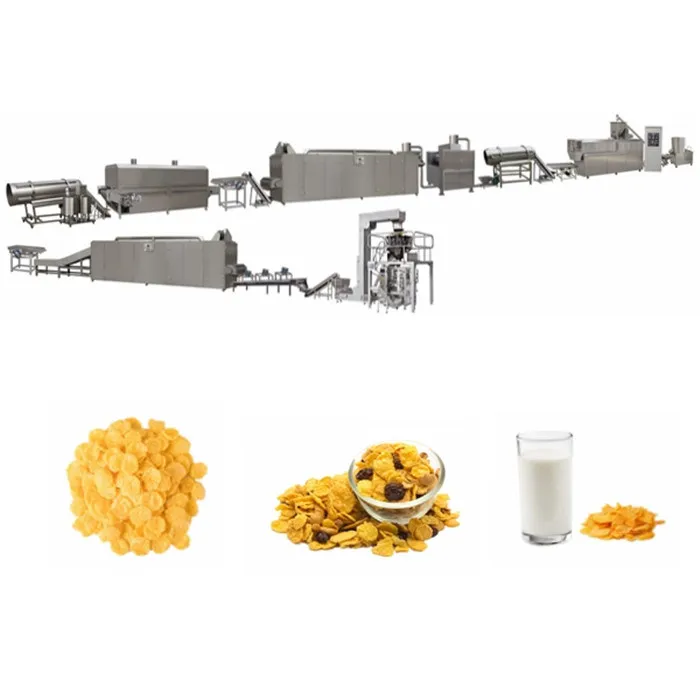
Extrusion Science First — We match screw configuration and barrel temperature profile to your specific cereal raw material before building the line, locking parameters during in-house trial runs so the corn flakes extrusion production line extrusion technology performs on your actual corn, wheat, or oat flour from day one.
Technical Specifications
| Parameter | Value |
|---|---|
| Product Type | Corn Flakes Extrusion Production Line |
| Models Available | MT70, MT85, MT75 |
| Screw Type | Twin Screw |
| Control System | PLC control with MCC integration |
| MT70 Installed Power | 160 kW |
| MT70 Power Consumption | 120 kW |
| MT70 Capacity | 150–200 kg/hr (basis not stated in source — confirm raw material type, moisture content and target flake thickness) |
| MT70 Overall Dimensions | 41 × 1.5 × 2.2 m |
| MT85 Installed Power | 190 kW |
| MT85 Power Consumption | 140 kW |
| MT85 Capacity | 300–400 kg/hr (basis not stated in source — confirm raw material type, moisture content and target flake thickness) |
| MT85 Overall Dimensions | 43 × 1.5 × 3.2 m |
| MT75 Installed Power | 210 kW |
| MT75 Power Consumption | 150 kW |
| MT75 Capacity | 300–500 kg/hr (basis not stated in source — confirm raw material type, moisture content and target flake thickness) |
| MT75 Overall Dimensions | 45 × 1.5 × 3.5 m |
| Flaking Machinery | Hydraulic double-roller system with separate dual-motor drive and infrared temperature monitoring |
| Dryer Heating Source | Gas or Electric (configurable) |
| Roasting Oven | Hot air roasting with vibrating pan, high-temperature spraying tubes, conciliation burner, dual circulating fans, cyclone dust removal |
| Coating System | Double tumble sugar melting, elevator, coating drum, spraying nozzle |
| Die Configuration | Adjustable mould for ball, tube, stick, ring, fruit loop, star, wheel, flower, heart shapes |
| Screw Feature | Automatic lubricating and cooling function; wear-resistant technology |
| Basic Raw Materials | Corn, rice, wheat, oat, barley powder |
| Assembly State | Complete production line from mixing to packing |
Application Suitability
| Application | Material or Output |
|---|---|
| Natural corn flakes production | Corn grits and corn flour at controlled moisture |
| Sugar-coated breakfast cereals | Corn base with syrup coating through double tumble system |
| Shaped extruded cereal formats | Rice, wheat, oat, and barley blends through adjustable die |
| Multi-grain breakfast cereals | Mixed grain powders requiring screw reconfiguration |
| Puffed cereal snacks | Corn and rice blends expanded through twin-screw shear and heat |
What "Rated Capacity" Hides About Your Corn Flakes
A number without a raw material specification is not a capacity — it is a guess.
I spent years on workshop floors watching extruders rated at a certain throughput choke on actual production material. The corn flakes extrusion production line extrusion technology behaves entirely differently when your local corn flour carries higher moisture than the factory test sample. Starch gelatinisation shifts, expansion ratios drop, and the flakes that leave the roaster come out dense and brittle instead of crisp and blistered. A line that runs flawlessly on one grain profile can waste hundreds of kilograms of material before the operator realises the barrel temperature zones need recalibrating [NEED_CITE: starch gelatinisation behaviour under varying moisture and shear conditions in twin-screw extrusion].
How Barrel Temperature Zones Shape the Flake Before It Ever Reaches the Roller
The extrusion stage determines everything that happens downstream. Each barrel temperature zone along the twin-screw extruder controls a different phase of starch gelatinisation — initial hydration, shear-induced cooking, and final expansion at the die face. When these zones are set generically rather than matched to your specific corn variety and moisture content, the extrudate arrives at the flaking station with inconsistent internal structure. Some pellets will be over-gelatinised and sticky; others will be under-cooked and crumble under roller pressure. Getting this right is the core of the corn flakes extrusion production line extrusion technology, because no amount of adjustment at the flaking or roasting stage can fix poor gelatinisation.
Moisture, Shear, and the Die Geometry That Defines Flake Behaviour
Water or steam injection during extrusion is not a fixed setting — it shifts depending on whether your base material is corn, wheat, oat, or a blend. Higher protein grains like wheat demand different moisture profiles and screw element arrangements than pure corn grits. The die opening geometry then governs how the cooked dough expands as it exits the barrel, which directly affects the thickness and density of the piece before it enters the flaking rollers. Our engineers build screw configuration records specific to each buyer’s raw material, documenting element arrangement, pitch, and kneading block positions so that batch consistency is repeatable across production runs [NEED_CITE: die geometry and expansion ratio relationships in cereal extrusion].
Reading the Specifications That Actually Matter
The twin-screw design across the MT70, MT85, and MT75 models provides the shear and residence time needed for thorough starch cooking in cereal applications. Single-screw extruders struggle with the moisture levels and ingredient variability typical of breakfast cereal formulations, whereas twin-screw configurations handle a wider range of raw material behaviour without surging. Installed power ranging from 160 kW to 210 kW across the model range reflects the motor capacity available to maintain screw speed under load — critical when processing denser grain blends like oat-barley mixes that demand higher torque. The hydraulic double-roller flaking station uses infrared temperature monitoring to keep roller surface temperature even, preventing one side of the flake from setting faster than the other, which causes curling and uneven roasting. The PLC control system ties extrusion parameters, flaking pressure, and roasting temperature into a single interface, so operators can trace any quality deviation back to the exact zone and setting responsible.
When Extrusion Parameters Are Wrong, Every Downstream Station Pays for It
Mismatched screw configuration does not just produce bad flakes — it creates a chain reaction through the entire line. Under-expanded extrudate overloads the flaking rollers, generating excessive fines that clog the dryer airflow and reduce roasting oven efficiency. The cyclone dust removal system on the roasting oven then works harder to capture particles that should never have been generated in the first place. In sugar-coated cereal production, uneven flake density causes the coating drum to apply syrup inconsistently — some flakes absorb too much and become soggy, while others remain uncoated and bland. These are not minor quality variations; they are the kind of defects that trigger buyer rejections at the distribution level [NEED_CITE: impact of extrusion consistency on downstream coating uniformity in cereal production].
What Sets This Approach Apart
Screw configuration and die design are specified to your raw material and target product, not copied from a generic build. The in-house machine testing workshop runs trial production on your actual corn, wheat, or oat flour before the line ships, generating a trial run report that locks extrusion parameters. Complete line integration from mixing through extrusion, flaking, drying, roasting, coating, and packing means throughput is matched at every station rather than assembled from mismatched standalone units. Twin-screw expertise spans corn flakes, puffed cereals, and multi-grain formulations, so reconfiguration when you switch base materials is handled through documented screw element changes rather than trial and error on your production floor. CE-certified equipment with MCC and PLC control ensures electrical safety and operational traceability from the first run.
Documentation & Verification
- Line layout and capacity calculation matching extruder output to flaking and roasting throughput
- Screw and die configuration record documenting element arrangement for your specific grain base
- Trial run report on your raw material produced in the testing workshop before dispatch
- Electrical schematic with voltage and frequency confirmation matched to your facility supply
- CE declaration of conformity and ISO certificate included with shipment documentation
- Operation and maintenance manual with wear parts list for screw elements and die inserts
Installation, Commissioning & Support
- Line footprint planning for MT70 through MT75 overall dimensions including dryer and roasting oven clearance
- Dedicated electrical circuit sizing based on installed power from 160 kW to 210 kW depending on model
- Hydraulic flaking station assembly and infrared sensor calibration performed during on-site commissioning
- PLC control system configured with operator language matching your production team requirements
- Twin-screw element inspection and automatic lubrication system verification at first startup
- Roasting oven burner adjustment and cyclone dust removal airflow balancing included in commissioning scope
Before You Request a Quote
To configure a corn flakes extrusion line that performs on your actual material, we need your base grain type and typical moisture content, the flake thickness and blistering profile your market expects, your local voltage and frequency specification, and whether you plan to run sugar-coated variants alongside natural flakes. If you have an existing mixer or packing system that the new line must integrate with, share those specifications as well.
Frequently Asked Questions
Q: How is screw configuration matched to different cereal raw materials?
A: Each grain type — corn, wheat, oat, barley — has different starch and protein behaviour under heat and shear. We configure the screw element arrangement, including kneading block positions and pitch sections, based on your specific flour analysis. A trial run on your raw material in our testing workshop validates the configuration before the extruder ships, so parameters are locked rather than guessed.
Q: What extrusion parameters control flake density and crispness after roasting?
A: Barrel temperature profile, moisture content at the barrel inlet, screw speed, and die geometry together determine the internal structure of the extrudate. These factors govern how the piece responds to flaking pressure and how it blisters in the hot air roaster. Adjusting any one parameter without considering the others produces unpredictable density variation.
Q: How does starch gelatinisation during extrusion affect roaster blistering?
A: Blistering in the roasting oven requires a specific internal moisture gradient and starch structure established during extrusion. If gelatinisation is incomplete, the flake surface seals before internal steam can expand, producing a flat, dense result. Over-gelatinised extrudate blisters unevenly and may scorch. The degree of cook must be precisely matched to your roasting temperature profile.
Q: What moisture settings differ between corn and wheat or oat base materials?
A: Corn grits typically require different steam or water injection levels than wheat or oat flour due to varying starch composition and particle size. Higher-protein grains like wheat need adjusted moisture to achieve equivalent gelatinisation without excessive dough stickiness. These settings are established during the pre-shipment trial run on your actual material and recorded in the screw configuration document.