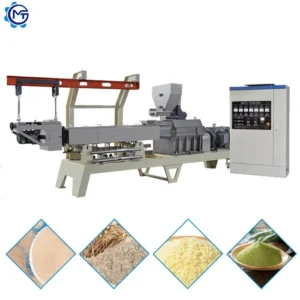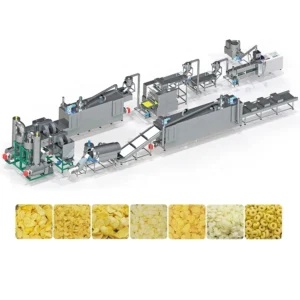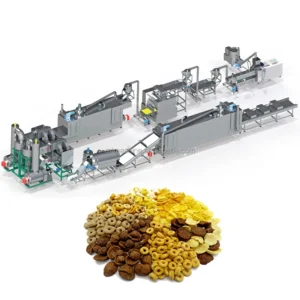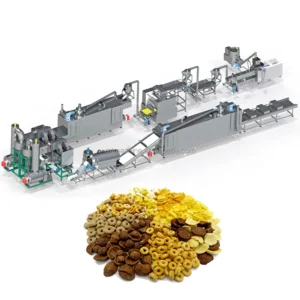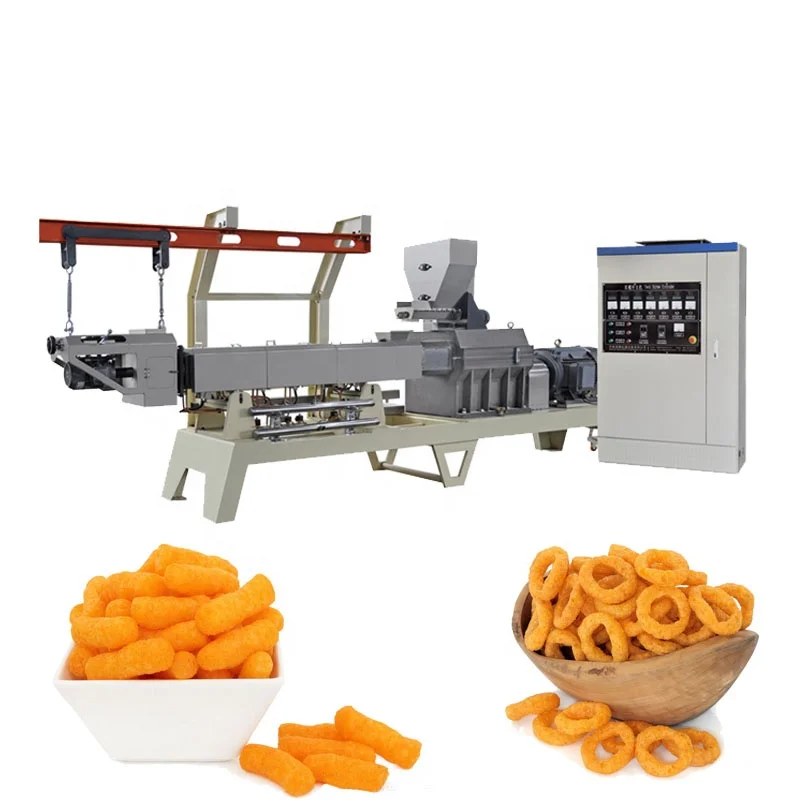
Staged Gelatinisation Control — Barrel temperature zones and screw element spacing on the MT70 are configured to your cereal raw material moisture and starch behaviour before the line ships.
Technical Specifications
| Parameter | Value |
|---|---|
| Model | MT70 |
| Product Type | Twin Screw Corn Flakes Extrusion Production Line |
| Installed Power | 160 kW |
| Power Consumption | 120 kW |
| Output Capacity | 150–200 kg/h (basis not stated in source — confirm raw material type, moisture content, and target product density) |
| Overall Dimensions | 41 × 1.5 × 2.2 m |
| Screw Type | Twin Screw |
| Control System | PLC (flaking station) |
| Heating Source Options (Dryer) | Gas or Electric |
| Flaking Machine Drive | Dual independent motors with hydraulic roller gap adjustment |
| Flaking Temperature Control | Infrared sensor feedback |
| Roasting Oven | Hot air circulation, conciliation burner, two independent fans, cyclone dust extraction |
| Coating System | Double tumble sugar melter, elevator, coating drum, spray nozzle array |
| Die Configuration | Adjustable mould shapes (ball, tube, stick, ring, fruit loop, star, wheel, flower, heart) |
| Certification | CE |
Application Suitability
| Application | Material or Output |
|---|---|
| Natural corn flakes production | Degerminated corn grits and corn flour blends |
| Sugar-coated breakfast cereal lines | Corn, rice, wheat, oat, and barley base powders with syrup coating |
| Shaped ready-to-eat cereals | Multi-grain formulations through adjustable die plates |
| Fortified cereal manufacturing | Vitamin and mineral premixed grain powders |
| High-fibre breakfast cereals | Oat bran and whole wheat composite meals |
Why "Nominal Capacity" Numbers Mislead on Cereal Extrusion Lines
Actual output depends entirely on what you feed the machine, not what the plate says.
I have watched buyers compare two cereal extruders on a single capacity number, sign a contract, and then discover that their local corn grits — coarser or higher in moisture than the seller assumed — reduce throughput and produce flakes that never crisp up in the roaster. Twin Screw Corn Flakes Extrusion Technology behaves differently across starch sources; a 200 kg/h rating on one formulation can drop materially on another [NEED_CITE: how raw material moisture content affects extruder throughput in cereal processing]. The only way to confirm capacity is to run your actual raw material through the machine before it leaves the factory floor.
Screw Element Arrangement for Cereal Starch Behaviour
The twin screw configuration inside the MT70 barrel is not a fixed arrangement. Each screw element — conveying, kneading, reverse-pitch — is positioned to match the gelatinisation window of the cereal you are processing. Corn grits require a different shear profile than an oat-heavy blend because the starch granule rupture temperature and moisture absorption rate differ. When the screw layout is copied from a generic build without accounting for your specific raw material, the dough exits the die under-gelatinised or over-sheared, and the resulting flakes lack the internal structure needed for proper toasting.
Barrel Temperature Zoning and Moisture Management
Staged heating across the barrel zones is where gelatinisation is actually controlled. The first zones hydrate the starch granules without bursting them prematurely, while the middle and final zones drive the moisture down to the exact level the flaking rollers expect. If a zone runs too hot, you get case-hardened pellets that crack instead of flattening between the rollers. Too cool, and the dough retains excess moisture, producing dense flakes that refuse to crisp in the roasting oven. Twin Screw Corn Flakes Extrusion Technology depends on this thermal staging being tuned to your formulation, not set to a default profile [NEED_CITE: cereal extrusion barrel temperature profiling best practices].
Die Geometry, Flake Thickness, and the Roasting Outcome
The adjustable die plate determines the cross-section of every extrudate strand before it reaches the flaking rollers. Thickness, perforation diameter, and land length together define the expansion ratio as the hot dough exits the die. A die set for thin strands produces delicate, fast-toasting flakes suited to sugar-coated lines, while thicker sections yield hearty natural flakes that need longer roasting dwell times. The infrared-controlled flaking station then compresses these strands to the target gauge, and the hydraulic roller gap maintains that gauge consistently across a full production shift. Getting the die geometry wrong means the roasting oven cannot deliver uniform surface bubbling and colour — some flakes scorch while others remain pale and soft.
The Hidden Cost of Mismatched Dryer and Roaster Capacity
An extruder running at its confirmed rate is only useful if the downstream dryer and roaster can keep pace. When the dryer belt is too short or the roaster fan volume is undersized, wet flakes queue up, cool unevenly, and lose the residual heat that drives final moisture reduction. I have seen lines where the extruder was specified correctly but the roasting oven could not handle the throughput, forcing the operator to slow the entire line down [NEED_CITE: throughput bottlenecking in cereal production lines]. The MT70 line addresses this by matching the hot air roasting oven — with its two independent circulating fans and cyclone extraction — to the extruder’s confirmed output range, so flakes move through the thermal stages without backlog.
What This Build Brings to Your Cereal Project
Screw and die specifications are set to your raw material sample, not pulled from a catalogue default. The in-house testing workshop runs your actual corn, rice, or multi-grain blend through the barrel and documents the gelatinisation, expansion, and flake density before the line is approved for shipment. Line layout calculations confirm that mixing, extruding, flaking, drying, roasting, coating, cooling, and packing stations all share the same confirmed throughput, eliminating the bottleneck problem that arises when stations are sourced separately. PLC control on the flaking station, combined with infrared feedback, holds roller gap and surface temperature steady across long runs — a detail that directly affects whether your sugar-coated flakes emerge uniformly glazed or patchy. Twin Screw Corn Flakes Extrusion Technology here is not a generic offering; it is parameter-locked to your product target [NEED_CITE: twin screw extrusion parameter documentation standards].
Documentation & Verification
- Screw and die configuration record matched to your submitted cereal raw material sample
- Trial run report on your actual grits or flour blend confirming flake density and expansion ratio
- Line layout and capacity calculation with station-by-station throughput reconciliation
- Electrical schematic with voltage, frequency, and PLC language confirmed for your facility
- Factory test record documenting barrel zone temperatures and flaking gauge measurements
- CE declaration of conformity and ISO certificate copies included in shipment documentation
Installation, Commissioning & Support
- Foundation plan provided for the 41 m line footprint, specifying load points for extruder and flaking station
- Power drop specification for the 160 kW installed load, including dedicated circuit for dual flaking motors
- Barrel heating zones and PLC parameters pre-set to trial-run values, fine-tuned during on-site commissioning
- Operator training covers die changeover procedure across all available mould shapes
- Wear parts list with screw element and die plate reorder references supplied at handover
- Scheduled maintenance intervals for hydraulic roller gap system and roaster fan assemblies documented in manual
Before You Send an Inquiry
To move past generic quotations and into a line configured for your actual conditions, we need your raw material specification — grain type, particle size, and moisture content — along with the target flake style, whether natural, sugar-coated, or shaped. Your local voltage and frequency, plus the preferred PLC interface language, let us confirm the electrical package before production begins. If you have an existing roasting or packing setup, share the equipment details so the line throughput can be reconciled to your current downstream capacity.
Frequently Asked Questions
Q: How is screw configuration specified for different cereal raw materials?
A: Each cereal — corn, rice, wheat, oat — has a distinct starch gelatinisation temperature and moisture absorption curve. We receive a sample of your actual raw material, run it through our testing workshop, and map the kneading and conveying element arrangement to achieve the correct shear and dwell time. The resulting screw combination record is documented and supplied with your line.
Q: What barrel temperature profile is required for proper starch gelatinisation in corn flakes?
A: Corn flakes typically need a progressive profile, starting with moderate heat to hydrate starch granules and rising through the middle zones to complete gelatinisation before the die. The exact curve depends on your corn variety and moisture content. Trial runs confirm the profile, and the parameters are saved in the PLC for repeatable batch control.
Q: How does die design affect flakes expansion ratio and final density?
A: Die land length and perforation diameter control how much the extrudate expands as pressure drops at the exit. A longer land restricts expansion, yielding denser strands that produce heavier flakes after rolling. We select the die geometry based on your target flake weight per volume and verify it during the pre-shipment trial run on your material.
Q: How is capacity verified on the buyer’s actual raw material before shipment?
A: Your raw material sample is processed through the MT70 in our testing workshop under production-representative conditions. We measure extrudate throughput, moisture at the die exit, flake gauge after rolling, and final crispness after roasting. The trial run report documents these results and forms part of your shipment documentation.
Q: What extrusion parameters differ between natural and sugar-coated flakes processing?
A: Natural flakes generally run at slightly higher moisture and require a longer roasting dwell for surface browning and crispness. Sugar-coated flakes are extruded to a lower moisture target so they accept the hot syrup coating without becoming soggy. Screw speed, barrel temperature, and die selection are adjusted accordingly, and the double tumble coating system is calibrated to your syrup viscosity.