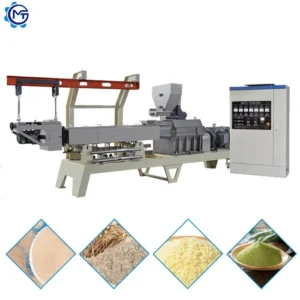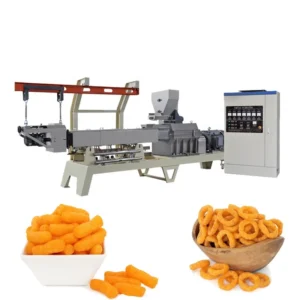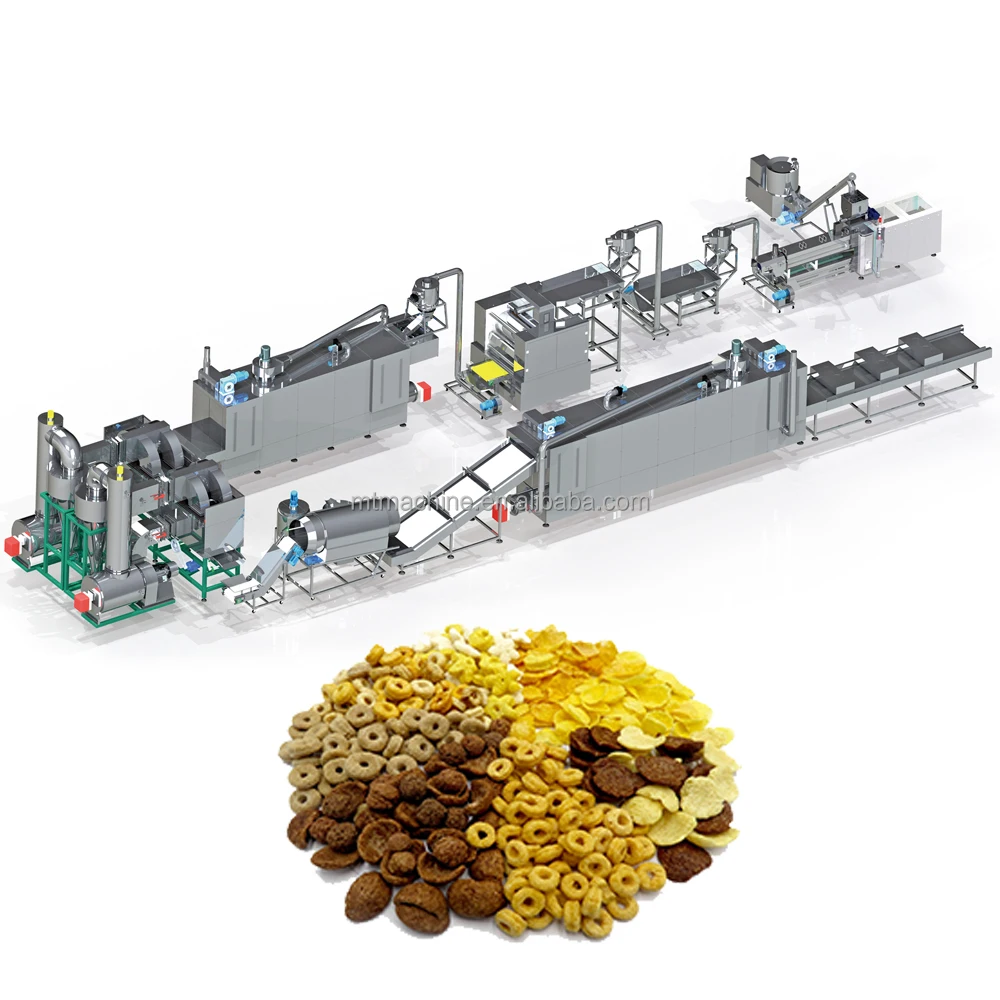
Matched Screw Geometry — Every screw element and die orifice is specified against the buyer’s grain base and target flake density, not pulled from a generic build.
Technical Specifications
| Parameter | Value |
|---|---|
| Product Type | Corn Flakes and Breakfast Cereal Production Line |
| Models Available | MT70, MT85, MT75 |
| Extruder Type | Twin Screw |
| Installed Power | 160 kW (MT70) / 190 kW (MT85) / 210 kW (MT75) |
| Power Consumption | 120 kW (MT70) / 140 kW (MT85) / 150 kW (MT75) |
| Output Capacity | 150–200 kg/h (MT70), 300–400 kg/h (MT85), 300–500 kg/h (MT75) (basis not stated in source — confirm raw material, moisture content, and final product format) |
| Overall Dimensions | 41 × 1.5 × 2.2 m (MT70) / 43 × 1.5 × 3.2 m (MT85) / 45 × 1.5 × 3.5 m (MT75) |
| Control System | PLC (flaking machinery); MCC/PLC for line integration |
| Raw Materials | Corn, rice, wheat, oat, barley powder |
| Dryer Heating Source | Gas or Electric |
| Flaking Machinery Features | Hydraulic system for double rollers; double motors for separate roller driving; infrared sensor temperature control |
| Hot Air Roasting Oven | Vibrating pan with high-temperature spraying tubes; conciliation burner; two separate circulating fans; cyclone dust removal device |
| Coating System | Double tumble for sugar melting, elevator, coating drum, spraying nozzle |
| Final Product Shapes | Ball, tube, stick, ring, fruit loop, star, wheel, flower, heart |
| Assembly State | Complete turnkey line |
| Standards | CE, ISO |
Application Suitability
| Application | Material or Output |
|---|---|
| Natural corn flakes | Corn grits processed through extrusion, flaking, drying, and hot air roasting |
| Sugar-coated corn flakes | Corn base with sugar spraying and coating after roasting |
| Multi-grain breakfast cereals | Rice, wheat, oat, or barley powder blends in various extruded shapes |
| Shaped cereal formats | Fruit loops, rings, stars, balls via extruder die adjustment |
Why Copied Screw Profiles Produce the Wrong Flake Density
The corn flakes extrusion line screw configuration and die design must reflect the buyer’s actual grain composition and the milk-bowl density the market expects.
A twin-screw setup cloned from a generic cereal line often over-shears corn grits, pushing starch gelatinisation past the point where flakes hold crispness in milk. I once saw a line in Turkey where the extruder was running a standard high-shear profile meant for puffed snacks — the resulting flakes shattered during roasting because the internal structure was too fragile. Process engineers know that the residence time inside the barrel, controlled by screw element arrangement, determines whether the dough arrives at the flaking rolls with the right elasticity. [NEED_CITE: starch gelatinisation temperature ranges by grain type]
Barrel Temperature Zones and Starch Behaviour
The barrel is divided into feeding, compression, and metering zones, each with independent heating and cooling. For corn grits, the compression zone typically needs to reach the gelatinisation threshold gradually — too fast and the starch network collapses before flaking, too slow and the dough lacks cohesion. A corn flakes extrusion line screw configuration and die design that accounts for this thermal profile prevents the common failure of flakes that either turn to dust in the roaster or remain unpleasantly hard.
Die Geometry Controls Expansion Before Flaking
The die orifice shape and diameter govern how much the extrudate expands as it exits the barrel under pressure drop. A round die produces a rope that gets flattened by the flaking rolls into a uniform sheet, while a shaped die creates the cross-section for rings, stars, or fruit loops. Getting the corn flakes extrusion line screw configuration and die design right means matching die land length to the viscosity of the specific grain blend — wheat-based doughs flow differently than corn-based ones, and the die must compensate. [NEED_CITE: die land length effects on extrudate expansion ratio]
Power, Throughput, and What the Numbers Mean
The installed power ratings — 160 kW on the MT70, 190 kW on the MT85, 210 kW on the MT75 — reflect the mechanical energy needed to convey, compress, shear, and meter the dough through the barrel. Power consumption figures of 120 kW, 140 kW, and 150 kW respectively indicate the typical draw under running conditions. The overall line lengths of 41 to 45 metres account for the full sequence from mixing through extrusion, flaking, drying, roasting, and cooling. When evaluating capacity, buyers should confirm output figures against their specific raw material and moisture content, since corn grits, oat flour, and rice blends each behave differently inside the barrel. The hydraulic flaking station uses double motors for independent roller driving, and the infrared sensor temperature control keeps roller surfaces within the range needed for consistent flake thickness.
The Cost of Misaligned Upstream and Downstream Stations
An extruder running at full capacity means little if the tunnel dryer or roasting oven cannot keep pace. I watched a European buyer lose half a shift because the hot air roaster had only one circulating fan — the bottleneck forced the extruder to idle repeatedly, cooling the barrel and ruining the thermal profile mid-run. When the flaking roll gap does not match the extrudate diameter, flakes emerge too thin and scorch in the roaster, or too thick and stay doughy at the core. These mismatches are not visible in a brochure; they surface only during an integrated trial where every station runs simultaneously. [NEED_CITE: effects of line bottlenecking on extrudate quality consistency]
Why the Extrusion Technology Matters Here
Screw elements are selected and sequenced based on the buyer’s grain formulation and target flake texture — mixing elements, kneading blocks, and conveying segments each play a different role. The die plate is machined to match the intended product shape, whether flat flakes from a rope cut or shaped cereal from a profiled die. An in-house testing workshop runs the buyer’s actual raw material before shipment, producing a trial run report that documents moisture levels, barrel temperatures, and resulting flake density. Line layout calculations match throughput across the extruder, flaking rolls, dryer, and roasting oven so no station bottlenecks another. PLC control on the flaking machinery and MCC/PLC integration across the line allow recipe storage and repeatability between batches.
Documentation & Verification
- Screw and die configuration record tied to your grain formulation
- Trial run report on your raw material from the testing workshop
- Line layout showing throughput balance across every station
- Electrical schematic with voltage and frequency confirmed for your market
- Machine specification sheet with control language and interface details
- CE declaration of conformity and ISO certificate
Installation, Commissioning & Support
- Foundation plan aligned with the 41–45 m line footprint and load points
- Dedicated power circuit sized for up to 210 kW installed capacity
- Sectional delivery with on-site assembly and alignment of flaking and roasting modules
- First-run parameter setting for barrel zones, flaking roll gap, and roaster temperature
- Operator training on PLC interface, recipe recall, and hydraulic roller adjustment
- Wear parts list covering screw elements, die plates, and roller surfaces
- Maintenance schedule for gearbox oil, barrel liner inspection, and fan bearing lubrication
What We Need to Move Forward
Share the primary grain or grain blend you intend to run, the moisture content at the mixer outlet, and the target flake thickness or cereal shape. Confirm your facility voltage, frequency, and preferred control language so electrical schematics are accurate before fabrication. Let us know your available floor space and ceiling height to guide the line layout proposal.
Frequently Asked Questions
Q: How is screw configuration selected for corn versus wheat or oat?
A: Corn grits require a moderate-shear profile that gelatinises starch without degrading the protein matrix, while wheat and oat flours need gentler kneading blocks to avoid over-working the gluten or beta-glucan structure. The screw element sequence — conveying, mixing, metering — is adjusted per grain to arrive at the flaking rolls with the correct dough elasticity and moisture distribution.
Q: What barrel temperature and moisture range give flakes that stay crisp in milk?
A: The compression zone must bring the dough through the starch gelatinisation window while maintaining enough residual moisture for the flaking rolls to compress without cracking. Too much moisture causes sticking; too little produces brittle flakes that disintegrate on contact with milk. Exact ranges depend on the grain blend and are documented during the pre-shipment trial run.
Q: How does the flaking roller gap affect final roasting behaviour?
A: A wider gap leaves flakes thicker, requiring longer roasting time to drive off core moisture — risking surface scorch. A narrower gap produces thinner flakes that roast quickly but may curl or fracture. The hydraulic system with independent roller motors maintains consistent gap pressure, and infrared sensors monitor surface temperature to prevent hot spots.
Q: Can the extrusion parameters be reconfigured for sugar-coated formats?
A: The extrusion stage itself produces the base flake, which then passes through sugar spraying, coating, and a second drying stage. The screw profile for the base flake may need adjustment if sugar coating adds weight that changes the milk-bowl density requirement. The coating drum and tumble system are sized to match the extruder output so no station idles.
Q: What does the pre-shipment trial run cover?
A: Your raw material is processed through the extruder, flaking station, dryer, and roaster in the testing workshop. The trial run report records barrel temperature at each zone, screw speed, flaking roll gap, roaster temperature, and the resulting flake density, thickness, and surface blistering — giving you documented parameters before the line ships.