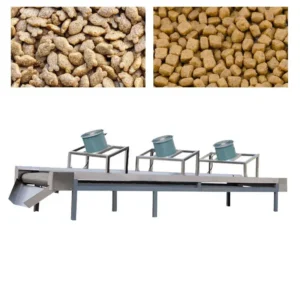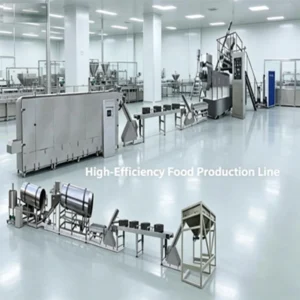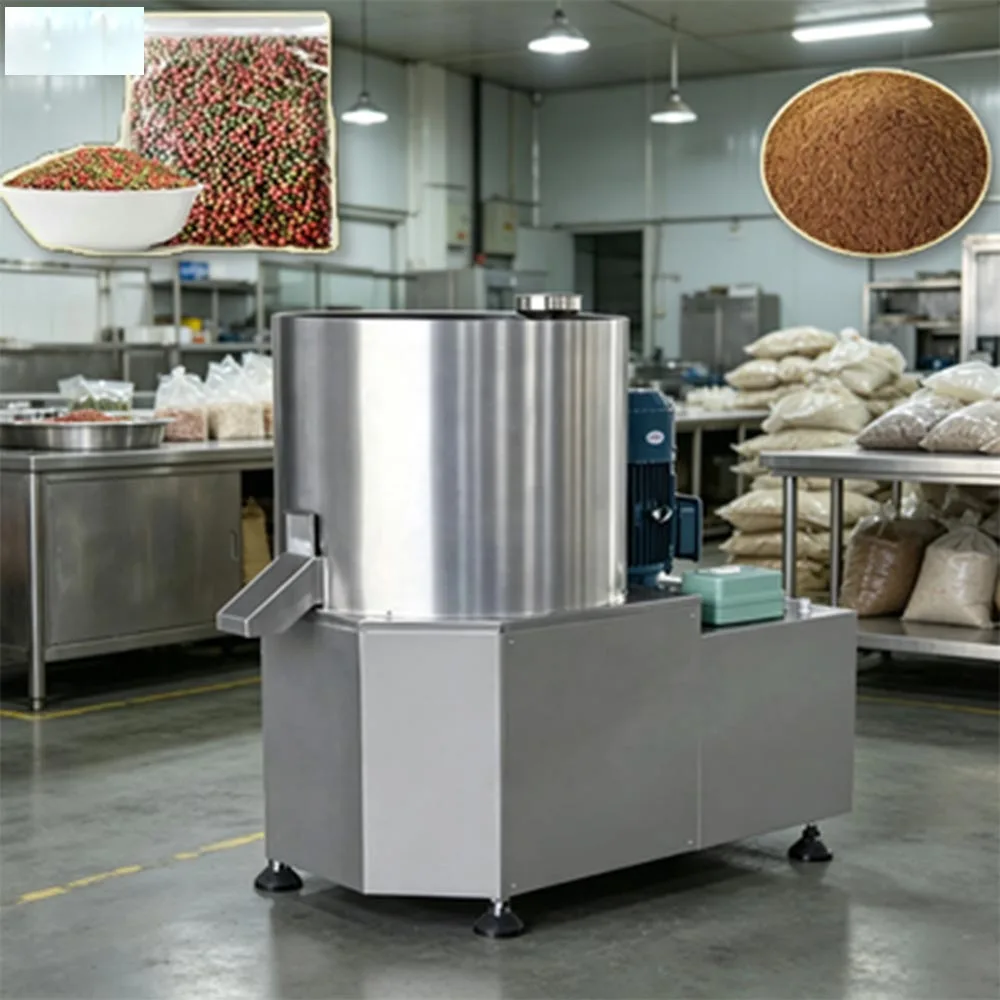
Screw Configuration Matched to Your Formula — Every barrel zone, die plate and moisture setting is tuned to your raw material during an in-house trial run before the extruder leaves our testing workshop.
Technical Specifications
| Parameter | Value |
|---|---|
| Product Type | Twin Screw Food Extruder |
| Extruder Type | Twin Screw |
| Output Capacity | 500 kg/h (basis not stated in source — confirm raw material formulation, moisture content and pellet size) |
| Pellet Diameter Range | 0.5 mm to 12 mm |
| Structure Material | Stainless Steel (food-contact surfaces) |
| Control System | Simple control panel (PLC/MCC option available upon confirmation) |
| Automation Level | Fully automatic continuous operation |
| Line Stations Included | Feeding, mixing, extruding, pelletizing |
| Power Design | Low energy consumption configuration (rated power to be confirmed per motor selection) |
Application Suitability
| Application | Material or Output |
|---|---|
| Floating fish feed for grow-out stage | Fish meal, soybean meal, wheat flour, starch blends formed into buoyant pellets |
| Sinking aquaculture feed for bottom-feeding species | High-protein formulations with adjusted gelatinisation for controlled density |
| Dry pet kibble for dogs and cats | Corn, meat meal, bone meal and vitamin premix extruded into dense kibbles |
| Starter feed for fry and juvenile fish | Micro-pellets down to 0.5 mm via fine die plate configuration |
What "500 kg/h" Really Means on Your Raw Material
Capacity is only valid when the screw profile, die geometry and moisture balance match the exact formulation you will run in production.
I once watched a twin-screw line in Peru drop to roughly half its nameplate output the moment the operator swapped our standard corn flour for the customer’s local fish bone meal blend. The extruder was not the problem — the screw configuration was set for a completely different starch-protein ratio. Extrusion technology only delivers its rated throughput when the shear profile and barrel temperature zones are specified against the buyer’s actual recipe. That is why a twin screw food extruder must be trialled on your raw material before anyone talks about real capacity [NEED_CITE: twin-screw extrusion process parameters for aquaculture feed formulations].
How Shear and Gelatinisation Shape Pellet Buoyancy
Floating versus sinking feed is not decided by the die alone. The degree of starch gelatinisation inside the barrel determines how much steam is trapped at the moment of exit, and that trapped steam governs final pellet density. A twin screw food extruder creates the uniform shear needed to gelatinise starch consistently across every barrel zone, which is critical when protein content varies between batches of fish meal.
Barrel Temperature Profile and Moisture-Shear Balance
Each barrel section can be heated or cooled independently, allowing the operator to build a temperature curve that matches the raw material’s gelatinisation onset. Too much heat too early causes premature expansion inside the barrel; too little leaves uncooked starch that weakens pellet structure. Moisture injection points work together with this thermal profile, and the twin-screw design ensures that added water or steam disperses evenly rather than forming wet pockets that collapse post-extrusion [NEED_CITE: barrel zone temperature control in food extrusion processing].
Reading the Specs That Actually Matter for Extrusion Quality
The pellet diameter range of 0.5 mm to 12 mm reflects the die plate options available, not the extruder’s only capability — die changes let one machine cover fry feed and adult kibble on the same line. Stainless steel contact surfaces prevent corrosion from the high-moisture, high-salt environment inside the barrel, which directly affects product hygiene and screw lifespan. The integrated line from feeding through pelletizing means moisture added at the mixer can be tracked all the way to the die face, reducing density variation between the first and last pellet of a shift.
What Happens When Screw and Die Are Chosen Generically
A screw configuration copied from a catalogue build may push nominal capacity on corn grits but produce kibble that sinks or fish pellets that disintegrate within minutes of hitting the water. Die hole geometry affects expansion behaviour after exit — a poorly matched die causes irregular shapes, inconsistent bulk density and downstream coating problems. I have seen entire production batches rejected at the packing stage because the extrusion parameters were never validated against the buyer’s formulation before the line was shipped [NEED_CITE: effect of die geometry on extrudate expansion and product density].
Why Buyers Source This Extrusion Technology Here
The screw configuration and die design are specified to your raw material and target pellet density rather than taken from a generic library. Every unit goes through a trial run in the testing workshop using your actual formula, so expansion rate and floating behaviour are confirmed before shipment. Because the complete line from batching to packing comes from one supplier, throughput at the dryer and coating drum is matched to the extruder output instead of becoming a bottleneck. Pre-sales consultation covers line layout, utility planning and barrel zone mapping, and on-site commissioning includes operator training on your specific recipe parameters.
Documentation & Verification
- Screw configuration and die design record matched to your raw material formulation
- Trial run report on your actual formula documenting expansion rate and pellet density
- Barrel zone temperature profile and L:D ratio sheet for process repeatability
- Line layout and capacity calculation confirming throughput across all stations
- Electrical schematic with voltage and frequency confirmation for your facility
Installation, Commissioning & Support
- Foundation plan accounts for the full integrated line footprint from feeder to pelletizer
- Dedicated power circuit sized for the extruder main motor and barrel heaters
- Barrel sections and screw elements arrive separated and are reassembled during commissioning
- First production run replicates testing workshop parameters on your raw material
- Operator training covers die change procedure across the 0.5 mm to 12 mm pellet range
- Wear parts list identifies screw elements and die plates requiring periodic replacement
What We Need to Move Forward
Send your raw material formulation including protein, starch and fat ratios along with target pellet diameter and whether you need floating or sinking density. Confirm your facility voltage, frequency and preferred control language so the electrical package is built correctly. Let us know your available floor space and ceiling height so the line layout fits your workshop before we finalise the extrusion technology proposal.
Frequently Asked Questions
Q: How is the screw configuration selected for my specific raw material and target pellet density?
A: We start with your complete formulation — protein source, starch type, fat level and moisture content — then select screw element profiles and pitch to achieve the shear intensity your recipe requires. A trial run in our testing workshop confirms the configuration delivers the target expansion and density before the extruder ships.
Q: What barrel temperature profile and moisture range are needed to achieve floating versus sinking feed?
A: Floating feed requires higher gelatinisation and greater steam entrapment at the die face, typically achieved with elevated barrel zone temperatures and precise moisture dosing. Sinking feed uses lower expansion, meaning reduced barrel heat and adjusted screw shear. Exact values depend on your starch source and protein ratio, which is why we run your formula before setting final parameters.
Q: Can a trial run on my raw material be done before shipment to verify expansion and density?
A: Yes. Our testing workshop runs your actual formula through the configured extruder, measuring pellet diameter, bulk density and floating duration. The trial run report documents all barrel temperatures, screw speed and moisture settings so the same results can be reproduced once the line is installed at your facility.
Q: How does die design affect pellet size, shape and post-extrusion expansion behaviour?
A: Die hole diameter and length-to-diameter ratio control how much the extrudate expands after exiting the barrel. A short die hole allows greater radial expansion, producing rounder and lighter pellets, while a longer die restricts expansion for denser shapes. We match die geometry to your target pellet size within the 0.5 mm to 12 mm range.
Q: What starch gelatinisation degree is achieved and how is it measured during extrusion?
A: Gelatinisation degree depends on barrel temperature, moisture content and residence time inside the twin-screw extruder. During the trial run we sample output pellets and assess starch conversion through standard laboratory methods. The resulting data lets us fine-tune barrel zone settings to reach the gelatinisation level your target product requires.