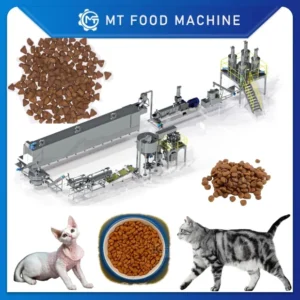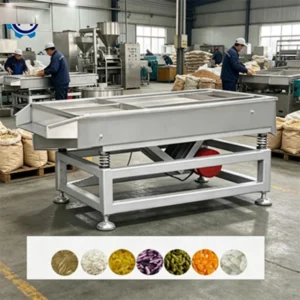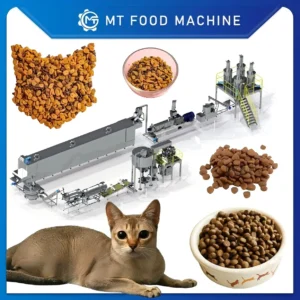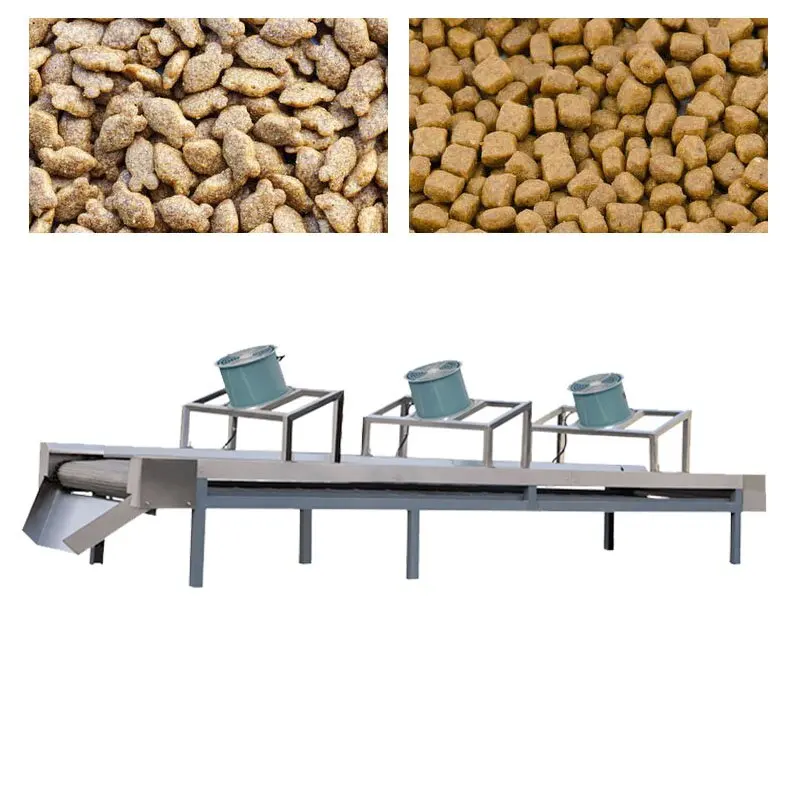
Screw and die configuration — every barrel segment, screw element and die plate is matched to your raw material recipe and target kibble density, not copied from a generic build.
Technical Specifications
| Parameter | Value |
|---|---|
| Product Type | Pet Food Making Machine |
| Screw Type | Twin-screw |
| Control System | PLC and MCC control |
| Barrel Material | Food-grade stainless steel contact surfaces |
| Screw Configuration | Modular, matched to raw material and product target |
| Die Design | Interchangeable, selected for kibble shape and expansion ratio |
| Automation Level | Automated batching through extrusion with PLC logic |
| Voltage and Frequency | Configurable to buyer’s local supply standard |
| Machine Testing | In-house workshop trial run before shipment |
| Certification | CE (since 2014), ISO |
Application Suitability
| Application | Material or Output |
|---|---|
| Dry kibble and premium pet food | Corn, wheat, rice, meat meal, bone meal, fish meal at varying inclusion rates |
| High-protein and grain-free formulations | Pea flour, lentil, chickpea and potato starch blends with meat or poultry meal |
| Functional and dental-care pet treats | Fibre-enriched doughs with added calcium or chlorophyll compounds |
| Aquatic-style floating pet snacks | Low-density starch-protein mixes requiring controlled expansion |
Why Generic Capacity Numbers Mislead Pet Food Buyers
Nominal throughput means nothing without your actual recipe as the basis.
I remember setting up a line for a client moving into high-meat kibble. We ran corn flour through the twin-screw extruder and everything looked smooth — steady output, good expansion, uniform shape. Then the client sent their real formula with around forty percent meat meal. The screw combination we had in the barrel was completely wrong. The extrudate barely expanded, kibble density went above what the market expected, and pieces sank in the water bowl. We had to pull the screws, reconfigure the element stack, adjust the die geometry and start again. That trial taught every engineer in the room a permanent lesson: a pet food making machine quoted at a round-number capacity on a generic grain recipe tells you almost nothing about what it will do on a specific buyer’s formulation [NEED_CITE: extrusion behaviour varies with protein and fat content in raw material].
When you evaluate any extruder for pet food production, ask what material was used to establish the headline capacity figure. If the answer is a simple starch like corn grits, request a trial on your own recipe before accepting the number. Density, expansion ratio and surface texture all shift when animal protein and fat enter the barrel, and those shifts determine whether the final kibble meets the specification your market demands.
How Screw Element Sequencing Controls Kibble Texture
The twin-screw extruder relies on a sequence of conveying, kneading and reverse-flow elements arranged along the barrel. Each segment contributes a different level of shear and residence time to the dough as it moves toward the die. On a high-meat pet food formula, the kneading blocks must be positioned to generate enough mechanical energy to gelatinise the remaining starch fraction while avoiding excessive heat that denatures protein and reduces palatability. Changing the element order by even one position alters the pressure profile at the die face and therefore the expansion ratio of the kibble as it exits. This is why the screw configuration for a pet food making machine must be documented and reproducible across every production batch.
Barrel Temperature Profiling and Moisture Management
Independent heating zones along the barrel let operators build a temperature gradient that matches the gelatinisation curve of the specific starch in the recipe. A grain-free formula based on pea flour requires a different thermal profile from a conventional corn-and-chicken kibble, because the starch granules swell and rupture at different temperatures [NEED_CITE: starch gelatinisation temperatures vary across botanical sources]. Moisture injection points between zones allow fine-tuning of dough plasticity without flooding the barrel. When moisture and temperature are coordinated correctly, the extrudate leaves the die with a consistent internal cell structure that dries uniformly downstream, reducing the number of cracked or hollow kibbles that fall outside specification.
Reading the Specification Table for Production Reality
The PLC control system provides recipe storage and parameter recall, so once the correct screw speed, barrel temperature and feed rate are established during trial, the operator simply loads the saved profile for each production run. This eliminates manual guesswork between shifts and maintains batch-to-batch consistency — a critical factor when a pet food brand promises uniform kibble size and density across every bag. The modular die arrangement means a single extruder can produce multiple kibble shapes by swapping die plates rather than replacing the entire barrel assembly. Food-grade stainless steel contact surfaces prevent corrosion from the salts and minerals commonly present in pet food premixes, extending the service interval between barrel inspections.
What Happens When the Extruder Is Specified Without the Line
A pet food making machine that performs well in isolation can still bottleneck an entire production line if the downstream dryer and coating drum are undersized. Kibble leaving the die carries significant moisture and must be dried to a shelf-stable level within a defined window; if the dryer cannot handle the extruder’s actual throughput, product piles up, cools unevenly and develops internal moisture gradients that lead to mould in the bag. Similarly, a flavouring drum with insufficient dwell time leaves coating unevenly distributed, producing palatability complaints from pet owners. These mismatches rarely appear in a single-machine quotation but surface the moment the line starts running at full rate [NEED_CITE: throughput matching across extrusion, drying and coating stations].
Why Procurement Conversations Start with the Recipe Here
Every configuration decision on this extruder traces back to the buyer’s raw material list and target product specification. The screw element stack, die geometry, barrel zone count and control logic are all defined after reviewing the formulation, not before. An in-house testing workshop allows the buyer’s actual ingredients to run through the machine before shipment, generating a trial report that documents screw speed, temperature profile, moisture level and the resulting kibble density and expansion ratio. CE and ISO documentation is prepared alongside the electrical schematic, so the machine arrives with the paperwork needed for local regulatory clearance rather than delaying commissioning while certificates are chased across time zones. The PLC interface language is confirmed during the specification phase so operators see instructions in their working language from the first day of training.
Documentation & Verification
- Screw and die configuration record matched to your specific pet food formula
- Trial run report on your raw material documenting density and expansion results
- Electrical schematic with confirmed voltage, frequency and control language
- CE declaration of conformity and ISO certificate for regulatory filing
- Operation and maintenance manual with wear parts list and replacement intervals
- Packing photographs and customs documentation support for smooth clearance
Installation, Commissioning & Support
- Foundation plan provided based on the extruder’s footprint and vibration profile
- Dedicated power circuit specified to match confirmed voltage and PLC load requirements
- Barrel and screw assembly verified on-site after transit to ensure alignment
- First production run supervised with parameter adjustment until kibble density meets spec
- Operator training covers PLC recipe recall, screw element inspection and die changeover
- Wear parts list supplied with initial spare screws and die plates for early replacements
What to Include in Your First Enquiry
Send your raw material formula with protein, fat and starch percentages so the screw configuration can be designed around real ingredients rather than generic assumptions. Specify your target kibble size, shape and density along with the daily output you plan to run. Confirm the voltage, frequency and control language at your facility so the electrical cabinet and PLC interface are built correctly before the machine leaves the workshop.
Frequently Asked Questions
Q: Can the extruder handle recipes with more than thirty percent meat meal?
A: Yes, provided the screw element stack is configured for high-protein, high-fat doughs. During the in-house trial, your exact formula runs through the barrel so the kneading block sequence and die geometry are adjusted until kibble density and expansion meet your market specification before the machine ships.
Q: How is kibble density controlled during production?
A: Density is managed through screw speed, barrel temperature profile, moisture injection rate and die opening size. The PLC stores the validated parameter set from the trial run, so operators recall the same recipe for every batch, maintaining consistent kibble buoyancy and texture throughout the production schedule.
Q: What happens if our recipe changes after the machine is installed?
A: The modular screw design allows element rearrangement to accommodate new formulations. You can request a revised screw configuration record, and the PLC recipe memory stores multiple profiles so switching between products on the same extruder requires only a parameter recall and, if needed, a die plate change.
Q: How are spare screws and die plates sourced after the initial set wears?
A: A wear parts list is included with the machine documentation, identifying every screw element and die plate by position and part number. Replacement components are manufactured to the same specification as the originals, and orders can be placed directly so downtime between changeovers stays within your planned maintenance window.
Q: Does the control system support multiple languages for operators in different regions?
A: The PLC interface language is confirmed during the specification phase before production begins. The HMI displays all operating screens, alarm messages and recipe parameters in the agreed language, ensuring that operators can manage the extruder without relying on translation during commissioning or daily production.