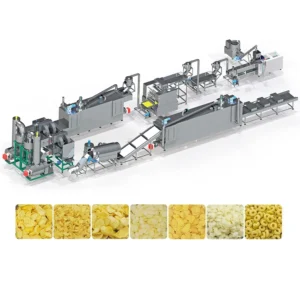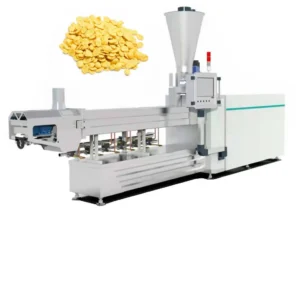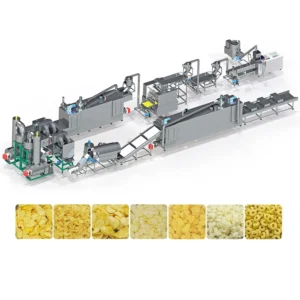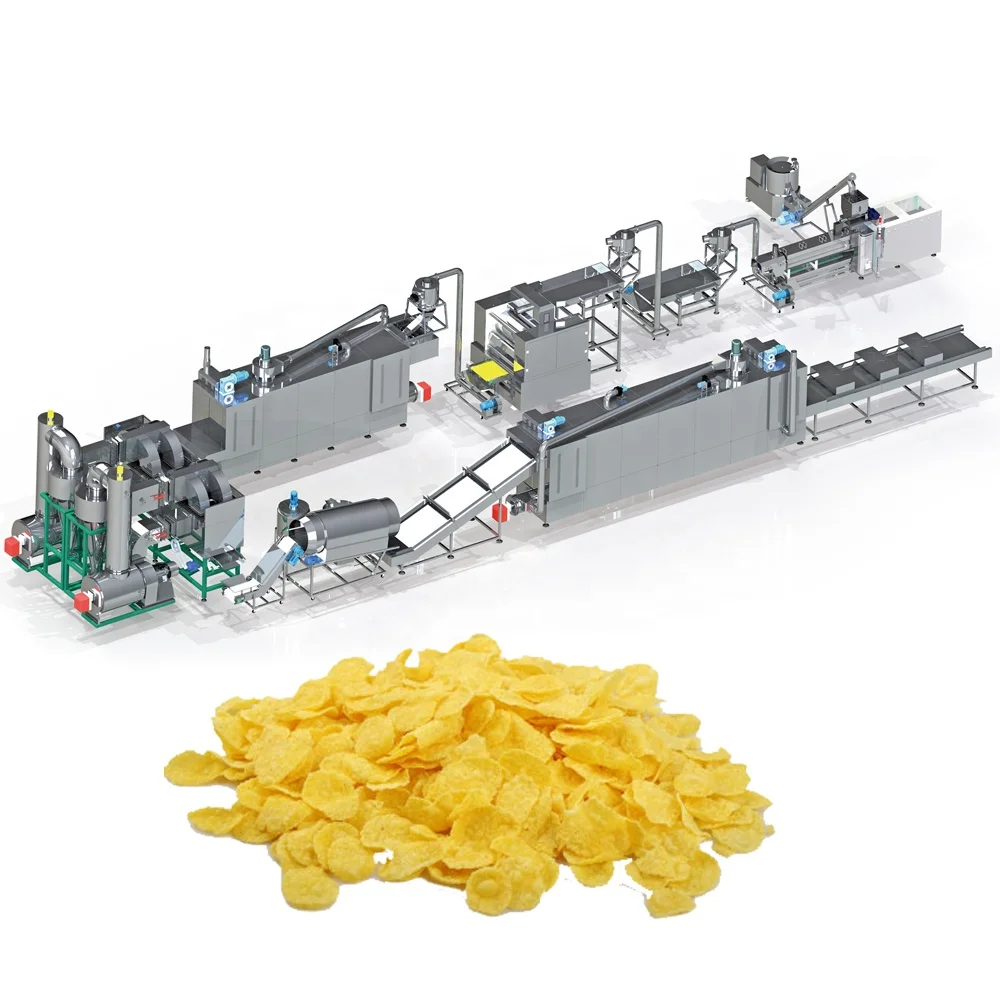
Integrated Screw Design — Die profiles and barrel zones configured against the buyer’s grain moisture and target flake density, validated before the line leaves Jinan.
Technical Specifications
| Parameter | Value |
|---|---|
| Product Type | Corn Flakes Production Line (Twin Screw Extrusion) |
| Extruder Type | Twin Screw with automatic lubricating and cooling function |
| Available Line Models | MT70 / MT85 / MT75 |
| Installed Power | MT70: 160 kW; MT85: 190 kW; MT75: 210 kW |
| Power Consumption | MT70: 120 kW; MT85: 140 kW; MT75: 150 kW |
| Output Capacity | MT70: 150–200 kg/h; MT85: 300–400 kg/h; MT75: 300–500 kg/h (basis to be confirmed on raw material and moisture) |
| Overall Dimensions | MT70: 41 × 1.5 × 2.2 m; MT85: 43 × 1.5 × 3.2 m; MT75: 45 × 1.5 × 3.5 m |
| Control Architecture | PLC control at flaking station; MCC integration across the full line |
| Flaking Mechanism | Hydraulic double-roller system with separate double-motor drive and infrared sensor temperature control |
| Thermal Processing | Dryer (gas or electric); Hot air roasting oven with conciliation burner, dual circulating fans, and cyclone dust removal |
| Coating Module | Double tumble for sugar melting, elevator, coating drum, and spraying nozzle |
| Process Sequence | Mixing → Extrusion → Flaking → Drying → Hot Air Roasting → Sugar Coating → Cooling → Packing |
| Warranty & Service | 24-month warranty with lifetime technical service |
| Certification | CE |
Application Suitability
| Application Scenario | Material or Output |
|---|---|
| Traditional breakfast cereal production | Corn grits and maize blends processed into toasted flakes |
| Fortified breakfast cereals | Grain mixes incorporating vitamin and mineral premixes |
| Sugar-coated cereal variants | Base flakes routed through the double tumble coating system |
| Alternative flaked grains | Wheat, rice, or multigrain blends adapted via screw and die changes |
| Extruded snack formats | Pellets or direct-expanded shapes derived from the same twin screw platform |
What "300 kg per Hour" Actually Depends On
The number on the quotation only holds if the screw profile matches the moisture content and particle size of the grain you actually put in the hopper.
I remember a corn flakes project where the buyer ordered a line rated at a specific throughput based on our standard test grain. When they ran their local corn grits, which carried a higher moisture level, the extrudate came out sticky and refused to flake properly. The first week of production delivered only a fraction of the expected volume [NEED_CITE: twin screw extrusion behavior relative to feed moisture variability]. A corn flakes extrusion production line only performs at its rated capacity when the screw configuration and die geometry are matched to the buyer’s specific raw material — not a generic reference sample. This is why running a trial on the actual grain blend in the testing workshop before shipment is a non-negotiable step in our process.
Barrel Zones and Shear Control in Flake Extrusion
The twin screw extruder on this corn flakes extrusion production line uses multiple heating zones along the barrel to manage starch gelatinisation progressively. Corn flakes require a specific degree of cook — enough to gelatinise the starch for digestibility and flake integrity, but not so much that the dough loses the structure needed for rolling. The automatic lubricating and cooling function on the screws helps maintain consistent shear energy, preventing localized overheating that causes scorching or uneven expansion before the flaking stage.
Die Geometry and the Path to the Flaker
The die plate determines the shape and density of the extrudate rope as it exits the barrel. For corn flakes, the die orifice size and land length are calculated to produce a strand that cools to the exact firmness the hydraulic double-roller flaking station expects. If the extrudate is too soft, it smears between the rollers instead of flattening into a clean flake; if too rigid, it fractures. The PLC-controlled flaking station with infrared sensor temperature control keeps the roller surface within a narrow band, so every flake entering the dryer has a uniform thickness [NEED_CITE: flake thickness tolerance and toaster oven blistering consistency].
Reading the Spec Sheet Against Your Production Reality
Installed power, power consumption, and overall dimensions are the three figures that determine whether the corn flakes extrusion production line fits your facility and your utility budget. The MT75 draws 150 kW in actual consumption across a 45-meter footprint, which means your electrical room must support that continuous load and your floor plan must accommodate the full process sequence from mixer to packer. The roasting oven uses a conciliation burner with two separate circulating fans and a cyclone dust removal device, meaning the thermal profile across the oven chamber stays even — essential for achieving the surface blistering that defines a quality corn flake. The dryer offers gas or electric heating, a choice that affects both operating cost and local code compliance depending on your market.
When the Coater Becomes the Bottleneck
A common oversight in cereal line planning is specifying an extruder and flaker for a given throughput but leaving the sugar coating drum undersized. The coating system on this line includes a double tumble sugar melting unit, an elevator, a coating drum, and a spraying nozzle array, all matched to the extruder’s output band. When a buyer sources the coater from a separate vendor and the drum cannot keep pace, the upstream stations must be throttled back or the sugar application becomes uneven [NEED_CITE: throughput imbalance effects in multi-station food processing lines]. The entire line stalls, and the capacity you paid for upstream goes unused.
Why Sourcing the Full Sequence from One Builder Matters
Every station — mixing, extrusion, flaking, drying, hot air roasting, sugar coating, cooling, and packing — is engineered under one supplier, so throughput is calculated across the entire chain rather than negotiated between separate vendors. The screw configuration and die design are specified to your grain formula, not pulled from a generic build. Before the line ships, your raw material runs through the in-house testing workshop so that screw combinations and roller pressures are validated on what you will actually produce. Documentation including the line layout and capacity calculation travels with the machines, giving your installation team a clear reference. The MCC and PLC control architecture means your operators interface with a unified system rather than patching together protocols from different equipment makers.
Documentation & Verification
- Line layout and capacity calculation showing throughput matched at every station from mixer to packer
- Screw and die configuration record written against your grain formula and target flake density
- Trial run report documenting performance on your raw material in the testing workshop before dispatch
- Electrical schematic with voltage and frequency confirmed for your local supply standard
- Operation and maintenance manual covering all stations in the sequence
- Wear parts list identifying screws, dies, and roller surfaces with replacement intervals
Installation, Commissioning & Support
- Foundation and utility planning based on the 41–45 m line footprint and 150–210 kW installed power range
- Dedicated electrical circuits sized for continuous load with confirmed voltage and frequency for your market
- MCC and PLC commissioning with operator language set to match your production team
- First-run parameter logging across barrel zones, roller pressure, and roasting oven temperature profiles
- Training on screw and die changeover procedures for different flake densities and grain blends
- Scheduled replacement guidance for high-wear extruder screws, die inserts, and flaking roller surfaces
Before You Request a Quotation
To configure the right line variant and confirm capacity on your actual grain, share the following: the type and moisture content of your corn or multigrain blend, your target hourly output, and the available floor space and ceiling height in your production hall. Let us know your local voltage and frequency, and whether your operators require a specific control language on the PLC and MCC interface [NEED_CITE: industrial machinery export voltage and control interface requirements]. If you need the trial run on your raw material before shipment, arrange to send a representative sample to the testing workshop.
Frequently Asked Questions
Q: How is the output capacity verified before the line ships?
A: Capacity is verified by running your actual raw material through the extruder and downstream stations in the in-house testing workshop. We log throughput, flake quality, and roasting consistency under the specific moisture and particle size of your grain blend. The trial run report documents these results, so the capacity figure you receive reflects your production conditions, not a generic benchmark.
Q: How are screw configuration and die design matched to my grain formula?
A: We start with the composition, particle size, and moisture content of your grain blend, then select screw element geometry and die land length to achieve the correct gelatinisation and extrudate firmness. The configuration is tested during the trial run, and any adjustments are made before the machines are packed for shipment. The final screw and die record is included in your documentation set.
Q: Is the entire line throughput-balanced or assembled from separate vendors?
A: Every station from the batching mixer through the packing conveyor is supplied and engineered by one builder. Throughput calculations account for residence time in the dryer and roasting oven, the cycle rate of the coating drum, and the cooling conveyor speed, so no single machine restricts the output of the others.
Q: Can a trial run be performed on my raw material before shipment?
A: Yes. The in-house testing workshop runs your grain blend through the extruder, flaker, and thermal stations to validate screw configuration, roller pressure, and oven profile. This step confirms that the line will produce flakes to your density and blistering specification from the first day of production at your facility.
Q: What voltage, frequency, and control language options are confirmed before production?
A: Before production begins, we confirm the voltage and frequency of your facility’s electrical supply and set the PLC and MCC interfaces to the operator language your team requires. The electrical schematic reflects these specifications, ensuring that commissioning proceeds without delays caused by mismatched power or unreadable control screens.