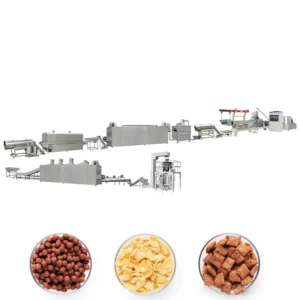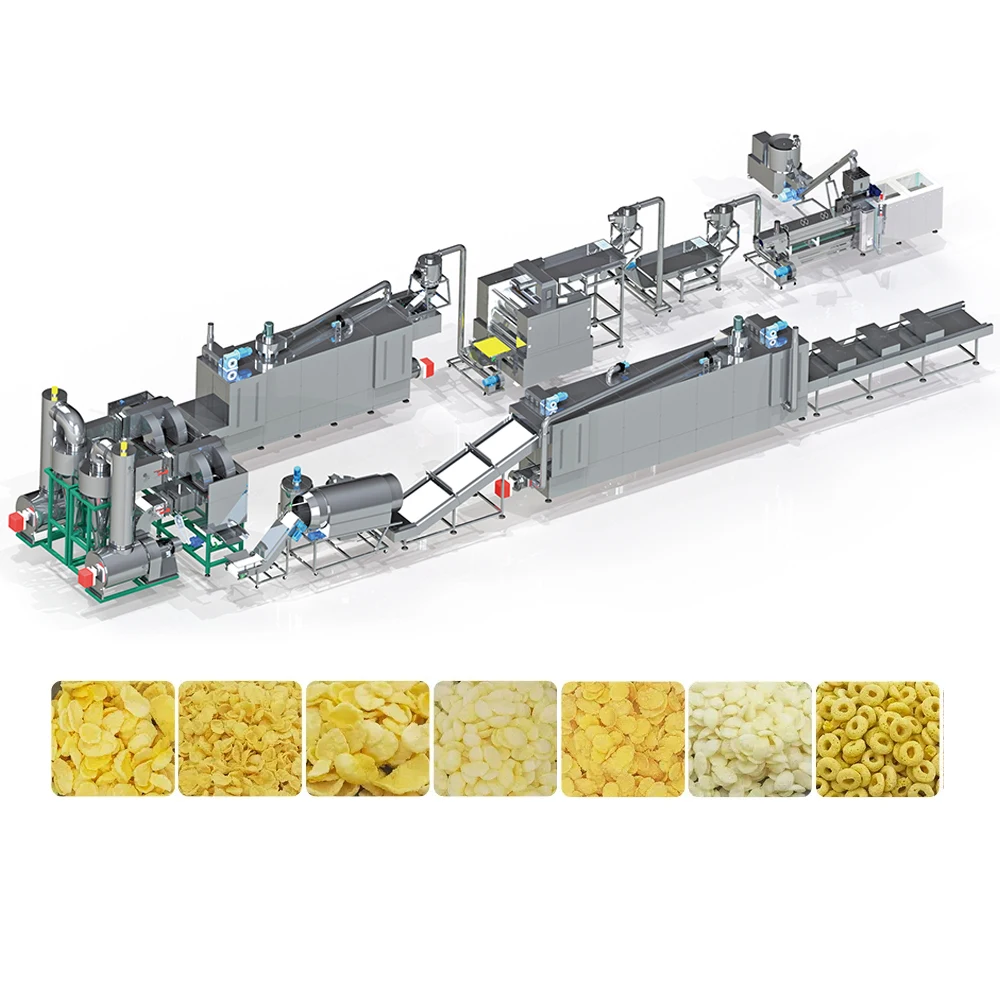
Screw Configuration Matched to Your Grain — Every MT75 twin-screw corn flakes extrusion line ships only after trial runs on your actual maize blend validate expansion density and flake texture.
Technical Specifications
| Parameter | Value |
|---|---|
| Product Type | Corn Flakes Extrusion Production Line |
| Model | MT75 |
| Extruder Type | Twin Screw |
| Installed Power | 210 kW |
| Power Consumption | 150 kW |
| Capacity | 300–500 kg/hr (basis not stated in source — confirm raw material and moisture content) |
| Overall Dimensions | 45 × 1.5 × 3.5 m |
| Flaking Machine | Hydraulic double-roller with PLC control and infrared temperature sensor |
| Flaking Drive | Double motors for separate roller driving |
| Roasting Oven | Hot air with conciliation burner, dual circulating fans, cyclone dust removal |
| Dryer Heating Source | Gas or Electric (configurable) |
| Coating System | Double tumble sugar melting, elevator, coating drum, spraying nozzle |
| Control System | PLC and MCC |
| Extruder Features | Automatic lubricating and cooling; wear-resistant screw construction |
| Standards | CE, ISO |
Application Suitability
| Application | Material or Output |
|---|---|
| Natural corn flakes production | Corn grits and maize flour at controlled moisture |
| Sugar-coated corn flakes | Corn base with sugar glaze spraying and secondary drying |
| Multi-grain flaked cereals | Rice, wheat, oat, and barley powder blends |
| Extruded cereal shapes | Ball, tube, ring, star, wheel, and fruit loop formats via die exchange |
What "300 kg/hr" Leaves Out About Corn Flakes Extrusion Line Specifications
Nominal throughput means nothing if your local maize behaves differently under shear and heat.
I learned this the hard way on a commissioning job in Nigeria. The line was quoted on standard corn grits, but the buyer’s local maize carried noticeably higher moisture. The extruder pushed material through, but expansion fell short — flakes came out thick, hard, and completely outside the texture their market expected. We had to rework the screw configuration and barrel temperature profile on-site to recover the batch. That is why corn flakes extrusion line specifications must always be read against the raw material you actually feed into the hopper [NEED_CITE: grain moisture variability in tropical maize supply chains].
How Screw Geometry Controls Starch Gelatinisation
The twin-screw extruder in the MT75 line handles feeding, extruding, cutting, heating, gearing, and control as integrated subsystems. Screw elements are selected and sequenced to manage shear intensity and residence time inside the barrel. For corn flakes, the goal is partial starch gelatinisation — enough to bind the dough sheet for flaking, but not so much that the pellet puffs prematurely before reaching the rollers. Barrel temperature profile and moisture addition work together with screw pitch to hit that narrow window. This is where twin screw corn flakes extruder technology separates a stable process from one that drifts with every new grain delivery.
Flaking and Roasting: Where Texture Is Won or Lost
The PLC-controlled flaking station uses a hydraulic double-roller system with independent motor drives and an infrared sensor for temperature uniformity across the roller surface. Consistent nip pressure and roller temperature determine whether the pellet flattens into a thin, even flake or cracks at the edges. Downstream, the hot air roasting oven uses a conciliation burner with two separate circulating fans to create surface blistering — those small bubbles that give corn flakes their characteristic crispness. The cyclone dust removal device keeps the roasting chamber clean across long production runs [NEED_CITE: blistering mechanism in flaked cereal roasting ovens].
Reading the Power and Dimension Data
The MT75 draws 210 kW installed and consumes approximately 150 kW during steady operation, which tells you the transformer and dedicated circuit must be sized accordingly before the line arrives. At 45 meters in length, the full production procedure — mixing, extruding, flaking, drying, hot air roasting, cooling, and packing — needs a straight-run floor plan or an engineer-designed layout that folds the line into your available space. The automatic lubricating and cooling system on the extruder reduces manual greasing intervals during continuous shifts, and the wear-resistant screw construction extends time between element replacements.
The Cost of Skipping the Trial Run
When a corn flakes line ships without a test run on your specific grain, the real commissioning starts after installation — on your factory floor, with your operators watching, and your raw material burning through inventory while parameters get dialed in. Flakes that are too dense will not blister properly in the roasting oven, and sugar coating will pool unevenly on a rough surface. The downstream dryer and coating drum may be perfectly specified, but if the extruded pellet density is wrong, every station after the extruder compensates for an upstream problem [NEED_CITE: extrusion pellet density impact on downstream cereal processing].
Why Source This Line Through the Testing Workshop
Screw configuration and die design are specified to your grain blend and target flake density, not copied from a generic build. The in-house testing workshop runs your actual raw material before shipment, producing a trial run report that confirms expansion, flake thickness, and roasting response. Throughput is matched across every station — extruder, flaking machine, dryer, roasting oven, and coating drum — so no single unit bottlenecks the line. Electrical schematics, voltage, frequency, and PLC control language are confirmed against your local grid and operator requirements before production begins. Pre-sales engineering covers layout design, and support continues through installation, commissioning, and wear parts supply.
Documentation & Verification
- Screw and die configuration record matched to your grain blend and target flake density
- Trial run report on your actual maize or multi-grain material from the testing workshop
- Electrical schematic with voltage, frequency, and PLC language confirmed for your market
- Line layout and capacity calculation showing throughput balance across every station
- Operation and maintenance manual with wear parts list for screws, dies, and flaking rollers
Installation, Commissioning & Support
- Foundation and floor plan based on the 45 × 1.5 × 3.5 m line footprint and station spacing
- Dedicated power circuit sized for 210 kW installed load with voltage and frequency confirmed
- On-site assembly and mechanical alignment of flaking rollers, dryer, and roasting oven modules
- First-run parameter setting for barrel temperature profile, roller pressure, and roasting airflow
- Operator training on PLC interface, screw element replacement, and hydraulic flaking station adjustment
- Wear parts program covering extruder screws, die plates, and flaking roller surfaces
What to Prepare Before Requesting a Quote
Share your grain type, typical moisture content at delivery, and any blending ratios if you run multi-grain recipes. Provide your target daily output and the usable floor dimensions of your production hall, including ceiling height. Confirm your local voltage, frequency, and the language your operators need on the PLC screen. If you have existing upstream mixers or downstream packing equipment, note the connection points so the line layout accounts for them.
Frequently Asked Questions
Q: How is extruder capacity verified against my specific grain blend and moisture content?
A: Before shipment, your raw material runs through the extruder in the in-house testing workshop. The trial run records expansion ratio, pellet density, and moisture loss across the barrel zones. Capacity figures are then confirmed against your actual grain behaviour, not a generic datasheet value.
Q: How is screw configuration and die design selected for target flake density?
A: Screw elements are sequenced to control shear and residence time for your grain’s starch gelatinisation point. Die geometry is chosen to produce a pellet that flattens cleanly under the flaking rollers without cracking or over-expanding, matching your target flake thickness and crispness.
Q: What barrel temperature and moisture range support proper starch gelatinisation in corn flakes?
A: The barrel profile is tuned across multiple heating zones to reach partial gelatinisation without full puffing. Moisture is added during mixing and sometimes via barrel steam injection. Exact values depend on your grain type and are locked in during the workshop trial run.
Q: How are flaking pressure and roasting temperature set for correct surface blistering?
A: The hydraulic flaking rollers apply calibrated nip pressure under infrared-monitored temperature. The roasting oven then uses dual circulating fans and a conciliation burner to create surface bubbles. Settings are established during commissioning and recorded for repeat production.
Q: What voltage, frequency, and control language options are confirmed before shipping?
A: Electrical schematics are prepared with your site voltage and frequency confirmed in writing. The PLC interface language is set to match your operator team. These details are locked before the control cabinet is wired, avoiding delays during on-site commissioning [NEED_CITE: industrial control language and voltage standards by export market].