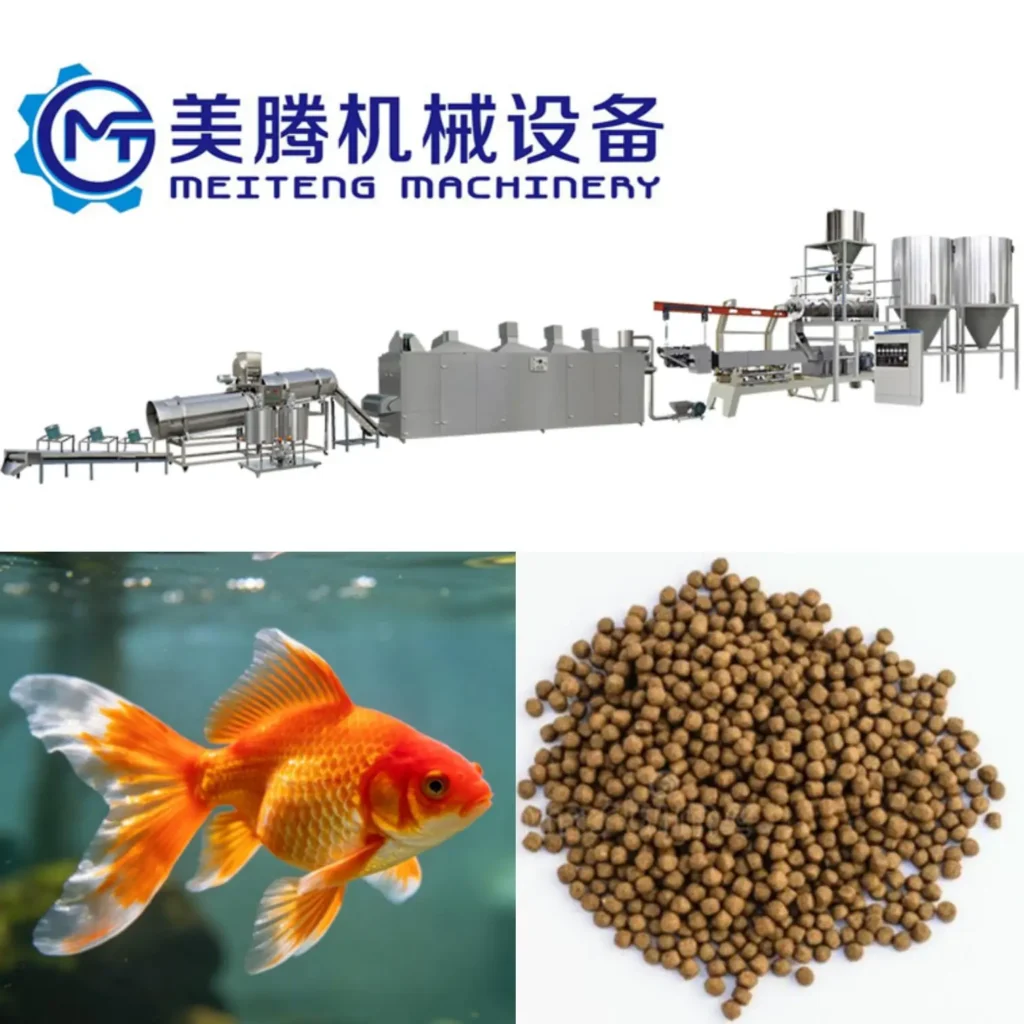
Matched Screw Geometry — configuration dialed to your exact protein and starch ratios rather than borrowed from a generic aquatic feed build.
Technical Specifications
| Parameter | Value |
|---|---|
| Product Type | Twin-Screw Fish Feed Extrusion Line |
| Extruder Type | Twin-Screw |
| Construction Material (food-contact parts) | 304 Stainless Steel |
| Output Capacity | up to 600 kg/h (basis not stated in source — confirm raw material formulation, moisture content and pellet size) |
| Control System | PLC / MCC options available |
| Line Stations | mixing → extrusion → drying → coating → cooling → packing |
| Certification | CE (line-level declaration to confirm), ISO |
Application Suitability
| Application | Material or Output |
|---|---|
| Floating pellet production for tilapia and carp | Starch-rich formulations requiring high expansion ratio |
| Sinking pellet production for trout and salmon | High-protein formulations with controlled density |
| Multi-species aquaculture feed plants | Variable formulations switching between floating and sinking targets |
| Catfish kibble lines | Corn, wheat and fish meal blends at medium moisture |
Why "600 kg/h" Means Nothing Without Your Formulation
Capacity figures only hold when tied to a specific raw material profile and target pellet density.
I once watched a fish feed line ship out rated at its brochure capacity, only for the buyer’s high-protein formulation to collapse the expansion entirely. Every pellet sank in the pond. Tilapia, which feed at the surface, ignored the lot. The rated number on the nameplate was technically accurate — for a different recipe. [NEED_CITE: starch gelatinisation thresholds in high-protein extrusion]
When the actual fish meal protein content in the buyer’s premix runs higher than what the trial used, the melt viscosity inside the barrel changes. Shear behaviour shifts. The die pressure needed to hold expansion climbs. A twin-screw fish feed extrusion line that performs on one formulation can underperform sharply on another if screw elements and barrel zones were never reconfigured for that chemistry. This is why any serious capacity discussion must begin with a material sample, not a catalogue page.
Barrel Temperature Zones and Starch Gelatinisation
The barrel on a twin-screw fish feed extrusion line is divided into independent heating and cooling zones. Each zone controls the thermal history of the melt at a different stage — preconditioning near the feed inlet, peak gelatinisation at the mid-barrel, and viscosity management approaching the die. When starch granules absorb moisture under shear and heat, they swell and rupture, forming the matrix that traps steam at the die exit and drives pellet expansion. If a zone runs too cool, gelatinisation is incomplete and the pellet crumbles. Too hot, and the protein network denatures before the starch can set, collapsing the structure.
Screw Element Sequencing for Density Control
Twin-screw extruders build their screw from interchangeable elements — conveying sections, kneading blocks, and reverse-flight segments. The sequence of these elements determines how long material stays in the barrel, how much shear it receives, and where peak pressure develops. For floating pellets, the screw is typically arranged to maximise shear and residence time so the starch matrix fully gelatinises and traps maximum steam at the die. For sinking pellets, the same twin-screw fish feed extrusion line can be reconfigured with fewer kneading blocks and a shorter high-shear section, reducing expansion so the pellet retains a density above water. This modularity is the core advantage of twin-screw over single-screw designs in aquaculture feed. [NEED_CITE: screw element configurations for aquafeed extrusion]
Reading the Specification Sheet Against Your Process
Output capacity listed at up to 600 kg/h carries no meaning until it is anchored to a formulation. The protein-to-starch ratio, initial moisture content, and target pellet diameter all shift what the extruder can actually deliver. The twin-screw configuration itself — whether the screws are co-rotating and the L:D ratio — determines the shear envelope available. Control system options (PLC or MCC) influence how consistently barrel zones and screw speed hold setpoints across a long production run. Food-contact parts in 304 stainless steel ensure corrosion resistance against the salts and organic acids common in fish meal blends. Each of these parameters should be evaluated against your specific recipe, not against a generic datasheet.
The Hidden Cost of a Generic Screw Build
When screw elements and die geometry are copied from a previous installation rather than matched to your raw material, the consequences arrive quietly. Floating feed that drifts downward after a few seconds in water. Pellets that disintegrate before fish can consume them, fouling pond water and raising ammonia levels. Production runs that need constant manual adjustment to barrel temperatures just to hold a marginal density spec. [NEED_CITE: aquafeed pellet durability and water stability standards]
None of these failures appear on a factory acceptance test that used a different formulation. The line runs, the pellets look right on the conveyor, and the problem only surfaces once the feed hits the pond — hundreds of kilometres from the factory floor, with the buyer’s reputation on the line.
What This Build Brings to Your Process
Every station on this twin-screw fish feed extrusion line — from batching through mixing, extrusion, drying, coating, cooling and packing — is sized so throughput matches across the chain rather than bottlenecking at one point. Screw configuration and die design are specified against the buyer’s raw material sample, not pulled from a standard library. An in-house testing workshop runs trial production on your actual formulation before the line ships, generating a trial run report that documents achievable density, expansion ratio and pellet durability on your recipe. The 304 stainless steel food-contact construction handles the corrosive nature of fish meal and mineral premixes. PLC and MCC control options are confirmed for your local voltage, frequency and preferred operating language before production begins.
Documentation & Verification
- Screw and die configuration record matched to your formulation
- Trial run report on your raw material from in-house testing workshop
- Line layout with throughput calculation across every station
- Electrical schematic with voltage and frequency confirmation
- CE declaration of conformity documentation package
- Operation and maintenance manual with wear parts list
Installation, Commissioning & Support
- Foundation and floor space plan based on full line footprint
- Power supply spec with dedicated circuit requirements for PLC or MCC panel
- Modular delivery with on-site assembly and barrel alignment check
- First-run commissioning with screw speed and barrel zone tuning
- Operator training covering die changes and screw element swaps
- Wear parts list with recommended spare screw and die inventory
Before You Request a Quote
To configure a twin-screw fish feed extrusion line that holds your density spec, we need your target species and whether the feed must float or sink. Share the raw material formulation — or at minimum the protein and starch sources with approximate ratios — along with your target pellet diameter range. Confirm your site voltage, frequency, and the control language your operators will work with. If you can send a sample of your premix, a trial run in the testing workshop will give you hard data before any commitment.
Frequently Asked Questions
Q: How is output capacity verified for my specific formulation?
A: Capacity depends on your raw material’s protein-to-starch ratio, moisture content and target pellet size. We run your actual formulation through the in-house testing workshop before shipment and document achievable throughput in a trial run report, rather than quoting a generic number disconnected from your recipe.
Q: How do you match screw configuration to my feed formulation?
A: Screw elements — conveying flights, kneading blocks, reverse segments — are sequenced based on your material’s shear sensitivity and target expansion. High-protein formulations typically need fewer kneading blocks than starch-heavy blends. The die geometry is then selected to match the expansion ratio your pellet density requires.
Q: How is floating versus sinking density controlled during extrusion?
A: Pellet density is governed by how much steam is trapped in the starch matrix at the die exit. Barrel temperature profile, screw element sequence and moisture injection together determine the degree of gelatinisation and expansion. Adjusting these parameters shifts the pellet between floating and sinking behaviour.
Q: Can a trial run be done on my raw material before I commit?
A: Yes. The in-house testing workshop runs your actual formulation through the extruder before shipment. The resulting trial run report documents pellet density, expansion ratio, durability and throughput, so you evaluate performance on your material before the line leaves the factory.