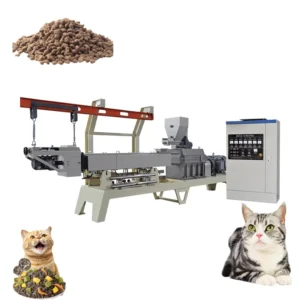
Screw Geometry Matched to Feedstock — the MT-70 barrel and screw elements are selected after reviewing your actual protein ratio, fat content, and starch source rather than defaulting to a generic pet food build.
Technical Specifications
| Parameter | Value |
|---|---|
| Model | MT-70 |
| Product Type | Twin Screw Pet Food Extrusion Line |
| Output Capacity | 200–250 kg/h (basis not stated in source — confirm raw material formulation and moisture content) |
| Screw Type | Twin Screw |
| Control System | PLC Controlled |
| Applications Covered | Dog, cat, and fish food production |
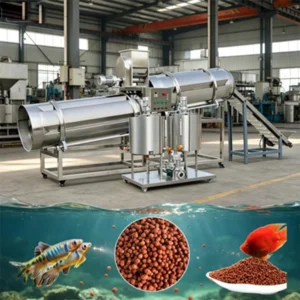
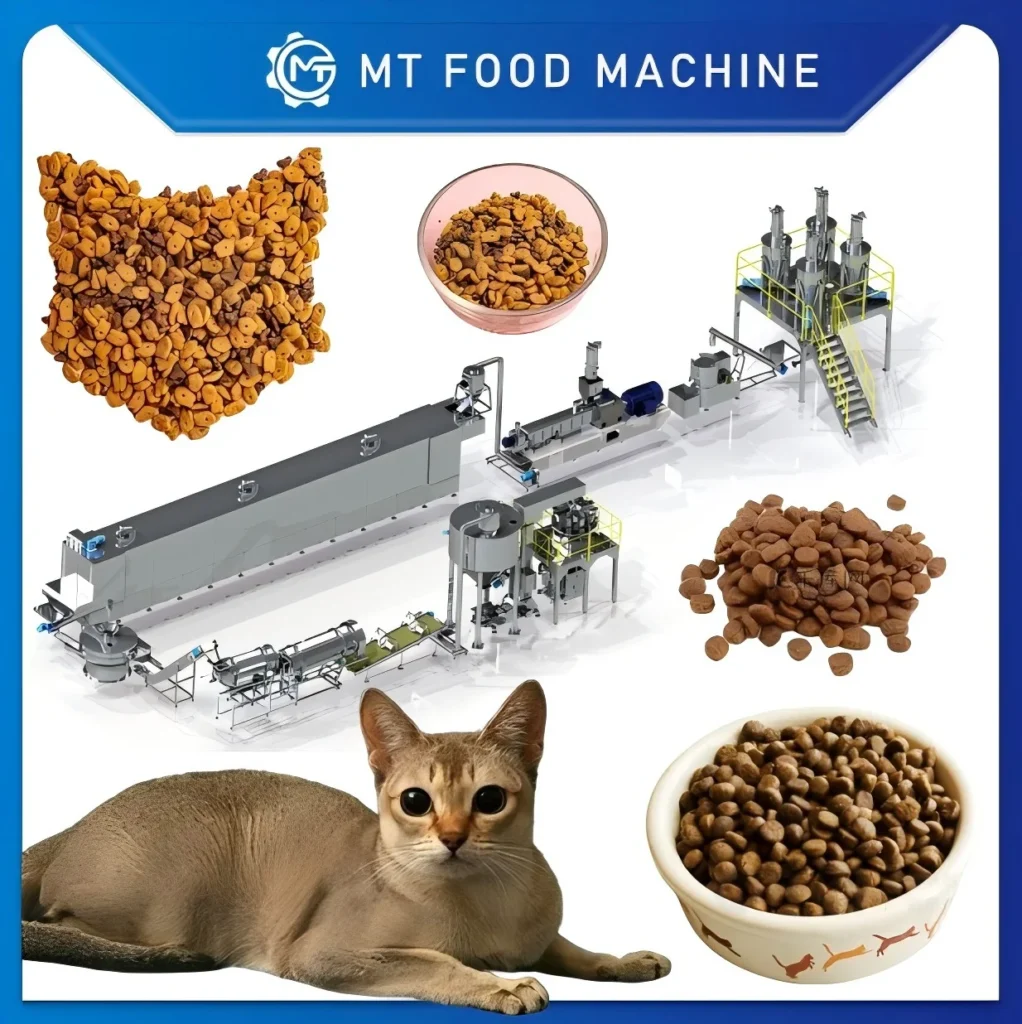
| Line Stations | Mixer, extruder, dryer, coating, cooling, packing (configuration to be confirmed per project) |
| Process Documentation | Process flow drawing provided |
| Warranty | 1 Year |
| Certification | CE (per company profile, confirm per unit) |
Application Suitability
| Application | Material or Output |
|---|---|
| Dry kibble for adult dogs | Corn, poultry meal, soy protein concentrate, animal fat at varying inclusion rates |
| Premium cat food pellets | High fresh-meat or fish-meal formulations requiring controlled gelatinisation |
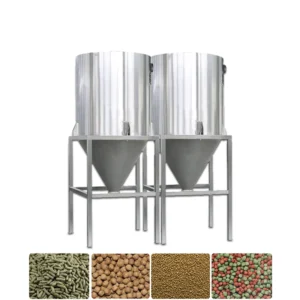
| Floating aquatic feed | Starch-rich blends tuned for low bulk density and water stability |
| Sinking aquaculture pellets | Higher-density formulations with adjusted barrel temperature profile |
| Puppy and kitten starter diets | Small-diameter die cuts with fine particle grind and uniform expansion |
What "200–250 kg/h" Actually Depends On
Capacity is a function of your formulation, not the motor plate.
A nominal throughput figure means very little when the buyer’s recipe diverges from the test material. I worked on a project last year where a Middle East client ordered a line rated at 200–250 kg/h, but their kibble formula carried noticeably more protein than our standard trial blend. On their actual mix, output settled around 180 kg/h until we reworked the screw pitch and die land length. The twin screw pet food extrusion technology inside the MT-70 handles a wide formulation window, but only when the configuration is matched to real ingredient data before the machine ships [NEED_CITE: impact of protein and fat ratios on extruder throughput in pet food production].
How Barrel Temperature Zones Shape Kibble Texture
The MT-70 barrel is divided into independently heated and cooled zones, each managed by the PLC. Early zones keep the blend below gelatinisation temperature so that mixing is thorough before the starch granules rupture. Later zones push heat into the dough precisely where expansion must occur. When the temperature profile is flat or poorly staged, kibble exits the die with an inconsistent cell structure — dense in some pieces, hollow in others. Tuning each zone to the starch source in your recipe is where twin screw pet food extrusion technology separates a stable product from a bag full of fines.
Screw Element Sequencing for Protein-Rich Formulations
Twin screws are built from individual flighted elements slipped onto splined shafts, and the order of those elements changes everything. Conveying sections move material forward, kneading blocks introduce shear, and reverse elements create residence time for cooking. A high-fresh-meat cat food recipe demands more kneading blocks and fewer aggressive reverse elements than a corn-heavy dog kibble formula. Getting this sequence wrong means either undercooked product or a barrel that surges and stalls. The MT-70 screw configuration is documented element by element so that the setup can be replicated or adjusted for future product runs [NEED_CITE: twin screw element arrangement and shear rate in food extrusion].
Reading the Spec Sheet Beyond the Headline Numbers
The PLC control on the MT-70 logs barrel temperatures, screw speed, and feeder rates for every production batch, which matters when you need to reproduce a kibble run six months later. Die selection — both the number of openings and the land length — directly governs pellet diameter and density; a longer land increases back-pressure and produces a denser, slower-expanding pellet. Moisture injection points along the barrel let operators fine-tune dough consistency without stopping the line. These parameters interact: raising screw speed increases shear heat, which may require reducing external barrel heating to avoid scorching. Understanding these relationships is the reason twin screw pet food extrusion technology requires a trial phase rather than a catalogue order.
The Cost of Skipping a Pre-Shipment Trial
I have seen lines arrive at a buyer’s facility only to produce kibble that sinks when it should float, or expands so aggressively that the coating drum cannot keep up. The root cause is almost always a screw and die setup that was copied from a previous project with a different raw material. Reworking those components on-site adds weeks of downtime and burns through raw material that could have been sold. A short trial run in the manufacturer’s testing workshop catches these mismatches before the crate is nailed shut [NEED_CITE: typical rework costs when extruder configuration is not validated before shipment].
Why the MT-70 Is Specified Per Order, Not Pulled from Stock
Every MT-70 line ships with a screw and die configuration record that names each element, its position on the shaft, and the die land length chosen for the buyer’s target kibble density. The in-house testing workshop runs the buyer’s own raw material through the assembled extruder, generating a trial run report that documents actual throughput, expansion ratio, and pellet durability. Line layout drawings match station capacities so the dryer, coating drum, and cooler are sized to the extruder’s real output rather than a brochure figure. Electrical schematics and voltage confirmation are completed before production begins, eliminating the commissioning delays that arise when a 400 V machine arrives at a 380 V facility. CE documentation accompanies every unit, and an operation and maintenance manual covers routine barrel cleaning, screw element inspection intervals, and wear-part replacement procedures.
Documentation & Verification
- Process flow drawing showing each station from batching through packing
- Screw and die configuration record listing every element and land length
- Trial run report on your raw material with throughput and expansion data
- Electrical schematic with voltage and frequency confirmed for your facility
- CE declaration of conformity and ISO certificate supplied with shipment
- Wear parts list identifying screw elements, dies, and cutter bearings
Installation, Commissioning & Support
- Foundation plan accounts for MT-70 footprint and dynamic load from twin screw drive
- Dedicated circuit sized to PLC-controlled motor and barrel heater ratings
- Extruder arrives with barrel sections separated for site reassembly and alignment
- First-run commissioning includes barrel temperature staging and screw speed tuning
- Operator training covers PLC parameter recall for repeat kibble formulations
- Spare screw elements and die plates stocked against the configuration record
- Scheduled barrel liner and screw flight inspection intervals documented in manual
What We Need Before Quoting
Send your raw material formulation with protein, fat, starch, and moisture percentages, along with the kibble diameter and bulk density your market requires. We also need your facility voltage and frequency, the available floor area for the full line, and whether you want a trial run on your ingredients before the extruder leaves the workshop.
Frequently Asked Questions
Q: How is screw configuration and die design selected for a specific raw material formulation?
A: We review the buyer’s ingredient list — protein source, starch type, fat level, and target moisture — then arrange conveying, kneading, and reverse elements on the twin screw shafts to match. Die land length and hole count are chosen to deliver the required kibble density. A trial run on the actual raw material confirms the setup before shipment.
Q: What barrel temperature profile is needed for proper starch gelatinisation in pet food extrusion?
A: Early barrel zones stay below the gelatinisation point to ensure thorough mixing, while later zones climb past it so starch granules rupture uniformly. The PLC on the MT-70 manages each zone independently, and the profile is adjusted during the trial run to match the specific starch source in the buyer’s recipe.
Q: How is kibble density and expansion controlled through moisture and shear parameters?
A: Moisture injection along the barrel changes dough viscosity, which alters how much the product expands at the die. Screw speed governs shear intensity and residence time. Together with die land length, these variables let operators target a specific bulk density for floating aquatic feed or dense, slow-sinking kibble.
Q: Can a trial run be conducted on my raw material before shipment?
A: Yes. The in-house testing workshop runs the buyer’s formulation through the fully assembled MT-70, recording actual throughput, expansion ratio, and pellet durability. The trial run report ships with the machine so the buyer can replicate results at their own facility from day one.
Q: How does extrusion technology differ between floating aquatic feed and dry kibble production?
A: Floating feed requires high expansion and low bulk density, achieved with aggressive shear and short die land lengths. Dry kibble for dogs or cats targets a denser, more durable pellet, which means longer die lands and a milder barrel temperature profile. The MT-70 twin screw configuration is reconfigured between runs to suit each product.