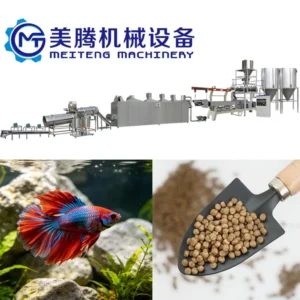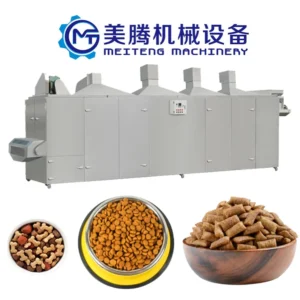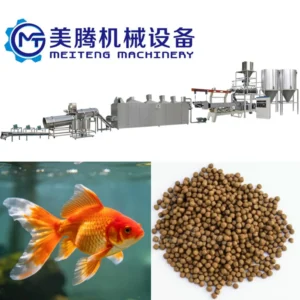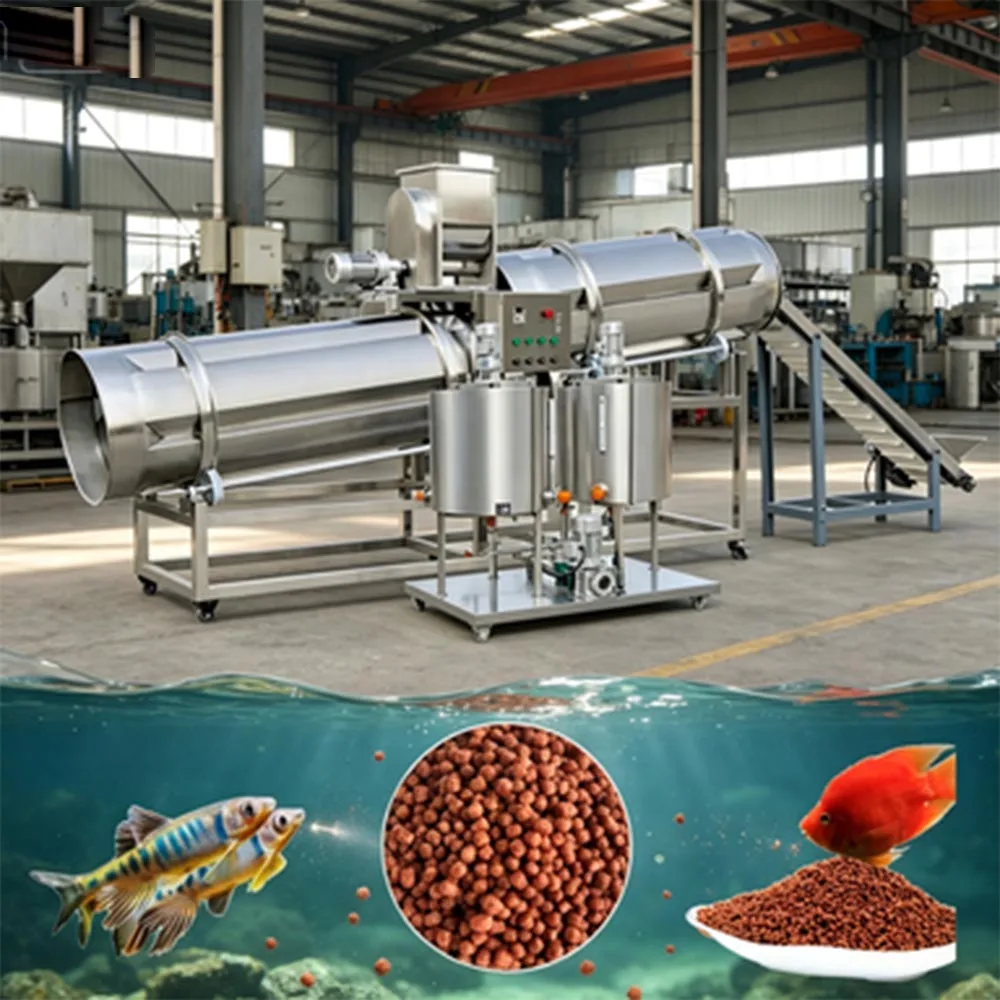
Wet Twin Screw Extruder for Floating Sinking Aquatic Fish Feed Pellets – Turnkey Solution
Screw configuration matched to formulation — every die and screw segment is specified against your actual raw material blend and target buoyancy, not copied from a generic aquatic feed build.
Technical Specifications
| Parameter | Value |
|---|---|
| Product Type | Twin Screw Aquatic Fish Feed Extrusion Production Line |
| Screw Type | Twin screw, wet extrusion |
| Control System | Intelligent PLC automatic control |
| Material Contact Parts | Food-grade 304 stainless steel |
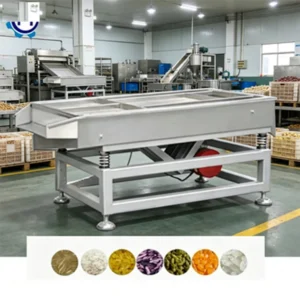
| Line Stations | Mixer → Extruder → Dryer → Seasoning/coating machine → Vibrating sieve → Conveyor → Finished product discharging |
| Automation Level | Full continuous automatic production |
| Pellet Adjustability | Size, hardness, buoyancy (floating and sinking) |
| Energy Features | Optimized energy-saving transmission structure and heating system |
| Maintenance Design | Quick replacement of vulnerable parts, convenient daily cleaning |
| Assembly State | Complete matched production configuration |
| Output Capacity | Large stable processing capacity for medium-to-large scale production (basis to be confirmed per raw material formulation, pellet size, and moisture content) |
| Voltage & Frequency | Configurable per destination market |
| Screw Diameter / L:D Ratio | To be confirmed per application |
| Barrel Zones | To be confirmed per application |
| Die Configuration | To be confirmed per pellet size target |
| Moisture Range | Steam or water injection (wet extrusion) |
| Certification | CE and ISO (confirm per line configuration) |
Application Suitability
| Application | Material or Output |
|---|---|
| Floating feed for catfish and tilapia | Fish meal, soybean meal, corn powder with compound additives |
| Sinking feed for shrimp and bottom-feeding species | High-protein formulations with adjusted moisture profiles |
| Ornamental fish pellets for koi, goldfish, tropical fish | Specialty blends requiring uniform density and smooth surface finish |
| Medium-to-large scale aquaculture operations | Continuous mass production of size-graded floating and sinking pellets |
Why "One-Size-Fits-All" Extrusion Ruins Pellet Buoyancy
Floating feed that sinks, or sinking pellets that drift — these failures trace back to screw configuration and die design copied from a generic build rather than matched to your actual raw material formulation and target buoyancy.
The twin screw fish feed extrusion technology must be dialed to your specific formulation, not borrowed from someone else’s production sheet.
I once watched a European aquaculture operation pull an entire production run from their packing line because the koi pellets they ordered were supposed to float for sixty seconds before a slow descent, but half the batch sank immediately. The extruder was configured for a standard tilapia formula, not the higher-fat ornamental blend the buyer was running. A few degrees of barrel temperature and one screw segment change would have solved it, but the line shipped with a default setup [NEED_CITE: impact of screw configuration on aquatic feed buoyancy control].
Barrel Temperature Profiles and Moisture Control in Wet Extrusion
The wet twin screw extrusion aquatic feed production line relies on precise steam and water injection to precondition raw material before it enters the barrel. Barrel temperature across multiple zones must be set to match the starch gelatinisation point of your specific grain and protein blend. Too much moisture in a high-soybean formulation and the pellets expand past target density; too little and the surface cracks during drying.
Die Geometry and the Floating-versus-Sinking Decision
Every pellet that leaves the die carries the signature of its aperture shape, length, and the pressure profile just behind it. For floating catfish feed, the die must allow sufficient expansion at the moment of exit. For sinking shrimp feed, a tighter die with higher back-pressure compresses the matrix into a denser pellet. Swapping between floating and sinking production on the same line requires a documented die configuration change, not guesswork by the operator. This is where the twin screw fish feed extrusion technology separates operations that hold specification from those that produce off-grade material [NEED_CITE: die design principles for extruded aquatic feed density control].
Reading the Specification Sheet Against Your Raw Material
The screw diameter and length-to-diameter ratio determine how long material stays inside the barrel and how much shear energy it absorbs before reaching the die. A high-fishmeal formulation behaves differently from a corn-dominant blend at identical screw speeds, so the rated output capacity only holds meaning when tied to your actual recipe and target pellet diameter. The PLC control system monitors barrel pressure and temperature across zones, but those set-points must be established during a trial run on your raw material, not assumed from a generic parameter list. Contact parts in food-grade 304 stainless steel resist corrosion from the salt and mineral content typical in aquatic feed blends, extending intervals between screw and barrel replacements.
The Cost of Skipping a Trial Run on Your Formulation
When an extrusion line ships without a trial run on the buyer’s actual raw material, the first week of production becomes an expensive experiment. Operators adjust barrel temperatures, swap screw elements, and test different die plates while raw material burns through the system and off-spec pellets pile up. The dryer may be undersized for the moisture content your particular formulation exits at, creating a bottleneck that forces the extruder to idle. I have seen this pattern repeat at aquaculture feed operations across different markets, and it always traces back to skipping the trial run that would have surfaced these mismatches before the line left the factory [NEED_CITE: pre-shipment trial run benefits for extrusion line commissioning].
Why Source This Line Through the Extrusion Technology Lens
Every screw segment and die plate is specified against your raw material formulation and target pellet buoyancy rather than pulled from a standard build catalog.
The barrel temperature profile is mapped to your starch and protein blend during a pre-shipment trial run in the testing workshop, so set-points are documented before the line arrives at your facility.
Throughput is calculated across every station — mixer, extruder, dryer, seasoning drum, vibrating sieve — so no single component becomes a bottleneck when running your actual formulation.
Electrical schematics and PLC programming language are confirmed for your destination market before production begins, preventing commissioning delays caused by voltage or control interface mismatches.
Documentation & Verification
- Line layout and capacity calculation matched to your raw material formulation and target pellet size
- Screw and die configuration record specifying every barrel zone setting for floating and sinking production
- Trial run report on your raw material documenting pellet density, floating rate, and surface finish
- Electrical schematic with voltage and frequency confirmed for your destination market
- Factory test record with PLC parameter logs from the pre-shipment testing session
Installation, Commissioning & Support
- Foundation and utility planning based on the complete line footprint including dryer and conveying equipment
- Dedicated electrical circuits sized to the PLC-controlled extruder motor and multi-zone barrel heating system
- On-site assembly of all line stations with throughput verification across mixer, extruder, dryer, and coating
- Initial barrel temperature and screw speed calibration using your raw material to match target pellet buoyancy
- Operator training on die changeover procedures between floating and sinking pellet configurations
- Wear parts inventory covering screws, dies, and barrel liners with recommended replacement intervals for aquatic feed
What We Need to Configure Your Line
Send your raw material formulation including protein source, grain ratio, and fat content alongside the target pellet diameter and whether you need floating, sinking, or both. We also need your facility voltage and frequency, the PLC interface language your operators require, and whether your existing packaging line has throughput constraints we should match the extrusion output to.
Frequently Asked Questions
Q: How is screw configuration and die design matched to my raw material and target pellet buoyancy?
A: Each screw segment and die plate is selected based on your specific formulation’s protein content, fat ratio, and starch source. We run a trial on your raw material in our testing workshop, adjusting barrel zones and screw geometry until pellet density, floating rate, and surface finish match your specification. The final configuration is documented and ships with the line.
Q: What barrel temperature profile and moisture control are needed for different aquatic feed formulations?
A: Barrel zone temperatures and steam injection rates vary significantly between a corn-dominant blend and a high-fishmeal recipe. During your pre-shipment trial run, we establish the exact temperature curve and moisture set-points for your formulation, then lock those parameters into the PLC so operators can recall them for each production batch.
Q: Can I do a trial run on my own raw material before shipment to verify pellet density and floating rate?
A: Yes. Our in-house testing workshop runs your actual raw material through the configured extruder, dryer, and coating station before the line ships. You receive a trial run report showing pellet density measurements, floating duration tests, and surface finish documentation against your target specification.
Q: How is throughput balanced between the extruder, dryer, and coating stations to avoid line bottlenecks?
A: We calculate capacity at every station based on your pellet size, moisture content at the extruder exit, and drying time required for your formulation. The dryer length, seasoning drum volume, and conveyor speed are all specified to match the extruder output, so no single station forces the rest of the line to idle.