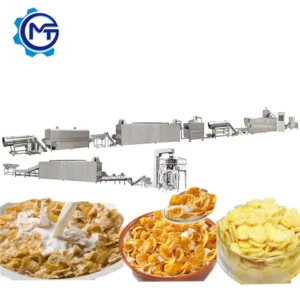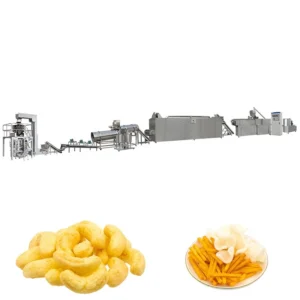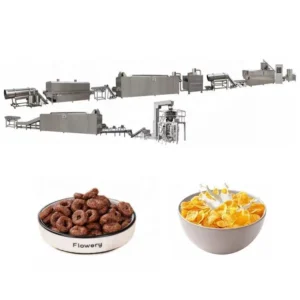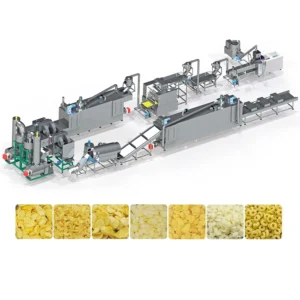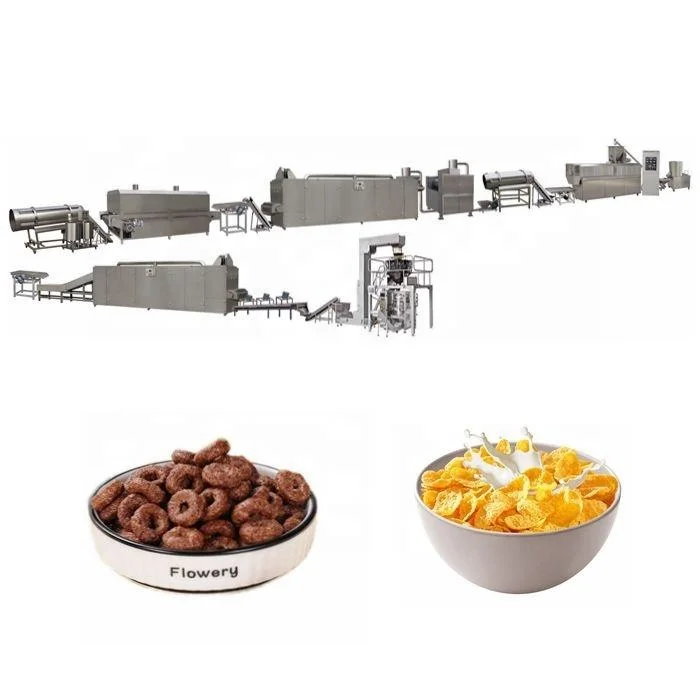
Matched Screw Geometry — Every MT70 / MT85 / MT75 barrel zone is configured after testing your actual cereal formulation, so gelatinisation and expansion are controlled rather than left to a generic screw build.
Technical Specifications
| Parameter | Value |
|---|---|
| Model | MT70 / MT85 / MT75 |
| Product Type | Twin Screw Extruded Corn Flakes Production Line |
| Screw Type | Twin-screw with automatic lubricating and cooling |
| Installed Power | 160 kW (MT70) / 190 kW (MT85) / 210 kW (MT75) |
| Power Consumption | 120 kW (MT70) / 140 kW (MT85) / 150 kW (MT75) |
| Output Capacity | 150–200 kg/h (MT70) / 300–400 kg/h (MT85) / 300–500 kg/h (MT75) (basis not stated in source — confirm raw material type and moisture content) |
| Overall Dimensions (L×W×H) | 41 × 1.5 × 2.2 m (MT70) / 43 × 1.5 × 3.2 m (MT85) / 45 × 1.5 × 3.5 m (MT75) |
| Control System | PLC and MCC control with flaker PLC integration |
| Flaker Drive | Double motors, hydraulic system for dual rollers |
| Flaker Temperature Control | Infrared sensor with even temperature pipe |
| Dryer Heating Source | Gas or Electric (configurable) |
| Roasting Oven | Hot air roasting, conciliation burner, dual circulating fans, cyclone dust removal |
| Coating System | Double tumble sugar melting, elevator, coating drum, spraying nozzle |
| Line Configuration | Complete turnkey line from mixing through packing |
| Voltage & Frequency | Customizable per local supply (source value — verify against manufacturer catalog) |
| Standards | CE, ISO |
Application Suitability
| Application | Material or Output |
|---|---|
| Natural corn flakes for breakfast cereal market | Corn grits, corn flour |
| Sugar-coated corn flakes | Corn, rice, wheat base with sugar glaze |
| Multi-grain breakfast flakes | Rice, wheat, oat, barley powder blends |
| Shaped cereal products (ball, ring, star, fruit loop) | Corn and grain formulations with die adjustment |
| Expanded snack foods | Corn, rice, wheat, oat, barley-based raw materials |
Why "Rated Capacity" Means Nothing Without Your Formulation
A corn flakes line only holds its stated output on the specific raw material and moisture profile it was configured for.
I learned this the hard way years ago on a South American project. The line ran smooth during factory trials on standard corn grits, but the buyer switched to a high-fibre whole wheat formula at their facility and expansion collapsed — flakes came out uneven in thickness, the whole batch was scrapped. Nominal throughput numbers on a spec sheet do not account for the starch composition, fibre content, or moisture behaviour of your actual grain blend. When the corn flakes extrusion technology twin screw setup is built around a generic screw profile, the barrel cannot deliver consistent gelatinisation across formulations [NEED_CITE: starch gelatinisation behaviour across grain varieties].
Screw Configuration Dictates Gelatinisation Depth
The twin-screw geometry and L:D ratio must match the starch content of your specific grain input. Corn grits gelatinise at a different moisture threshold and shear requirement than oat or barley flour. When the screw profile is specified to your formulation, each barrel zone delivers the correct residence time and shear intensity, so the extrudate exits the die at the right degree of cook — not under-processed, not over-sheared. This is where corn flakes extrusion technology twin screw design separates a consistent flake from one that shatters during roasting.
Barrel Temperature Profile Controls Flake Density
Every zone along the barrel carries its own temperature setting, and the profile changes depending on whether you are running natural flakes or a sugar-coated variant. Too much heat in the metering section causes premature expansion before the flaker; too little leaves the pellet under-expanded and dense. Moisture injection points and steam input are balanced against barrel heat to govern the final pellet density entering the flaking rollers [NEED_CITE: barrel zone temperature control in cereal extrusion]. The hydraulic flaker system with infrared temperature monitoring then compresses each pellet to a uniform thickness, which directly determines crispness after the hot air roasting stage.
Die Geometry Determines What the Flaker Receives
The die plate shapes every extrudate pellet before it reaches the flaking station. Pellet diameter and length set the contact area on the roller and influence how evenly the flake spreads under pressure. Switching dies also allows the same extrusion platform to produce shaped cereal formats — rings, stars, fruit loops — without changing the core screw build. For processors moving between natural corn flakes and multi-grain variants, die swaps are faster than reconfiguring the entire barrel assembly.
Reading the Spec Sheet Like a Process Engineer
Installed power across the MT70, MT85, and MT75 models ranges from 160 kW to 210 kW, with actual power consumption sitting at roughly 70–75% of that figure during steady-state operation. The gap between installed and consumed power reflects the peak demand during startup and the headroom needed when processing higher-fibre or higher-moisture blends that demand more torque. The double-motor flaker drive with hydraulic roller pressure allows independent speed control on each roller, preventing the sheet tearing that single-drive flakers cause on uneven pellet feeds. Gas-heated dryers reduce per-hour energy cost where gas is cheap; electric dryers offer tighter temperature control in markets where electricity pricing is stable. The conciliation burner in the roasting oven paired with dual circulating fans distributes hot air evenly, so flakes at the centre of the belt roast at the same rate as those at the edges.
The Cost of Skipping the Trial Run
Buyers who approve a line based on a generic screw configuration and skip the raw material trial run often discover the mismatch during commissioning — weeks after the equipment arrives. Flakes may come out too dense for the target market, or the sugar coating fails to adhere because the surface porosity is wrong. Retooling the screw and die on-site costs time and often requires flying in a technician [NEED_CITE: on-site extruder reconfiguration downtime and cost]. Running your actual formulation through the testing workshop before shipment catches these problems when they are still cheap to fix.
Why Source This Line From a Single Supplier
The complete line from batching through packing sits under one supplier, so throughput between the extruder, flaker, dryer, roaster, and coating drum is calculated to match rather than assembled from disconnected vendors. Screw configuration and die design are specified to your grain formulation, not pulled from a catalogue of generic builds. An in-house testing workshop allows trial runs on your actual raw material before the line ships. Twin-screw expertise spans corn, rice, wheat, oat, and barley applications, so reconfiguration guidance is available when you add a new SKU. Pre-sales engineering covers line layout, utility planning, and capacity balancing from the first consultation.
Documentation & Verification
- Line layout with throughput calculations matched across every station for your target capacity
- Screw and die configuration record documented against your specific cereal formulation
- Trial run report on your raw material validating expansion, density, and flake thickness
- Electrical schematic with voltage and frequency confirmation for your local grid
- Operation and maintenance manual with wear parts list for screw and die replacements
- CE declaration of conformity and ISO certificate for customs and compliance
Installation, Commissioning & Support
- Foundation and floor space planning based on the 41–45 m line footprint and station clearances
- Dedicated electrical circuit sized to the 120–150 kW operating load with confirmed voltage and frequency
- Assembly sequence from extruder through roaster with utility connections mapped per station
- First-run parameter setting including barrel temperatures, flaker pressure, and roaster airflow
- Operator training covering die changes, screw cleaning, and PLC interface navigation
- Wear parts supply schedule for screw elements, die plates, and flaker roller surfaces
- Routine maintenance intervals for the automatic screw lubrication and cooling system
What We Need to Configure Your Line
Before quoting, we need your grain formulation details — the specific flour or grit type, blend ratios, and target moisture at the mixer output. Share your daily production target and the bowl-life or crunch specification your market expects. If your facility has existing upstream milling or downstream packing equipment, let us know the interface points so the line layout accounts for them. Confirm your local voltage, frequency, and preferred PLC language so the control panels are built to match.
Frequently Asked Questions
Q: How is the screw configuration matched to my cereal raw material?
A: We run your actual grain blend in our testing workshop before finalising the screw profile. Starch content, fibre level, and moisture behaviour determine the L:D ratio, flight depth, and kneading block placement in each barrel zone. The configuration is documented per your formulation, not copied from a standard build.
Q: How do you confirm stated capacity on my formulation during trials?
A: The trial run uses your raw material at your specified moisture content. We measure throughput at steady state, record expansion ratio and flake density, and compare results against your target. The trial report becomes part of your documentation package before shipment.
Q: What controls flake density for natural versus sugar-coated variants?
A: Barrel temperature profile, moisture input, and die geometry together govern pellet density entering the flaker. Sugar-coated variants often require a slightly denser pellet to withstand the coating drum tumbling. The hydraulic flaker with infrared temperature control then sets the final flake thickness.
Q: How is throughput balanced across extruder, flaker, dryer, and roaster?
A: Each station is sized during the line layout phase so that no single unit creates a bottleneck. The extruder output rate, flaker belt speed, dryer residence time, and roaster capacity are calculated together based on your formulation and target hourly volume.
Q: What PLC options are available and how is voltage confirmed?
A: The PLC and MCC control system supports configurable interface languages. Voltage and frequency are confirmed against your local grid specification before electrical panels are built. The electrical schematic is included in your documentation package for local electrician reference during installation.