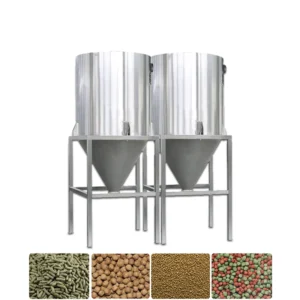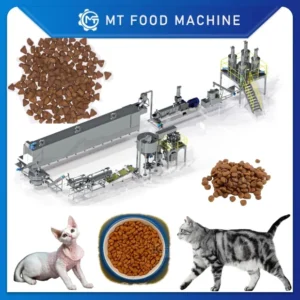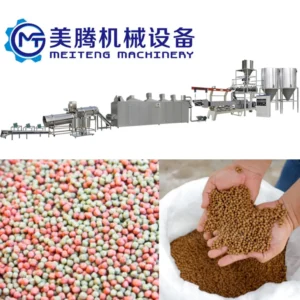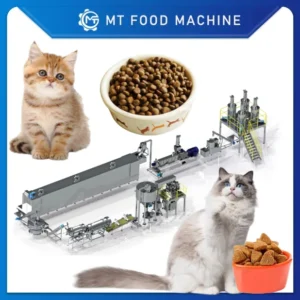
Process-Specific Extrusion Profiling — Every screw element and die orifice is matched to the buyer’s actual raw material formulation and target pellet buoyancy, verified through in-house trial runs before dispatch.
Technical Specifications
| Parameter | Value |
|---|---|
| Product Type | Twin Screw Aquatic Fish Feed Extrusion Production Line |
| Screw Type | Twin screw |
| Control System | Intelligent PLC automatic control system |
| Contact Material | Food grade 304 stainless steel |
| Production Mode | Full continuous automatic production |
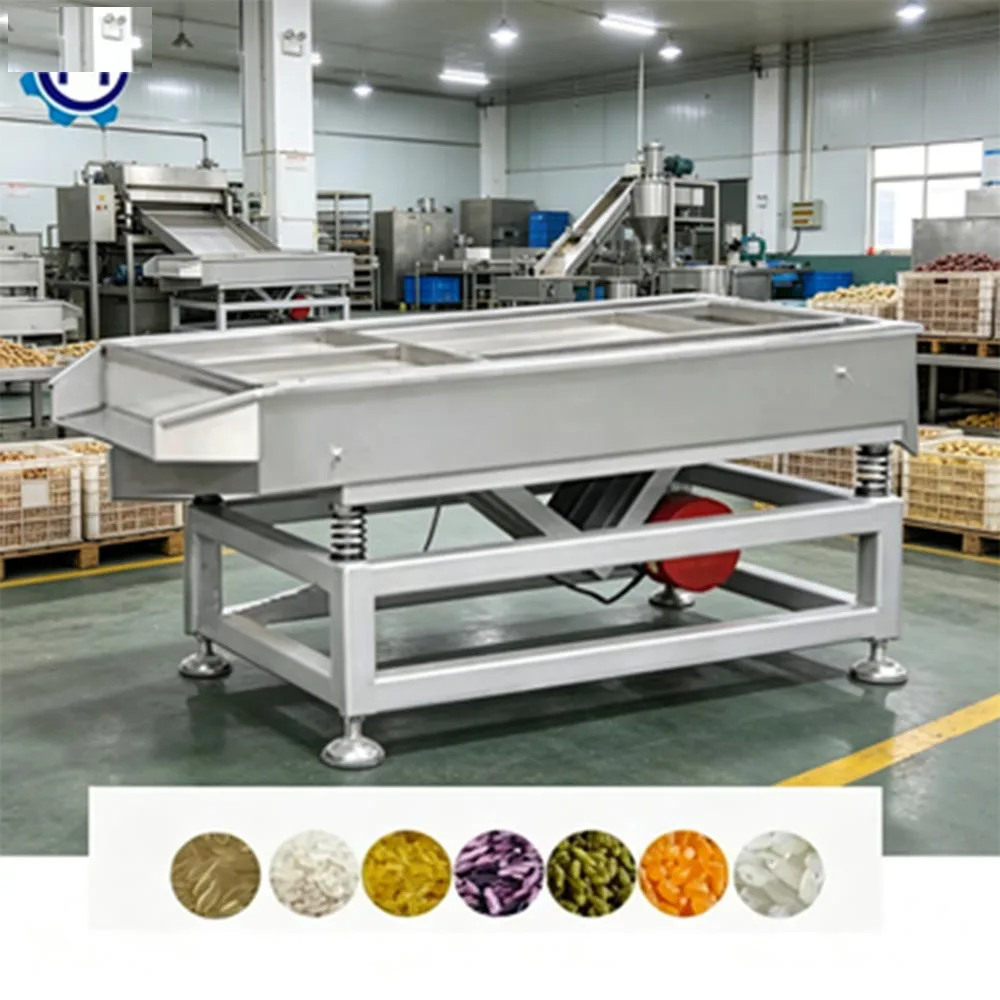
| Line Stations | Mixer, extruder, dryer, seasoning coating machine, vibrating sieve, conveyor equipment |
| Pellet Adjustment | Adjustable pellet size, hardness, and buoyancy |
| Energy Feature | Optimized energy saving transmission structure and heating system |
| Processing Capacity | Large stable capacity for industrial mass production (basis not stated in source — confirm raw material formulation, pellet size and moisture content) |
| Certification | CE, ISO |
Application Suitability
| Application | Material or Output |
|---|---|
| Floating pellets for koi and goldfish | Fish meal, corn powder, soybean meal, compound additives |
| Sinking pellets for tropical freshwater species | High-ratio cassava starch, fish meal, vitamin premix |
| Slow-sinking pellets for bottom-feeding fish | Blended grain and protein meals with adjusted moisture |
| Medium to large scale commercial aquaculture feed | Continuous output matched to dryer and coating throughput |
Why Generic Buoyancy Promises Fail at Commissioning
Floating feed that sinks on arrival, or sinking pellets that refuse to drop below the surface, trace back to one root cause: screw configuration and die design copied from a standard build rather than matched to the buyer’s specific formulation. Buoyancy is an extrusion variable, not a catalog checkbox. When twin screw aquatic fish feed extrusion technology is applied without profiling the starch gelatinization curve of the actual raw material, density drifts outside the narrow band the market expects. Process engineers who have rebuilt a barrel temperature profile mid-commissioning know the cost of skipping a pre-shipment trial run [NEED_CITE: starch gelatinization temperature thresholds for cassava versus corn starch in aquatic feed].
Shear History and Starch Gelatinization Depth
Twin screw aquatic fish feed extrusion technology controls pellet density primarily through the shear history the material experiences inside the barrel. By alternating conveying elements, kneading blocks, and reverse-flight screws along the shaft, the process dictates how thoroughly starch granules rupture and release amylose. A formulation high in cassava starch demands a different kneading block sequence than one dominated by corn meal, because the gelatinization onset temperature and moisture threshold diverge significantly. Getting this wrong means the pellet exits the die with unruptured starch cores that absorb water unevenly, destroying the buoyancy target.
Barrel Temperature Zoning and Moisture Injection
The barrel is segmented into independently heated zones, each with its own thermocouple and heating element. Moisture content at the feed throat and steam or water injection at intermediate zones further shift the expansion ratio at the die face. A process engineer tuning a sinking pellet recipe will deliberately suppress expansion in the final metering zones by lowering barrel temperature and restricting die orifice diameter. Conversely, floating pellets require maximum expansion, achieved through higher moisture at the preconditioner and elevated temperature in the last two barrel zones [NEED_CITE: relationship between die orifice diameter and pellet expansion ratio in twin screw extrusion].
Interpreting the Core Parameters
The twin screw configuration allows the L/D ratio and screw element arrangement to be rebuilt for each formulation, unlike a fixed-geometry single screw that locks the buyer into a narrow material window. Food grade 304 stainless steel contact surfaces prevent iron-catalyzed lipid oxidation in fish meal formulations, preserving pellet shelf life. The intelligent PLC automatic control system records barrel temperature, screw speed, and feeder rate for every batch, enabling traceability when a production run must be replicated months later. An optimized energy saving transmission structure reduces heat loss from the drive train into the barrel, keeping thermal input focused on the material rather than the gearbox.
The Hidden Cost of Skipping Configuration Matching
When a line ships with a generic screw profile, the buyer’s first production week is consumed by trial-and-error adjustments that stall throughput and generate off-spec pellets. Sinking feed that floats wastes an entire batch, and the cost compounds if the local market has already committed to delivery schedules. Inconsistent pellet density also stresses downstream coating drums, where seasoning adhesion depends on a predictable surface porosity. Process engineers who inherit an untuned extruder often spend more labor hours correcting buoyancy drift than they would have invested in a pre-shipment trial [NEED_CITE: cost of off-spec aquatic feed batch rejection in commercial aquaculture supply chains].
Why Process Engineers Source Here
Screw configuration and die design are specified to the buyer’s raw material and target buoyancy before production begins, not adapted after the line arrives. An in-house machine testing workshop runs the buyer’s actual formulation through the extruder before shipment, generating a trial run report that documents the barrel temperature profile and screw speed that achieved specification. Complete lines from batching to packing arrive under one supplier, meaning throughput is matched across the mixer, extruder, dryer, and coating stations rather than assembled from disconnected vendors. Pre-sales consultation extends through on-site installation and commissioning, with operator training covering PLC parameter adjustment for future recipe changes. Ongoing maintenance support includes a documented wear parts list so replacement screws and dies are available when the first changeover is due.
Documentation & Verification
- Line layout and capacity calculation showing throughput balance across mixer, extruder, dryer, and coating stations
- Screw and die configuration record matched to the buyer’s raw material formulation
- Trial run report on customer raw material verifying floating or sinking pellet density before shipment
- Electrical schematic with voltage and frequency confirmation for the target market power grid
- CE declaration of conformity and ISO certificate for the complete production line
- Operation and maintenance manual with wear parts list and replacement intervals
Installation, Commissioning & Support
- Foundation load calculation provided based on the total line weight and dynamic vibration of the extruder drive train
- Dedicated electrical circuit sizing confirmed against the intelligent PLC control panel rated power requirement
- Barrel heating zones and thermocouple wiring verified during on-site commissioning before first material run
- Operator training covers PLC parameter adjustment for switching between floating and sinking pellet recipes
- Wear parts list supplied with recommended replacement intervals for screw elements, die plates, and cutter bearings
- Preventive maintenance schedule aligned to food grade 304 stainless steel contact surface inspection cycles
What to Include in Your Inquiry
Provide the target pellet diameter range, the raw material formulation with starch and protein percentages, and the desired buoyancy specification for each product variant. Share the local voltage and frequency standard, the preferred PLC interface language, and the available workshop footprint including ceiling height. If a pre-shipment trial run on your actual raw material is required, confirm the sample quantity and shipping logistics for the testing workshop.
Frequently Asked Questions
Q: How is screw configuration matched to my raw material and target buoyancy?
A: The screw element sequence — conveying, kneading, and reverse-flight sections — is designed around the gelatinization temperature and moisture threshold of your specific starch and protein blend. A trial run in the testing workshop confirms the configuration before the extruder ships.
Q: Can I verify floating versus sinking performance before the line is delivered?
A: Yes. The in-house testing workshop runs your raw material through the configured extruder, and a trial run report documenting barrel temperature, screw speed, and pellet density is issued before shipment approval.
Q: How is pellet density controlled during continuous production?
A: The intelligent PLC automatic control system monitors barrel zone temperatures, screw speed, and moisture injection rates in real time, maintaining the expansion ratio within the specification window recorded during the trial run.
Q: What documentation accompanies the extrusion line at delivery?
A: You receive the screw and die configuration record, trial run report, electrical schematic, CE declaration, ISO certificate, operation manual, and a wear parts list with replacement intervals.
Q: How is throughput matched between the extruder, dryer, and coating stations?
A: Line layout and capacity calculations ensure each station’s processing rate aligns, preventing material backlog or starvation during continuous production of either floating or sinking pellet variants.