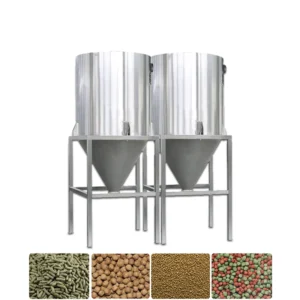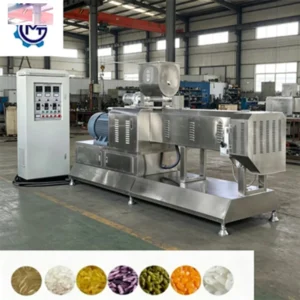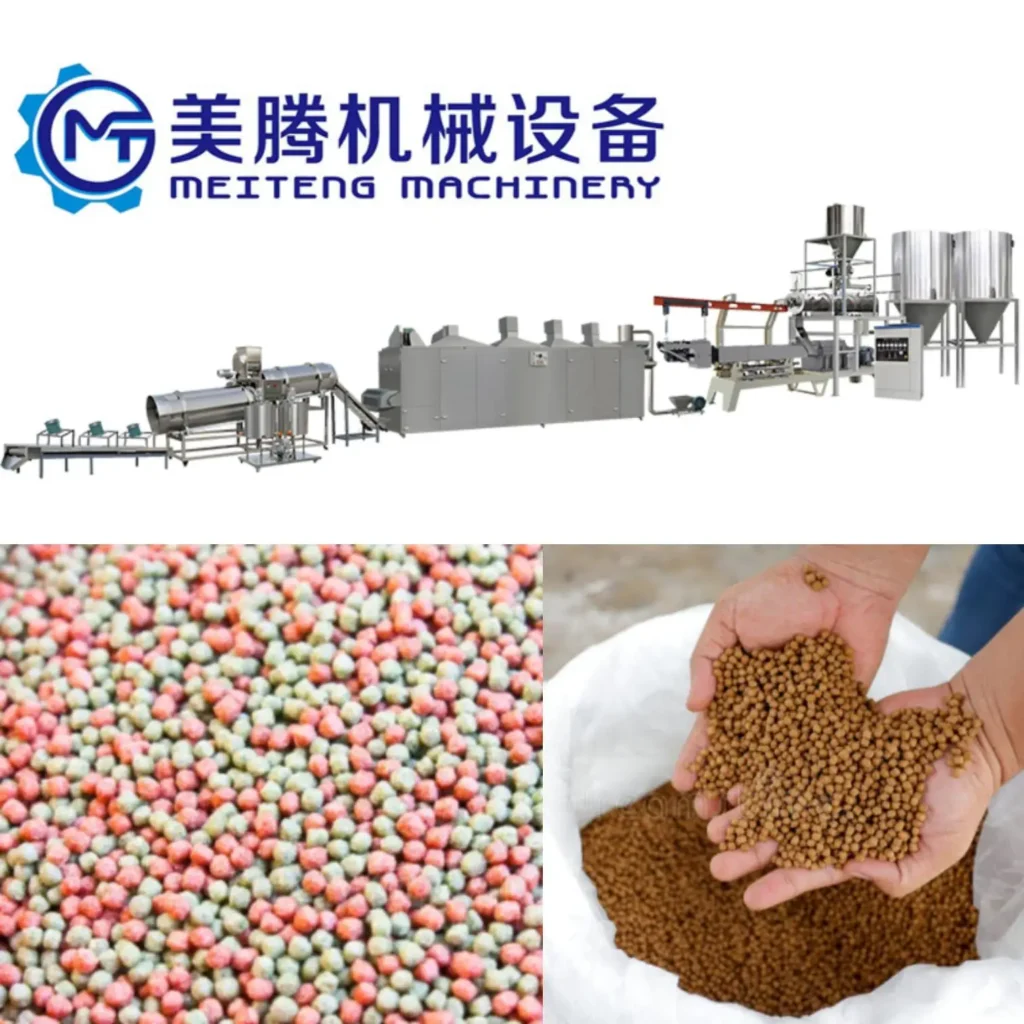
Precision-engineered extrusion parameters — Screw configuration, barrel profile and die geometry are matched to your raw material formulation, not copied from a generic twin-screw build.
Technical Specifications
| Parameter | Value |
|---|---|
| Product Type | Twin-Screw Fish Feed Extrusion Line |
| Output Capacity | Up to 2–3 t/h (basis not stated in source — confirm raw material formulation, moisture content, pellet diameter and sinking/floating type) |
| Screw Type | Twin-screw |
| Construction Material | 304 stainless steel (food-grade contact parts) |
| Control System | PLC and MCC automated control |
| Line Stations | Batching and mixing → extrusion → drying → coating/flavouring → cooling → packing |
| Die Configuration | Matched to target pellet size and density (floating or sinking) |
| Screw Configuration | Specified to buyer’s raw material and target product |
| Voltage & Frequency | To be confirmed per destination market |
| Standards | CE (since 2014), ISO certified |
Application Suitability
| Application | Material or Output |
|---|---|
| Floating feed for carnivorous species | Trout and salmon formulations with high protein and fat content |
| Sinking and slow-sinking feed | Catfish and tilapia rations based on soybean meal, corn and fish meal |
| Shrimp and benthic species feed | Fine-particle aquatic formulations requiring high water stability |
| Multi-species production on one line | Changeover between pellet diameters and density targets for mixed aquaculture operations |
Why Pellet Density Drifts Outside Specification
Floating feed that sinks or kibble density falling outside what your market expects is almost always a screw-and-die configuration problem, not a capacity problem. The twin-screw fish feed extrusion line technology only delivers consistent density when every barrel zone, screw element and die orifice is specified to your actual formulation. A line assembled from generic screw profiles will gelatinise starch unevenly when the raw material mix shifts, pushing pellet density beyond acceptable limits [NEED_CITE: starch gelatinisation thresholds in aquaculture feed extrusion]. I once configured a line where the screw combination was set for a standard fish meal recipe, but the buyer introduced high-ratio cassava starch on site — shear spiked, gelatinisation overshot, and floatability dropped sharply. That kind of mismatch only surfaces when you skip the material-specific screw build.
Shear Control and Starch Gelatinisation
The twin-screw fish feed extrusion line technology relies on controlled shear to gelatinise starch without destroying protein structure. Barrel temperature zoning works with moisture and steam injection to keep the melt within a narrow window. Too little shear leaves raw starch uncooked, reducing digestibility; too much shear breaks down the matrix that holds the pellet together in water. The screw configuration and L:D ratio determine residence time and shear intensity, which is why these parameters must be set after reviewing the buyer’s exact ingredient list and moisture data.
Die Geometry and Pellet Expansion
The die plate controls how the extrudate expands as it exits the barrel. Orifice diameter, land length and face-cut design together determine final pellet size, density and whether the product floats or sinks. For floating feed, the die must allow enough expansion to trap air cells inside the pellet; for sinking feed, a longer land compresses the melt to reduce void space. Die design is the last variable in the chain — if the upstream screw and barrel profile are wrong, no die adjustment will correct the density. Selecting the right die geometry is the step that turns a general-purpose extruder into a process tuned for your species and market [NEED_CITE: die land length influence on extrudate density].
Reading the Specs That Actually Matter
The 304 stainless steel contact parts ensure food-grade compliance across the entire product path, which matters when switching between medicated and standard feed batches. PLC and MCC automated control gives operators repeatable parameter sets — barrel temperatures, screw speed and feeder rates are stored per recipe, so batch-to-batch variation stays within a tight band. The batching and mixing station upstream of the extruder must deliver uniform moisture distribution; uneven preconditioning causes density swings that no downstream control can fix. Voltage and frequency confirmation before production prevents motor and heater mismatches at commissioning, a problem that delays start-up more often than buyers expect.
The Cost of Skipping Material-Specific Configuration
When screw elements are chosen from a default library rather than matched to the buyer’s starch-to-protein ratio, the line may run but the product will not hold specification across formulation changes. Wear accelerates on screws running outside their designed shear range, meaning replacement sets are needed sooner than planned. A mismatched dryer or coating drum downstream creates a bottleneck, so the extruder never reaches its rated throughput. These issues compound: the buyer orders a second set of dies trying to fix density, when the root cause sits upstream in the screw profile [NEED_CITE: extruder wear rates under off-design shear conditions].
Engineering the Line as One Process
Every station from batching to packing is sized so throughput matches — the dryer, coating drum and cooler are not afterthoughts bolted on from separate vendors. Screw configuration and die design are documented in a build record tied to your raw material, not pulled from a catalogue. An in-house testing workshop runs your actual formulation before shipment, producing a trial run report that confirms pellet density and floatability on your ingredients. Twin-screw expertise covers trout, salmon, catfish, tilapia and shrimp applications, so the process parameters carry over when you add a new species to the line. Pre-sales engineering through on-site commissioning and operator training keeps the same team involved from first layout drawing to first production shift.
Documentation & Verification
- Screw and die configuration record documenting the build matched to your raw material formulation
- Trial run report from the in-house testing workshop on your actual ingredients before shipment
- Line layout and capacity calculation with throughput balanced across every station
- Electrical schematic with voltage, frequency and control language confirmed for your facility
- CE declaration of conformity and ISO certificate for regulatory and customs clearance
- Operation and maintenance manual with wear parts list for ongoing production planning
Installation, Commissioning & Support
- Foundation and floor space planning based on the full line footprint from batching to packing
- Dedicated power circuits confirmed against PLC and MCC load requirements before equipment arrival
- On-site assembly supervision covering barrel alignment, screw insertion and die mounting
- First-run parameter tuning with barrel temperature, screw speed and steam injection set to your formulation
- Operator training on recipe management, density sampling and routine screw inspection
- Wear parts inventory review covering screw elements, die plates and barrel liners for planned replacement cycles
Preparing Your Technical Enquiry
Share your raw material formulation with ingredient percentages and moisture content so screw configuration can begin before quotation. Confirm the target pellet diameter, density range and floating or sinking requirement for each species you plan to produce. Specify your facility voltage, frequency and preferred control language to lock in the electrical design early.
Frequently Asked Questions
Q: How is pellet floatability and density controlled through screw configuration and die design?
A: Floatability depends on the expansion ratio at the die face, which is set by the upstream screw profile and barrel temperature zones. Screw elements are arranged to deliver the correct shear and residence time for your starch-to-protein ratio, while die orifice diameter and land length control how much the extrudate expands. Together they determine whether air cells are trapped inside the pellet or compressed out.
Q: What raw material formulation data is needed before screw and barrel profile are finalised?
A: The ingredient list with percentage breakdown, raw material moisture content, and the target pellet specification including diameter and density. Starch type and protein source affect gelatinisation behaviour, so cassava, corn and wheat each require different screw element arrangements. Without this data, the configuration defaults to a generic build that may not hold your specification.
Q: How is the stated 2–3 t/h capacity verified?
A: That figure must be confirmed against your specific raw material formulation, moisture content, pellet diameter and whether the product is floating or sinking. Capacity on a high-protein trout diet differs from a starch-heavy tilapia ration. The in-house testing workshop runs your actual ingredients to establish realistic throughput before the quotation is finalised.
Q: How does barrel temperature zoning affect starch gelatinisation and final pellet texture?
A: Each barrel zone can be heated or cooled independently to control the melt temperature as material moves through the extruder. Early zones precondition and begin gelatinisation; later zones manage expansion and density. Incorrect zoning leaves raw starch in the pellet or overcooks the matrix, both of which affect water stability and digestibility.
Q: What is the role of moisture and steam injection in controlling expansion and density?
A: Moisture softens starch granules so they gelatinise under shear, while steam injection at the preconditioner and barrel adds thermal energy without mechanical work. The amount and timing of steam determine how much the extrudate expands at the die. Too little moisture limits expansion; too much causes pellets to collapse during drying, reducing floatability.