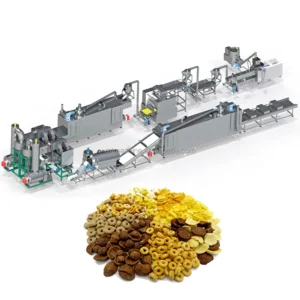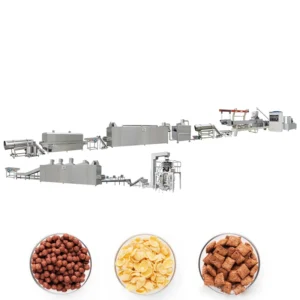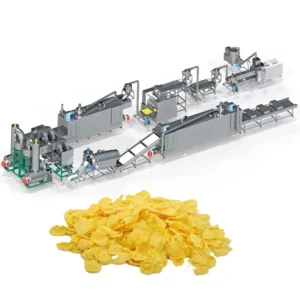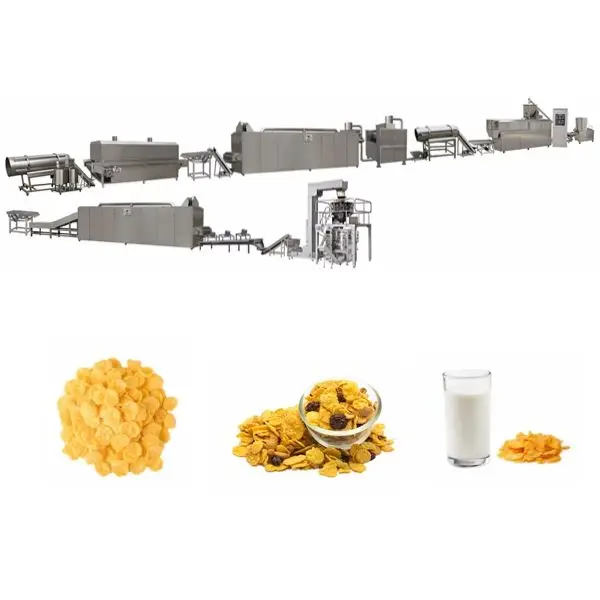
Screw profile matched to grain — every die opening and barrel zone on this corn flakes extrusion production line is configured after testing your specific corn, rice, or oat blend, not copied from a generic template.
Technical Specifications
| Parameter | Value |
|---|---|
| Product Type | Corn Flakes Production Line with Twin Screw Extruder |
| Models Available | MT70 / MT85 / MT75 |
| Screw Type | Twin-screw |
| Installed Power | MT70 – 160 kW / MT85 – 190 kW / MT75 – 210 kW |
| Power Consumption | MT70 – 120 kW / MT85 – 140 kW / MT75 – 150 kW |
| Output Capacity | MT70 – 150–200 kg/h (basis not stated in source); MT85 – 300–400 kg/h (basis not stated in source); MT75 – 300–500 kg/h (basis not stated in source) |
| Overall Dimensions (L×W×H) | MT70 – 41 × 1.5 × 2.2 m; MT85 – 43 × 1.5 × 3.2 m; MT75 – 45 × 1.5 × 3.5 m |
| Control System | PLC control on flaking machinery; MCC and PLC available on extruder line |
| Flaking Machinery | Hydraulic double-roller system with separate dual-motor drive; infrared sensor for temperature pipe control |
| Dryer Heating Source | Gas or electric |
| Hot Air Roasting Oven | Vibrating pan with high-temperature spraying tubes; two separate circulating fans; cyclone dust removal; precise temperature control |
| Coating System | Double tumble for sugar melting; elevator; coating drum; spraying nozzle |
| Line Stations | Mixing → Extruding → Flaking → Drying → Hot Air Roasting → Sugar Spraying/Coating → Drying → Cooling → Packing |
| Basic Raw Materials | Powder of corn, rice, wheat, oat, barley |
| Final Product Shapes | Natural corn flakes, sugar-coated corn flakes, ball, tube, stick, ring, fruit loop, star, wheel, flower, heart |
| Assembly State | Complete production line |
| Factory Layout | Custom-designed to buyer’s factory dimensions |
| Voltage & Frequency | Configured to buyer’s local standard |
| Standards | CE; ISO |
Application Suitability
| Application | Material or Output |
|---|---|
| Natural corn flake production for breakfast cereal packaging | Corn powder, corn grits |
| Sugar-coated corn flakes for retail cereal boxes | Corn, wheat, and oat powder blends with sugar coating |
| Multi-grain breakfast cereal with varied shapes | Rice, barley, oat, and wheat powder blends |
| Fortified breakfast cereal for nutrition programmes | Grain powder blended with vitamin and mineral premix |
| Snack-format extruded shapes from the same line | Ball, tube, ring, fruit loop, star, and flower shapes via die change |
Why Your Corn Flake Density Keeps Missing Spec
The extruder screw configuration and barrel temperature profile must be set to your actual grain blend, not a generic corn flour standard.
Process engineers see this pattern repeatedly: a corn flakes extrusion production line arrives on site, runs the buyer’s locally sourced maize, and produces flakes that are either too dense to crisp in the roasting oven or too fragile to survive packing and transport. The root cause traces back to a screw profile that was never adjusted for the buyer’s raw material moisture content, particle size, and starch composition. When expansion behaviour at the die face does not match the target flake density, no amount of downstream adjustment in the dryer or roaster compensates for it. [NEED_CITE: starch gelatinisation behaviour varies with grain cultivar and moisture content]
Starch Gelatinisation Under Controlled Shear
The twin-screw configuration in a corn flakes extrusion production line technology setup provides the mechanical shear and residence time needed to gelatinise starch uniformly across the barrel zones. Moisture injection, screw speed, and barrel zone temperatures work together to control how thoroughly the starch granules break down before the material reaches the die. Incomplete gelatinisation leaves hard centres in the flake that resist blister formation during roasting, while over-gelatinisation produces a gummy extrudate that collapses after the die.
Die Geometry and Expansion Ratio
The die opening diameter and land length determine how much the extrudate expands as it exits the barrel pressure zone. For corn flakes, the target is a controlled, moderate expansion — enough to create an open internal structure that crisps during roasting, but not so much that the pellet puffs into a snack-like sphere. Screw element arrangement in the final barrel zone, combined with die selection, governs this balance. Process engineers adjust the die profile to match the specific grain blend, since oat and barley additions change the expansion behaviour compared to pure corn.
Barrel Temperature Profile Across Zones
A multi-zone barrel allows precise thermal staging along the screw length. Feed zones run cooler to prevent premature gelatinisation and bridging, while the cooking and metering zones reach the temperatures required for full starch conversion. The exact profile depends on the raw material — a high-oat blend behaves differently from pure maize under the same thermal conditions. On this line, the PLC and MCC control system manages zone temperatures and screw speed so that operators can store and recall recipes for each grain formulation. [NEED_CITE: barrel zone temperature staging in twin-screw food extrusion]
Reading the Spec Sheet for Corn Flake Output
The three available models — MT70, MT85, and MT75 — span different installed power ratings and physical footprints, and the output capacity figures listed are nominal values whose basis in terms of raw material type and moisture is not stated in the source documentation. A technical buyer comparing these models should request the capacity calculation run against their own grain formula. The overall line length ranging from 41 to 45 metres means the full station sequence — mixing through cooling — occupies a substantial footprint, so factory layout planning must account for the complete run including the hot air roasting oven and dual-pass drying sections.
When a Generic Build Fails at First Run
A corn flakes extrusion production line configured on assumed raw material parameters rather than tested grain samples will reveal its problems during commissioning, not before. Flakes may blister unevenly in the roasting oven because the pellet density is outside the range the oven was designed for, or the flaking rollers may produce inconsistent thickness if the extrudate moisture at the roller inlet varies from batch to batch. [NEED_CITE: importance of pre-shipment trial runs on buyer raw material] These issues force weeks of on-site troubleshooting that could have been resolved with a single workshop trial before the equipment shipped.
What Sets This Line Apart at the Process Level
Screw configuration and die design are specified to the buyer’s raw material and target flake texture rather than pulled from a catalogue of generic builds. The in-house testing workshop runs the buyer’s actual grain blend before shipment, producing a documented trial report with recorded expansion, moisture, and density values. Throughput is matched across every station — extruder, flaking rollers, dryer, and roasting oven — so no single machine bottlenecks the line. Electrical schematics, voltage, and frequency are confirmed to the buyer’s local standard before production begins. The line is backed by documented CE and ISO compliance for market entry in regulated regions.
Documentation & Verification
- Screw and die configuration record matched to your grain blend and target flake density
- Trial run report on your raw material from the in-house testing workshop
- Electrical schematic with voltage, frequency, and control language confirmed pre-production
- Line layout and capacity calculation showing matched throughput across all stations
- CE declaration of conformity and ISO certificate for regulatory market access
Installation, Commissioning & Support
- Custom line layout from 41 to 45 metres designed to your factory floor dimensions
- Voltage and frequency configured to your local grid before the MT70, MT85, or MT75 ships
- PLC and MCC control system programmed in your operator’s language at commissioning
- First-run parameter tuning for your grain blend including barrel zone temperatures and die selection
- Wear parts list covering screws, dies, and flaking roller surfaces for planned maintenance scheduling
Preparing Your Technical Inquiry
To move from general interest to a workable line proposal, technical buyers should share the raw material composition including grain type ratios and typical moisture range, the target flake density and blister specification, and the available factory floor dimensions. Providing your local voltage and frequency standard along with the preferred control language allows the electrical package to be specified correctly from the start. If a trial run on your grain blend is needed before commitment, sending a raw material sample enables the workshop test that validates screw configuration and die selection.
Frequently Asked Questions
Q: How is screw configuration determined for different grain blends and target flake densities?
A: The screw element arrangement — conveying, kneading, and reverse elements — is selected based on the buyer’s raw material composition and the target expansion ratio at the die face. A blend with oat or barley requires different shear intensity than pure corn to achieve proper starch gelatinisation without over-cooking. The configuration is validated during an in-house trial run on the buyer’s actual grain sample before the line ships.
Q: What moisture range and barrel temperature profile are needed for proper starch gelatinisation?
A: The moisture addition and barrel zone temperatures are set so that starch granules reach full gelatinisation by the metering zone without premature cooking in the feed section. Exact values depend on grain particle size and composition — corn, wheat, and oat blends each require a different thermal profile. These parameters are established during the workshop trial run and documented in the trial report provided before shipment.
Q: How does die design affect flake expansion, thickness, and blister behaviour during roasting?
A: The die opening diameter and land length control how much the extrudate expands upon exiting the high-pressure barrel. For corn flakes, moderate expansion produces a pellet with the right internal structure to blister correctly in the hot air roasting oven. Die geometry is matched to the grain blend’s expansion characteristics and verified during the pre-shipment trial to ensure the roasted flake meets the target crispness and bowl-life specification.
Q: Can a trial run be performed on the buyer’s raw material before shipment?
A: Yes. The in-house testing workshop accepts raw material samples from the buyer and runs the complete extrusion sequence on a lab-scale twin-screw extruder. The trial report records screw configuration, barrel temperature profile, moisture addition, expansion ratio, and pellet density. This allows process engineers to confirm that the line configuration will produce flakes within specification using the buyer’s own grain supply.
Q: How is throughput matched between the extruder, flaking rollers, dryer, and roasting oven?
A: Each station is sized so that its maximum throughput aligns with the extruder output on the buyer’s specific raw material. The flaking roller capacity, dryer belt length and residence time, and roasting oven pan area are all calculated during the line layout phase. This prevents any single station from bottlenecking production and ensures the line runs at a consistent rate from mixing through to cooling and packing.