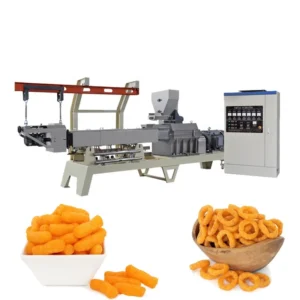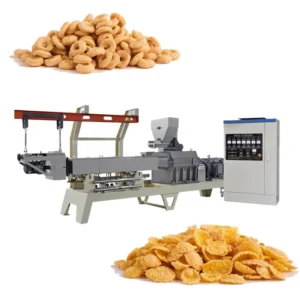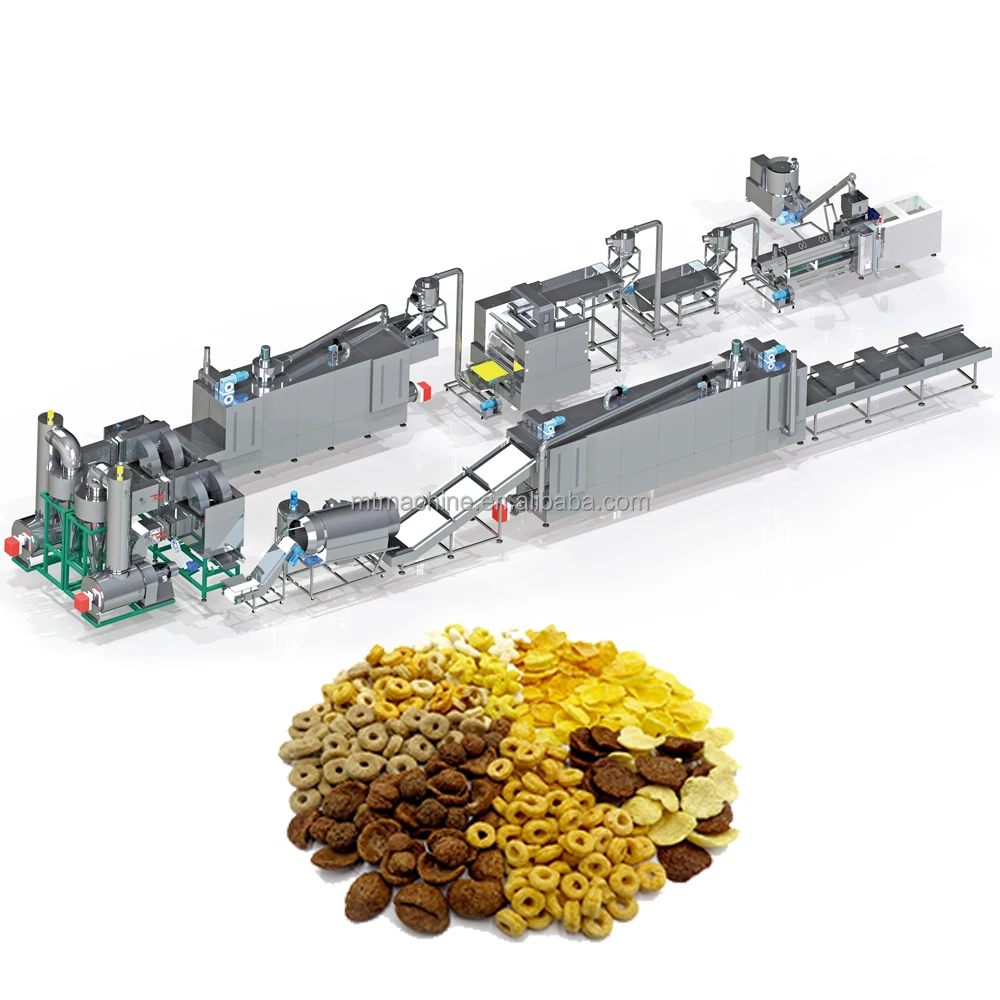
Extrusion-Specific Configuration — Screw geometry and barrel zone mapping matched to buyer grain blend rather than copied from generic cereal builds.
Technical Specifications
| Parameter | Value |
|---|---|
| Product Type | Corn Flake Breakfast Cereal Production Line |
| Available Models | MT70 / MT85 / MT75 |
| Installed Power | 160 kW (MT70) / 190 kW (MT85) / 210 kW (MT75) |
| Power Consumption | 120 kW (MT70) / 140 kW (MT85) / 150 kW (MT75) |
| Capacity | 150–200 kg/h (MT70) / 300–400 kg/h (MT85) / 300–500 kg/h (MT75) (basis to be confirmed) |
| Overall Dimensions | 41 × 1.5 × 2.2 m (MT70) / 43 × 1.5 × 3.2 m (MT85) / 45 × 1.5 × 3.5 m (MT75) |
| Screw Type | Twin-screw |
| Extruder System | Feeding, extruding, cutting, heating, gearing, controlling |
| Flaking Machinery | PLC control, hydraulic double rollers, separate roller motors, infrared temperature sensor |
| Dryer Heating Source | Gas or Electric (configurable) |
| Roasting Oven | Conciliation burner, dual circulating fans, cyclone dust removal |
| Coating System | Double tumble sugar melting, elevator, coating drum, spraying nozzle |
| Control System | PLC and MCC |
| Material Compatibility | Corn, rice, wheat, oat, barley powder |
| Assembly State | Complete line: mixing, extruding, flaking, drying, roasting, coating, cooling, packing |
Application Suitability
| Application | Material or Output |
|---|---|
| Natural corn flakes for retail breakfast cereal | Corn grits or whole corn meal |
| Sugar-coated or honey-coated corn flakes | Corn base with syrup coating |
| Variety-shape breakfast cereals | Rice, wheat, oat, or barley blends (ball, tube, stick, ring, fruit loop, star, wheel, flower, heart via die change) |
| Fortified breakfast cereal programs | Grain powder blends with vitamin and mineral premix |
What "Standard Parameters" Ignore About Corn Flake Extrusion
A generic screw build on variable corn protein content produces flakes that collapse in milk, and no amount of dryer tuning fixes a bad extrudate.
I once watched over a ton of corn raw material turn to waste in Colombia because the local corn flour had lower protein than the reference spec. The barrel temperature curve and screw shear that worked perfectly on standard yellow corn produced extrudate with insufficient structural integrity — the flakes went soft within seconds of hitting a milk bowl. Generic corn flakes extrusion technology specifications copied from one grain source do not transfer across regions or cultivars [NEED_CITE: starch gelatinisation behaviour across corn protein variants]. The real variable is not capacity; it is whether the screw configuration and die geometry have been matched to the starch-protein matrix your specific raw material forms under heat and shear.
Screw Shear and Barrel Temperature Mapping
The MT70, MT85, and MT75 lines use a twin-screw configuration where each barrel heating zone is set to a distinct target temperature, creating a profile rather than a uniform heat bath. This zoning controls the rate at which starch granules absorb moisture and gelatinise as the corn mass moves through the barrel. Adjusting the shear section of the screw changes mechanical energy input independently of thermal input, which is critical when a grain blend gelatinises at a different threshold than expected.
Die Geometry and Flake Expansion Behaviour
The die opening dimensions and the moisture content of the extrudate at the die face together determine the expansion ratio of the pellet before it reaches the flaking rollers. Too much expansion yields a flake that is porous and fragile; too little produces a dense, hard flake that fails the bowl-life test. These corn flakes extrusion technology specifications must be locked in during a trial run on the actual grain lot, because published expansion numbers from a different corn source will not hold on your material [NEED_CITE: pellet expansion ratio measurement in breakfast cereal processing].
How Moisture, Shear, and Temperature Interact at the Die
Three variables converge at the die face: residual moisture in the dough, the shear energy delivered by the screw configuration, and the barrel zone temperature in the final metering section. Increasing shear while holding temperature constant raises gelatinisation without adding steam, which changes the surface blister pattern on the finished flake. Adjusting moisture upward softens the extrudate but can reduce the structural strength needed for the hydraulic flaking rollers to produce a clean, uniform gauge. Balancing these three is not a calculation you can do from a datasheet — it requires running your grain through the machine and measuring the extrudate density and moisture at the die exit in real time.
The Hidden Cost of Skipping a Raw Material Trial
When an extruder ships with a screw build that was configured for a reference corn rather than the buyer’s actual grain, the problem does not appear at installation — it appears after the first full production run, once the flakes are toasted and coated and someone pours milk over them. Bowl life, crispness retention, and surface blister consistency are all locked in at the extrusion stage. Re-configuring screws and re-profiling barrel zones after installation means production downtime, wasted raw material, and delayed market delivery [NEED_CITE: post-installation extruder reconfiguration in cereal plants]. A trial run on the buyer’s corn, rice, or oat blend in the testing workshop, with documented expansion ratio and flake density measurements, catches this before the machine leaves the factory.
Why This Line Is Configured Before It Is Built
Each MT70, MT85, or MT75 is specified against the buyer’s grain type, target flake thickness, and coating variant before screw elements and die plates are selected. The flaking station uses hydraulic pressure and infrared-controlled roller temperature to hold a consistent flake gauge that matches the extrudate density. The roasting oven with its dual circulating fans and cyclone dust removal is sized to the throughput of the extruder it follows, so the line does not bottleneck at drying. Every corn flakes extrusion technology specifications package includes a screw and die configuration record tied to the buyer’s raw material, not a generic build sheet. The PLC and MCC control system is programmed in the operator’s language with voltage and frequency confirmed for the destination market before the electrical cabinet is wired.
Documentation & Verification
- Line layout and throughput calculation matched across every station from mixer to packer
- Screw and die configuration record documented against your grain blend and target flake density
- Trial run report on your raw material confirming expansion ratio and flake gauge before dispatch
- Electrical schematic with confirmed voltage, frequency, and PLC language for your facility
- CE declaration of conformity and ISO certificate included in the shipping documentation package
- Operation and maintenance manual with wear parts list for screws, dies, and roller surfaces
Installation, Commissioning & Support
- Foundation planning accounts for the full line length of up to 45 m and the hydraulic flaking roller load
- Power supply specification covers installed power up to 210 kW with dedicated circuit requirements per station
- PLC and MCC panels arrive pre-wired to the confirmed voltage and frequency for your market
- First-run commissioning includes barrel temperature profiling and screw shear adjustment on your corn or grain blend
- Operator training covers die changes for shape variants and hydraulic pressure setting on the flaking rollers
- Wear parts inventory covers screws, die plates, and flaking roller surfaces with reorder lead times confirmed at delivery
What We Need to Specify Your Line
Send us your grain type and protein-moisture analysis, the target flake thickness and bowl-life specification your market expects, and whether you need sugar or honey coating capability. Include your facility voltage and frequency, PLC language preference, and the available floor space with ceiling height so we can draft the line layout and confirm which model fits your throughput target.
Frequently Asked Questions
Q: How is screw configuration and die design matched to my specific grain blend?
A: We review your raw material analysis — protein content, moisture, and particle size — then select screw elements and die geometry from our configuration library. A trial run on your grain in the testing workshop validates expansion ratio and extrudate density before the machine is finalised. The configuration record ships with the line.
Q: What barrel temperature profile is needed for proper starch gelatinisation in corn flakes?
A: The profile depends on your corn variety and moisture content. Each barrel zone is set independently to control the gelatinisation rate. During the trial run, we map the temperature curve that gives your grain the correct structural integrity for flaking and bowl life, then document it in the machine specification sheet.
Q: Can I run a trial on my raw material before shipment?
A: Yes. You ship a sample of your corn, rice, or oat blend to the testing workshop, and we run a full extrusion and flaking trial. The trial report documents extrudate density, expansion ratio, flake gauge, and surface blister pattern. Configuration changes are made before the line ships if the results fall outside your specification.
Q: How does flaking roller pressure and temperature affect the final flake?
A: The hydraulic system applies controlled pressure across the double rollers, and the infrared sensor monitors roller surface temperature. Together these determine flake thickness and surface consistency. Incorrect pressure on a fragile extrudate causes cracking; insufficient temperature leads to sticking and gauge variation across the roller width.
Q: What electrical and control options are confirmed before commissioning?
A: Voltage, frequency, and PLC display language are confirmed during the specification stage, before the electrical cabinet is built. The MT70, MT85, and MT75 are available with gas or electric dryer heating. The roasting oven and coating system utilities are matched to your facility’s available supply and documented in the electrical schematic.