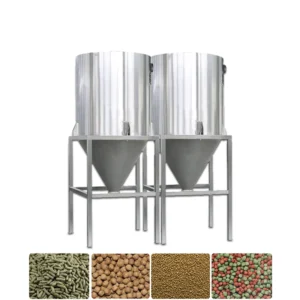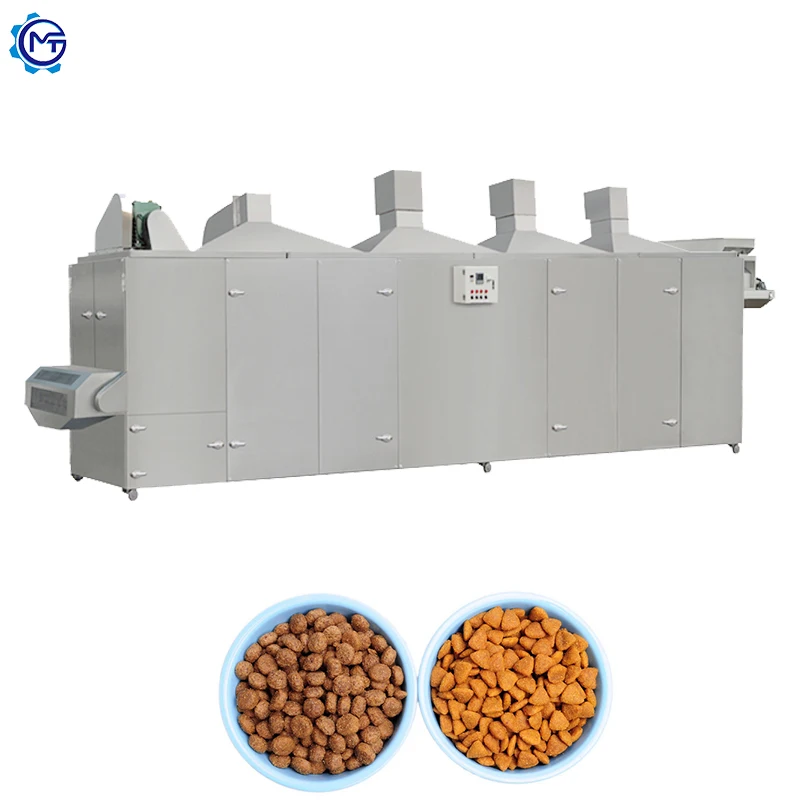
Precision-Engineered Extrusion Profiles — Every screw element and barrel zone on this pet food line is configured after trial runs on your specific formulation, not copied from a generic template.
Technical Specifications
| Parameter | Value |
|---|---|
| Product Type | Pet Food Extrusion Production Line |
| Output Capacity | Up to 3 tons per hour (basis not stated in source — confirm raw material, moisture content, and product format) |
| Screw Type | Twin-screw |
| Control System | PLC and MCC control |
| Applications | Dry dog and cat kibble; floating and sinking aquatic feed |
| Process Documentation | Includes process flow drawing for feed production |
| Certification | CE certified |
| Quality Standard | ISO certified |
| Warranty | 1-year warranty |
Application Suitability
| Application | Material or Output |
|---|---|
| Dry kibble production for dogs and cats | Corn, meat meal, poultry by-product, cereal blends, fresh meat slurry |
| Floating aquatic feed | Fish meal, soybean meal, starch binders for catfish and tilapia |
| Sinking aquatic feed | High-protein formulations for shrimp and bottom-feeding species |
| Premium pet food formats | Multi-texture kibble, high-fresh-meat-inclusion recipes, functional nutrition blends |
What "Rated Capacity" Leaves Out When Your Formula Changes
A nominal throughput figure means nothing if the extruder cannot hold it on your actual raw material blend.
I once watched a Middle East pet food line ship with a screw profile set for a corn-based recipe. The buyer switched to a formula with fresh chicken slurry at significant inclusion rates during commissioning, and the kibble collapsed — density exceeded spec and every pellet sank in the bowl. The extruder had the right motor and the right barrel length on paper, but the shear profile and temperature gradient were wrong for that material [NEED_CITE: starch gelatinisation behaviour under high-moisture meat inclusion]. When buyers evaluate pet food extrusion machinery specifications, the conversation must start with the exact formulation, not a catalogue number.
How Screw Configuration Dictates Kibble Architecture
The screw elements inside the barrel are not a fixed design — they are a sequence of conveying, kneading, and reverse-shear blocks arranged to match your recipe. A formulation high in cereal starch needs a different shear history than one loaded with fresh meat or fat. The L:D ratio determines how long the material stays under thermal and mechanical stress, which directly governs starch gelatinisation and protein texturisation. Getting the pet food extrusion machinery specifications right at this stage prevents downstream failures in the dryer and coater.
Barrel Temperature Zones and Expansion Control
Each barrel section has its own heating and cooling circuit, creating a temperature gradient from the feed inlet to the die face. Early zones hydrate and pre-gel the starch; mid-barrel zones build dough viscosity under shear; the final zones control melt temperature before the die [NEED_CITE: thermal profiling in twin-screw extrusion for expanded food products]. If the gradient is too flat, expansion is uneven and kibble density drifts outside the target window. If the final zone runs too hot, the product flashes steam violently at the die exit, causing surface cracking and excessive fines generation in the cooler.
Reading the Specs That Actually Matter
The twin-screw configuration allows this line to handle a wider range of raw material particle sizes and moisture levels than single-screw alternatives, because the intermeshing screw flights provide positive conveying and self-wiping action. The PLC and MCC control system logs barrel zone temperatures, screw speed, and feeder rates continuously, so any drift from the validated parameter set triggers an alarm rather than a full batch of off-spec kibble. The CE-certified build ensures electrical safety and guarding compliance for export markets, while the ISO-certified manufacturing process means assembly and inspection follow documented procedures rather than workshop habit.
The Hidden Cost of a Mismatched Die and Dryer
An extruder that produces the correct melt at the die face can still deliver the wrong kibble if the die geometry and cutting system are not matched to the target shape and density. A die with too few orifices forces higher throughput per hole, changing the expansion ratio and producing oversized, hollow pellets. Pair that with a dryer that lacks sufficient residence time or airflow volume, and the kibble exits with a moisture gradient — hard shell, soft core — which causes cracking during bagging and shortens shelf life [NEED_CITE: moisture equilibrium and shelf stability in dry extruded pet food]. These are not theoretical problems; they show up in the first production week.
Why Sourcing the Extrusion Core Here Reduces Line Risk
Screw configuration and die design are specified to your raw material and target kibble geometry, not pulled from a standard catalogue. The in-house testing workshop runs your actual formulation before shipment, generating a trial run report that locks parameters before the crate is sealed. The complete line — from batching through extrusion to packing — comes from one supplier, so throughput at every station is balanced rather than bottlenecked at the dryer or coater. Electrical schematics confirm voltage, frequency, and control language for your facility before production begins. Twin-screw expertise spans pet food, aquatic feed, snacks, and cereal applications, meaning the engineering team has seen how formulations behave across categories.
Documentation & Verification
- Screw and die configuration record matched to your specific raw material blend and target kibble density
- Trial run report generated on your formulation in the testing workshop before dispatch
- Machine specification sheet confirming barrel zone count, screw diameter, and L:D ratio
- Electrical schematic with voltage, frequency, and HMI language verified for your market
- CE declaration of conformity and ISO certificate included in shipping documentation
- Wear parts list with screw element and die plate reorder references
Installation, Commissioning & Support
- Foundation load and floor space layout provided for the twin-screw extruder and downstream dryer footprint
- Dedicated power circuit sized to the PLC and MCC control panel and total connected motor load
- Barrel sections and screw shafts shipped disassembled for container loading, reassembled on site during commissioning
- First production run supervised by an engineer who validates barrel temperature profiles against the trial run data
- Operator training covers screw element replacement, die changeover, and PLC alarm response procedures
- Wear parts inventory recommended for the first replacement cycle of screws, barrels, and die plates
What We Need to Specify Your Line Accurately
Share your raw material list with inclusion percentages and moisture content, the target kibble shape and density range, and the daily output you need to hit. Include your facility voltage and frequency, the available floor space and ceiling height, and whether you already have upstream mixing or downstream packing equipment in place. If you have a formulation you want validated before purchase, we can arrange a trial run on that material in the testing workshop.
Frequently Asked Questions
Q: How is screw configuration selected for a specific pet food formulation and target kibble density?
A: The screw element sequence — conveying, kneading, and shear blocks — is arranged based on your raw material’s starch content, protein level, and moisture. High-meat formulations require lower shear intensity to prevent protein denaturation, while cereal-heavy recipes need more mechanical energy input for complete gelatinisation. The configuration is validated during a trial run on your material before shipment.
Q: What barrel temperature profile is needed for proper starch gelatinisation in my raw material?
A: Each barrel zone is set independently. Early zones typically run lower to hydrate starch granules, mid-barrel zones increase temperature to initiate gelatinisation under shear, and final zones hold the melt at a precise temperature before the die. The exact gradient depends on your starch source and inclusion rate, confirmed during the in-house trial run.
Q: How does die design affect expansion ratio and final product texture?
A: Die orifice diameter, length-to-diameter ratio, and pattern determine how the melt expands when pressure drops at the exit. A longer die land restricts expansion for denser, sinking aquatic pellets, while a shorter land allows greater puff for dry kibble. The cutting system speed then controls final pellet length and shape uniformity.
Q: Can a trial run be conducted on my raw material before shipment?
A: Yes. The in-house testing workshop runs your actual formulation through the configured extruder, documenting screw speed, barrel temperatures, moisture input, and resulting kibble density. The trial run report ships with the machine so commissioning starts from validated parameters rather than from scratch.
Q: How do moisture input and shear control interact to determine whether kibble floats or sinks?
A: Floating kibble requires controlled expansion that traps air cells inside the pellet structure, achieved through balanced moisture injection and moderate shear. Sinking feed demands higher density, produced by reducing expansion through lower melt temperature, higher die restriction, and adjusted screw shear profile. Both outcomes depend on the interaction between moisture, shear, and temperature rather than any single variable.