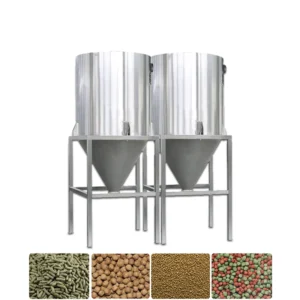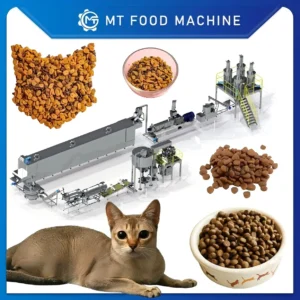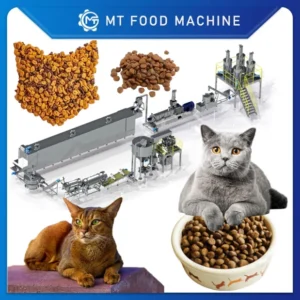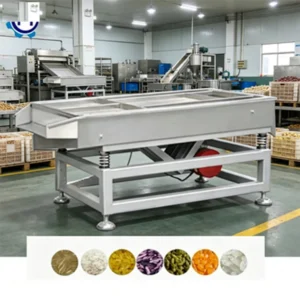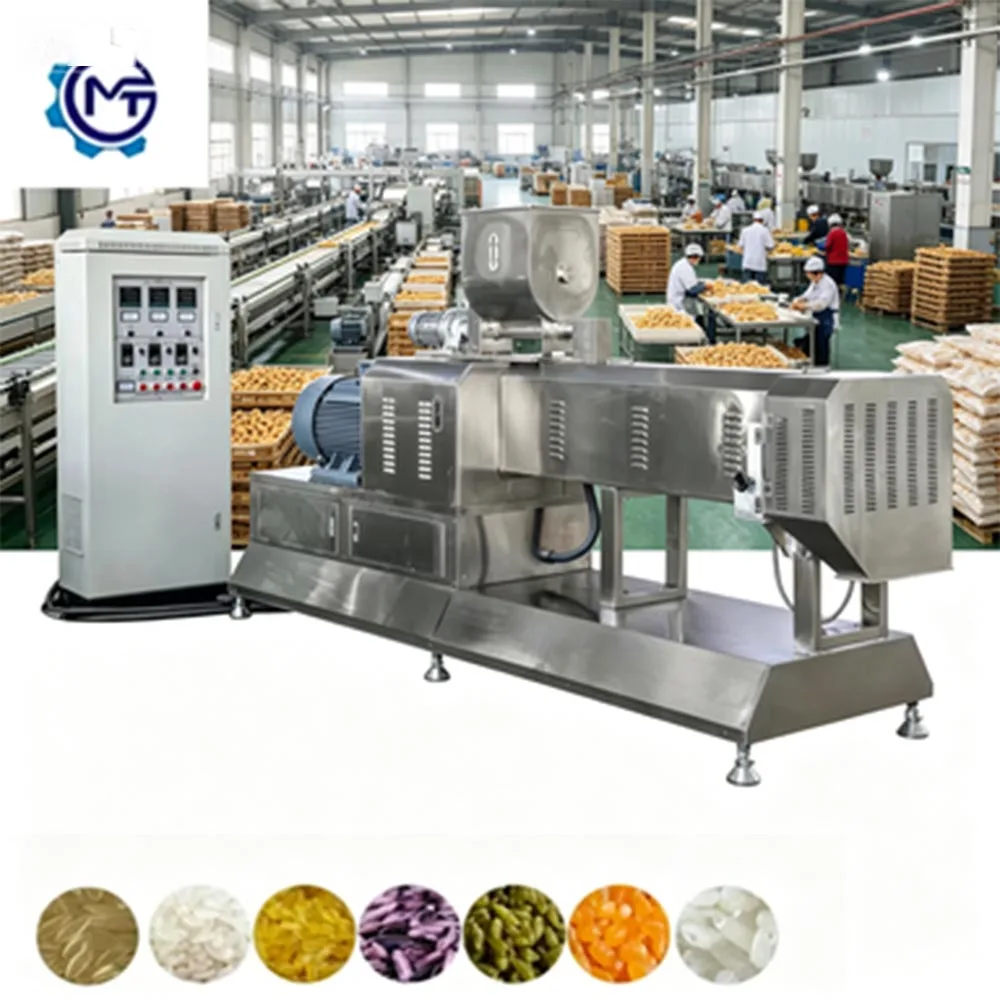
Screw Geometry Dictates Pellet Fate — A floating kibble that sinks destroys feed conversion ratios, which is why every screw element and die orifice in this line is configured against the buyer’s actual raw material formulation and target buoyancy before steel is cut.
Technical Specifications
| Parameter | Value |
|---|---|
| Product Type | Twin Screw Fish Feed Extruder Production Line |
| Screw Type | Twin screw |
| Control System | Intelligent PLC automatic control system |
| Contact Material | Food grade 304 stainless steel |
| Line Stations | Raw material mixer, extruder, dryer, seasoning coating machine, vibrating sieve, conveyor equipment |
| Output Capacity | Medium to large scale industrial production (basis not stated in source — confirm raw material formulation, pellet size, and moisture content) |
| Pellet Adjustability | Pellet size, hardness, buoyancy adjustable according to breeding requirements |
| Production Mode | Full continuous automatic production from mixing to finished product discharging |
| Energy Feature | Optimized energy saving transmission structure and heating system |
| Operation Interface | Humanized operation interface with simple parameter adjustment |
| Maintenance Design | Convenient daily cleaning, regular maintenance, quick replacement of vulnerable parts |
Application Suitability
| Application | Material or Output |
|---|---|
| Koi and goldfish floating feed | Fish meal, soybean meal, corn powder, compound additives |
| Tropical fish slow-sinking pellets | High-protein blends with lipid coating requirements |
| Freshwater aquaculture feed | Starch-rich formulations requiring complete gelatinisation |
| Shrimp and bottom-feeder sinking feed | Dense mineral-supplemented compound mixes |
| Ornamental fish color-enhancing diets | Pigment-fortified raw material blends |
What "Floating" Really Means on the Specification Sheet
Floating feed that sinks in the pond, or pellets that disintegrate before the fish reach them — these failures trace back to a screw configuration that was never matched to the buyer’s actual formulation. The twin screw fish feed extruder extrusion technology only delivers target buoyancy when screw pitch, barrel temperature, and die geometry are specified together against the raw material’s starch and protein behaviour.
I have watched lines in Jeddah produce beautiful floating pellets on the trial recipe, then fail the moment the client switched to their local soybean meal supplier. The starch gelatinisation window shifted, the expansion ratio dropped, and half the output sank within minutes [NEED_CITE: starch gelatinisation thresholds across common aquatic feed raw materials]. The vibrating screen downstream was then overwhelmed by off-spec material, and the line’s effective throughput collapsed. Density is not a fixed property of the machine; it is a negotiated outcome between the formulation and the extrusion parameters.
How Screw Configuration Controls Expansion
The twin-screw arrangement creates intermeshing zones where raw material undergoes simultaneous shear and thermal treatment. Each screw element — conveying, kneading, reverse — is selected and sequenced to govern residence time and mechanical energy input at that stage. For floating pellets, the configuration must generate sufficient pressure before the die to produce rapid moisture flash-off and controlled expansion. The twin screw fish feed extruder extrusion technology allows engineers to rearrange these elements when a new formulation demands a different shear profile, without replacing the entire barrel assembly.
Barrel Temperature Profile and Moisture Management
Barrel zones are independently heated and cooled, creating a temperature gradient that moves the material through distinct phases: hydration, gelatinisation, cooking, and pressurisation. Moisture content at the conditioning stage directly governs how much expansion occurs at the die face. Too little moisture and the pellet exits hard and under-expanded; too much and the structure collapses before it reaches the dryer [NEED_CITE: relationship between extrusion moisture content and post-die expansion in aquatic feed production]. The PLC system tracks and logs each zone’s set point, giving the process engineer a repeatable starting reference for every production run.
Reading the Specs That Actually Matter
The food-grade 304 stainless steel contact surfaces resist the chloride corrosion common in fish meal processing environments, where salt-laden vapour attacks carbon steel within weeks. The intelligent PLC automatic control system maintains consistent screw RPM and barrel temperature across all zones, eliminating the drift that causes density variation between the first and last hour of a shift. Twin-screw geometry handles high-fat formulations that would stall a single-screw machine, because the positive conveying action does not rely on friction between the material and the barrel wall. The line’s continuous production mode — mixing through vibrating sieve discharge — means throughput is balanced at every station rather than bottlenecked at one.
When the Die Design Was Copied, Not Calculated
A generic die plate with uniformly spaced orifices will produce pellets of inconsistent density across the die face, because flow distribution varies with the raw material’s viscosity at temperature. The centre pellets may float while the perimeter pellets sink, and no amount of dryer adjustment will correct a density error that was locked in at the die. Off-spec pellets then reach the vibrating sieve, where they either pass through as false acceptances or overload the reject stream, cutting effective yield without any alarm on the control screen [NEED_CITE: die flow distribution impact on pellet density uniformity in twin-screw extrusion].
Why This Line Holds Its Specification
Screw configuration and die design are specified to the buyer’s own raw material and target pellet buoyancy, not copied from a generic build. The in-house testing workshop runs trial production on the customer’s actual formulation before shipment, verifying floating or sinking behaviour under controlled conditions. Throughput is matched across every station — mixer, extruder, dryer, vibrating sieve — so the line delivers its rated output without one section starving or overwhelming another. Electrical schematics confirm voltage and frequency for the destination market before the control panel is wired, avoiding commissioning delays on site. Pre-sales engineering continues through installation, operator training, and wear part supply.
Documentation & Verification
- Screw and die configuration record specifying element sequence and orifice geometry to your formulation
- Trial run report on your raw material verifying pellet buoyancy, density, and surface finish before dispatch
- Line layout with throughput calculation matching extruder output to dryer and vibrating sieve capacity
- Electrical schematic confirming voltage, frequency, and control language for your facility
- Operation and maintenance manual covering screw element inspection intervals and die cleaning procedures
- CE declaration of conformity and ISO certificate for customs and regulatory compliance
Installation, Commissioning & Support
- Foundation plan accounting for extruder vibration load and dryer thermal expansion clearances
- Dedicated circuit sizing for the PLC-controlled main drive motor and barrel heating zones
- Modular line stations arriving pre-assembled for sequential positioning and utility connection
- First-run parameter logging on your raw material, establishing baseline screw RPM and temperature set points
- Operator training covering die changeover, screw element replacement, and vibrating sieve screen tensioning
- Wear parts list specifying screw elements, die plates, and seal kits with recommended reorder intervals
What to Include in Your Inquiry
Send your raw material formulation with moisture and lipid percentages, the target pellet diameter and whether it must float or sink, and your daily production target so we can calculate station throughput. Confirm your facility’s voltage, frequency, and preferred control language. If you have existing upstream mixers or downstream packing equipment, share their specifications so the line layout accounts for the interface points.
Frequently Asked Questions
Q: How is screw configuration matched to my raw material for target buoyancy?
A: We review your formulation’s starch, protein, and lipid ratios, then select screw element types and sequence to achieve the shear and residence time needed for full gelatinisation. A trial run on your actual material confirms the configuration before shipment, and adjustments are made in the testing workshop if buoyancy targets are not met on the first pass.
Q: What barrel temperature profile produces floating versus sinking pellets?
A: Floating pellets require higher barrel temperatures and specific moisture levels to generate rapid expansion at the die face. Sinking pellets need lower expansion, achieved by reducing moisture and adjusting the temperature gradient to limit gas cell formation. The PLC logs every zone’s profile for repeatability across production runs.
Q: Can I run a trial on my own raw material before shipment?
A: Yes. The in-house testing workshop processes your supplied raw material through the configured extruder and downstream stations. The trial report documents pellet density, buoyancy, surface quality, and output rate, giving you verified data before the line leaves the factory.
Q: How does twin-screw extrusion differ from single-screw for aquatic feed?
A: Twin-screw geometry provides positive conveying that handles high-fat and high-moisture formulations without stalling. The intermeshing screws create more uniform shear and thermal treatment across the material cross-section, producing consistent gelatinisation and pellet density that single-screw machines struggle to maintain on variable formulations.
Q: What is the relationship between extrusion parameters and dryer capacity?
A: The moisture content and temperature of pellets leaving the die determine how much water the dryer must remove. If extrusion parameters shift and pellets exit wetter than designed, the dryer becomes the bottleneck. We match dryer capacity to the extruder’s actual output moisture during the line configuration stage to prevent this imbalance.