Screw-First Engineering — Every barrel zone and die plate is matched to your raw material formulation before the line ships, verified through in-house trial runs on your actual mix.
Technical Specifications
| Parameter | Value |
|---|---|
| Product Type | Pet Food Extrusion Machine |
| Output Capacity | up to 3 tons per hour (basis not stated in source — confirm raw material type, moisture content and pellet size) |
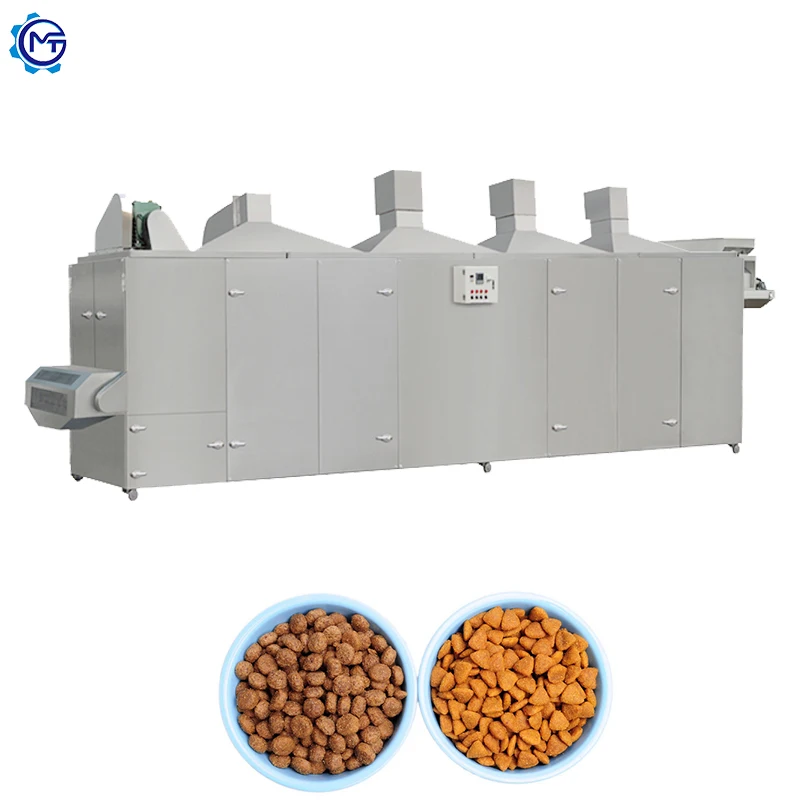
| Applications | Dry dog and cat kibble, aquatic fish feed (floating and sinking) |
| Warranty | 1 year |
| Process Documentation | Fish feed process drawing included |
| Screw Type | To be confirmed (single or twin screw) |
| Voltage & Frequency | Configurable to target market standard |
| Control System | Available with PLC or MCC control |
| Certification | CE and ISO available (to be confirmed per order) |
Application Suitability
| Application | Material or Output |
|---|---|
| Dry dog kibble production | Corn, meat meal, bone meal, fish meal blends at controlled moisture |
| Cat food pellet extrusion | High-protein formulations with animal fat and palatant coatings |
| Floating aquatic feed | Starch-rich mixes requiring controlled expansion for buoyancy |
| Sinking fish feed pellets | Dense formulations with reduced expansion ratio for bottom feeding |
Why "Rated Capacity" Means Nothing Without Your Recipe
A pet food extrusion machine screw configuration die design package that ignores your actual ingredient ratios will never hit the nameplate throughput.
I have watched lines rated for high output choke on formulations with heavy fish meal content because the screw pitch and compression ratio were copied from a standard corn-based build. The extruder runs, but density drifts, expansion collapses, and kibble texture falls outside what the market accepts. Aquatic feed is even less forgiving — get the shear profile wrong and floating pellets sink before they reach the surface. [NEED_CITE: starch gelatinisation requirements in high-protein extrusion]
Matching Shear to Starch and Protein Behaviour
The core challenge in dry pet food and aquatic feed extrusion is balancing mechanical shear against thermal input. High-protein recipes resist gelatinisation differently than starch-dominant mixes, so barrel temperature zones must be mapped to the specific ingredient cascade entering the feed hopper. A pet food extrusion machine screw configuration die design that treats all recipes identically will produce inconsistent expansion from the first batch to the last.
Controlling Density From Barrel to Die
Expansion ratio is set at the die face, but it is earned through every preceding barrel zone. Moisture injection points, screw element staggering, and residence time together determine how completely starch granules rupture before the melt exits. When the target is a floating aquatic pellet, the entire thermal-mechanical profile shifts toward higher expansion and lower bulk density compared with a sinking kibble specification. [NEED_CITE: expansion ratio control in twin-screw food extrusion]
Reading the Specs That Actually Matter
The gap between single and twin screw designs becomes critical once protein content rises above typical cereal levels — twin-screw geometry handles sticky, high-fat formulations without surging. Longitudinal barrel length relative to screw diameter governs how much residence time the melt receives, which directly affects gelatinisation completeness and, ultimately, pellet durability. Die orifice diameter and land length set the final expansion ratio, meaning the same extruder body can produce vastly different kibble structures depending on which die plate is mounted. Control architecture matters equally: a system with independent barrel zone heating lets the operator fine-tune the thermal gradient batch by batch, preventing the density drift that sinks floating feed or shatters brittle kibble during packaging.
The Hidden Cost of a Generic Screw Build
When screw elements and die geometry are selected from a catalogue rather than calculated against a specific recipe, the first sign of trouble appears during commissioning. Kibble emerges too dense or too fragile, the dryer cannot keep pace because moisture content is off-spec, and the coating drum cannot achieve uniform palatant adhesion. Retooling after installation means shipping new screw sections internationally, losing production weeks, and absorbing freight costs that were never budgeted. [NEED_CITE: post-installation retooling delays in extrusion lines]
What Separates a Configured Line From a Catalogue Order
Every screw element and die plate is specified against the buyer’s raw material analysis and target pellet density, not pulled from a default assembly. Barrel temperature profiles are documented zone by zone so that commissioning starts from a known baseline rather than trial and error. In-house trial runs on customer-supplied raw material verify expansion, texture, and density before the extruder leaves the workshop. Process flow drawings are provided for full line integration review, ensuring dryer and coating capacity match extruder throughput rather than bottlenecking it. Pre-sales engineering consultation covers voltage, frequency, and control language confirmation to prevent commissioning delays on site.
Documentation & Verification
- Screw and die configuration record matched to your raw material formulation
- Trial run report on your ingredient mix before the extruder ships
- Line layout drawing with throughput calculations across every station
- Barrel zone temperature profile and electrical schematic for your voltage standard
- Factory test record documenting run parameters and pellet density measurements
- Wear parts list identifying screw elements and die plates specific to your build
Installation, Commissioning & Support
- Foundation plan accounts for extruder weight distribution and vibration isolation points
- Dedicated power circuit sized to confirmed motor rating and heating element load
- Barrel and screw assembly verified on site against the configuration record
- First-run parameter log captures actual temperature, moisture, and screw speed values
- Operator training covers die changeover and screw element replacement procedures
- Wear parts inventory recommendation based on your specific screw and die set
Before You Request a Quote
To size the extrusion section correctly, share your raw material breakdown including protein, fat, and starch percentages, the target kibble or pellet dimensions, and the moisture content you plan to run. Confirm your local voltage and frequency standard, the control language your operators need, and whether you can ship a sample batch of your formulation for a pre-shipment trial run.
Frequently Asked Questions
Q: How is screw configuration selected for a specific raw material and target density?
A: Each screw element sequence is calculated from your ingredient analysis — protein, fat, starch ratios, and fibre content determine compression ratio and shear intensity. The die plate orifice and land length are then matched to achieve the expansion ratio your market requires, whether that is a light floating pellet or a dense sinking kibble.
Q: What barrel temperature profile is needed for starch gelatinisation in pet kibble?
A: Gelatinisation temperature depends on starch source and moisture level in the mix. Barrel zones are set in a graduated profile, typically rising through the compression section and holding steady through the metering zone. The exact values are confirmed during the trial run on your actual recipe and recorded in the configuration document.
Q: How is floating versus sinking behaviour controlled in aquatic feed extrusion?
A: Floating pellets require higher expansion, achieved through greater shear, specific moisture levels, and die geometry that promotes rapid pressure release. Sinking feed uses reduced expansion with denser die land configurations. The screw configuration and barrel profile are adjusted accordingly to hold consistent buoyancy across production runs.
Q: Can a trial run be done on my raw material before the extruder ships?
A: Yes. The workshop runs your actual formulation through the configured extruder, measuring expansion ratio, pellet density, and texture against your specifications. Results are documented in a trial run report, and any screw or die adjustments are completed before the machine is packed for shipment.
Q: How do moisture and shear interact to affect expansion and texture?
A: Higher moisture lowers melt viscosity, which can reduce expansion unless shear is increased to compensate. Too much shear with low moisture causes excessive wear and burnt notes in the final product. The balance is mapped during the trial run so that the production recipe holds stable texture batch after batch.