Matched screw profile to formulation — Every barrel zone, screw element and die orifice on this twin-screw fish feed extrusion line is specified against the buyer’s actual raw material blend, not pulled from a generic catalogue build.
Technical Specifications
| Parameter | Value |
|---|---|
| Product Type | Twin-Screw Fish Feed Extrusion Line |
| Output Capacity | 300–600 kg/h (basis not stated in source — confirm raw material formulation, moisture content and pellet size) |
| Screw Type | Twin-screw |
| Construction Material | 304 stainless steel (product contact parts) |
| Target Species | Trout, salmon, catfish and other freshwater/marine fish species |
| Control System | Available with PLC or MCC control (to be confirmed per site utility and language requirement) |
| Voltage & Frequency | Configurable to site supply (to be confirmed before production) |
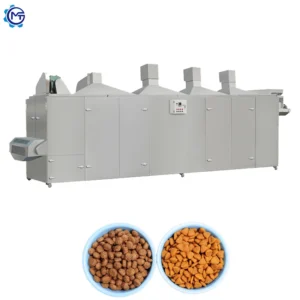
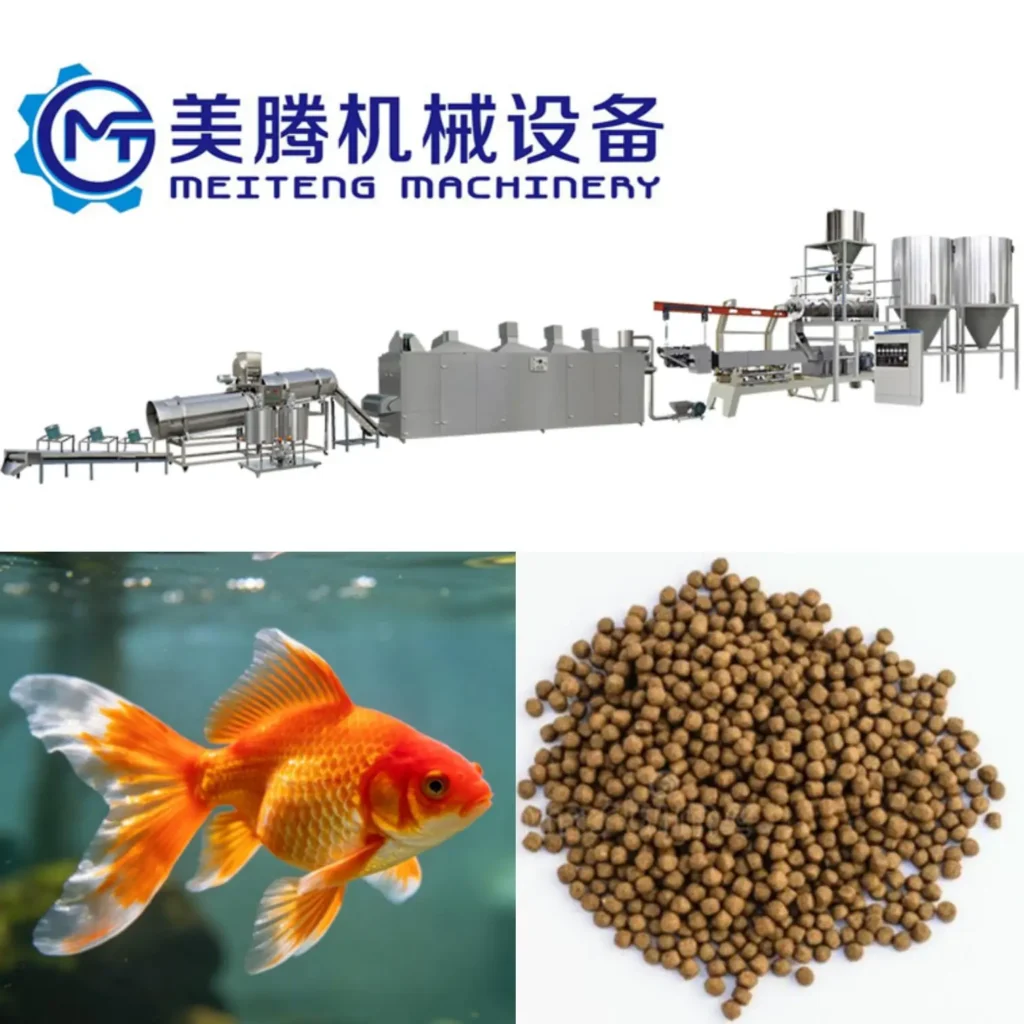
| Line Stations | Mixing, extrusion, drying, coating, cooling, packing (configuration subject to throughput matching) |
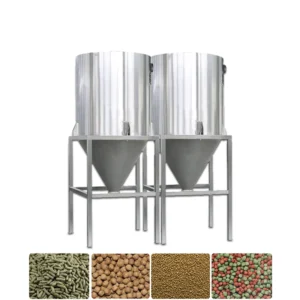
| Pellet Format | Floating and sinking formats achievable through screw profile and die selection |
| Certification | CE and ISO (manufacturer-held — confirm applicability to specific line configuration) |
Application Suitability
| Application | Material or Output |
|---|---|
| Trout and salmon starter feed | High-protein formulation requiring tight density control for slow-sinking pellets |
| Catfish grower feed | Grain and fish meal blends processed into durable floating pellets |
| Multi-species aquatic feed | Variable pellet diameter and density through die changeover on a single line |
| Fortified broodstock diet | Heat-sensitive micro-ingredient retention through controlled barrel temperature zoning |
Why "300–600 kg/h" Means Nothing Without Your Formulation
Throughput is a function of raw material behaviour, not a nameplate figure.
A twin-screw fish feed extrusion line rated at a given output on standard corn starch may see that number drop significantly when the recipe shifts to a high-fresh-meat aquatic diet with different moisture absorption and gelatinisation characteristics. I have watched commissioning stretch well beyond schedule because the line was built around a theoretical capacity that dissolved the moment real ingredients hit the barrel. The screw speed, barrel temperature profile and die back-pressure all interact with the specific starch and protein matrix in the mix [NEED_CITE: starch gelatinisation behaviour under twin-screw shear at varying moisture levels]. Specifying the twin-screw fish feed extrusion line specifications against the buyer’s actual formulation — and running a trial before shipment — collapses that risk.
Barrel Temperature Zoning and Starch Gelatinisation
The twin-screw platform divides the barrel into independently heated and cooled zones, each governing a stage of the extrusion cycle: hydration, mixing, shear-induced gelatinisation and expansion at the die. For aquatic feed, starch must gelatinise sufficiently to bind the pellet yet retain enough structure to survive post-extrusion drying without cracking. The temperature gradient across zones determines how completely this conversion occurs, and the correct profile shifts depending on whether the blend is heavy on wheat flour, rice bran or cassava starch.
Screw Element Sequencing for Pellet Density Control
Screw configuration is not a fixed design — it is an assembly of kneading blocks, reverse-flight elements and conveying screws sequenced to manage residence time, shear intensity and pressure build-up. Floating pellets demand a configuration that generates enough expansion at the die to trap air cells within the matrix, while sinking pellets require higher shear and tighter compression to produce a denser, more compact structure. The same twin-screw fish feed extrusion line can switch between these formats when the screw element sequence and die geometry are reconfigured accordingly.
Die Geometry and Species-Specific Pellet Sizing
Die orifice diameter, land length and face configuration directly govern pellet diameter, surface finish and expansion ratio. Trout starter feed may call for 1.5 mm pellets with a smooth surface to reduce nutrient leaching in cold water, while catfish grower feed typically runs at 4–6 mm with a more open texture for palatability [NEED_CITE: pellet diameter and surface texture requirements across aquaculture species]. The die plate is matched to the target pellet format and changed when production shifts between species or life-stage diets.
The Real Cost of Skipping the Trial Run
Lines shipped without a pre-dispatch trial on the buyer’s formulation arrive as engineering puzzles rather than production assets. Commissioning engineers then spend days adjusting screw speed, barrel temperatures and feed rate from a baseline that was never relevant to the actual recipe. Pellets that should float end up sinking; nutritional specs drift outside the label claim; the dryer runs at a throughput that does not match the extruder output. Every hour of unplanned commissioning is an hour of lost production and eroded buyer confidence [NEED_CITE: commissioning delays caused by untested raw material behaviour in food extrusion].
Why This Line Is Specified, Not Assembled
Every station from batching through packing is designed as a matched system, so the extruder output, dryer residence time and coating drum capacity align rather than bottleneck one another. The screw configuration and die design are documented against the buyer’s specific formulation and target pellet density. An in-house testing workshop runs the buyer’s actual raw material before the line ships, producing a trial report that sets the baseline parameters for commissioning. Twin-screw expertise spans pet food, aquatic feed, snacks and cereals — the process knowledge carries across formulation types. Electrical schematics, voltage and control language are confirmed against the facility’s utility supply before production begins, avoiding the rewiring delays that stall on-site startup.
Documentation & Verification
- Line layout with throughput calculation matched across every station from batching to packing
- Screw and die configuration record tied to your raw material formulation and pellet target
- Trial run report generated on your actual ingredients in the testing workshop before dispatch
- Electrical schematic and voltage confirmation aligned to your facility supply specification
- CE declaration of conformity and ISO certificate for the applicable line configuration
- Operation and maintenance manual with wear parts list specific to your screw and die set
Installation, Commissioning & Support
- Foundation requirements calculated from the line footprint and extruder motor load for stable installation
- Dedicated power circuit specification based on confirmed voltage, frequency and total connected load
- Modular station delivery allowing phased assembly when workshop access is constrained
- Commissioning parameter baseline drawn from the pre-shipment trial run report on your formulation
- Operator training covering screw element changeover, die swap procedures and barrel temperature adjustment
- Wear parts supply including replacement screw elements and die plates documented in the spare parts list
What to Include in Your Inquiry
To configure the line accurately, share your raw material formulation with moisture content, the target pellet diameter and density for each species you plan to produce, and your facility’s available voltage and frequency. If you are running both floating and sinking formats, indicate the production split between them. Confirm whether your existing upstream milling or downstream packing equipment needs to interface with the new line, and specify the control language your operators require.
Frequently Asked Questions
Q: How is the 300–600 kg/h capacity verified against my specific raw material formulation and moisture content?
A: The capacity range is a starting point, not a guarantee. We run your actual raw material blend in our testing workshop before shipment, measuring throughput at the target pellet size and moisture level. The trial report documents the verified output, screw speed and barrel temperature profile, giving you a realistic baseline for commissioning rather than a theoretical figure.
Q: How do screw configuration and barrel temperature profile control pellet floatability versus sinking rate?
A: Floating pellets require controlled expansion at the die, achieved through specific kneading block sequences and temperature zones that retain gas cells in the matrix. Sinking pellets need higher compression and shear to collapse those cells and increase density. The screw element arrangement and barrel zone temperatures are adjusted together to hit the target buoyancy for each species.
Q: What die options are available for different pellet diameters and species-specific density targets?
A: Die plates are selected based on your target pellet diameter, expansion ratio and surface finish requirements. Orifice size, land length and hole pattern are specified per formulation. When you produce multiple species, we supply additional die plates and document the changeover procedure so your team can switch formats on the line.
Q: Is a trial run on my raw material performed before shipment, and what does the trial report cover?
A: Yes. We process your supplied raw material through the extruder in our testing workshop and record output rate, pellet density, expansion ratio, moisture at the die and the full screw and barrel parameter set. The trial report travels with the shipment, so your commissioning team starts from proven settings rather than generic defaults.
Q: How are voltage, frequency and control language confirmed to match my facility before commissioning?
A: Before production begins, we confirm your site voltage, frequency and phase configuration, then match all motors, heaters and control components accordingly. The HMI language is set to your operator preference. The electrical schematic is delivered in advance so your electricians can prepare the incoming supply and verify circuit protection before the line arrives.