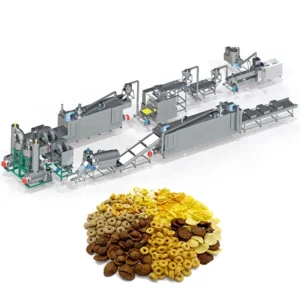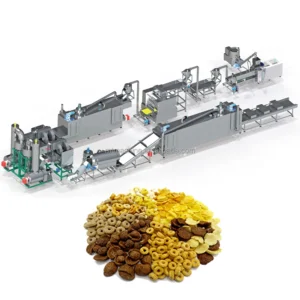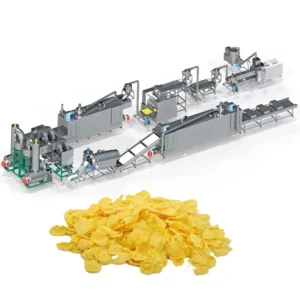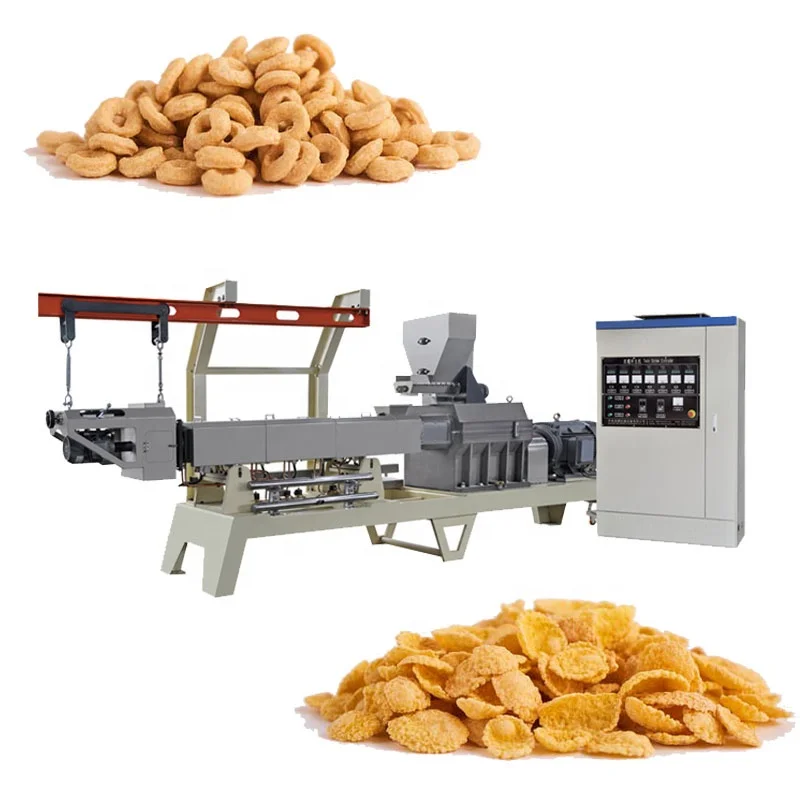
Precision-Matched Screw Geometry — every barrel zone and die aperture is specified against the buyer’s grain analysis report rather than borrowed from a generic cereal line template.
Technical Specifications
| Parameter | Value |
|---|---|
| Model | MT70 / MT85 / MT75 |
| Product Type | Corn Flakes Processing Line |
| Screw Type | Twin-screw |
| Installed Power | 160 kW (MT70) / 190 kW (MT85) / 210 kW (MT75) |
| Power Consumption | 120 kW (MT70) / 140 kW (MT85) / 150 kW (MT75) |
| Output Capacity | 150–200 kg/h (MT70), 300–400 kg/h (MT85), 300–500 kg/h (MT75) (basis not stated in source — confirm raw material, moisture content, and product format) |
| Overall Dimensions | 41 × 1.5 × 2.2 m (MT70) / 43 × 1.5 × 3.2 m (MT85) / 45 × 1.5 × 3.5 m (MT75) |
| Control System | PLC and MCC |
| Basic Material | Powder of corn, rice, wheat, oat, barley |
| Production Procedure | Mixing — Extruding — Flaking — Drying — Hot Air Roasting — Cooling — Packing (natural); adds Sugar Spraying — Sugar Coating — Drying (coated) |
| Flaking Machinery | Hydraulic double-roller system, dual-motor separate drive, infrared temperature sensor control |
| Dryer Heating Source | Gas or electric |
| Roasting Oven | Hot air roasting with vibrating pan, conciliation burner, dual circulating fans, cyclone dust removal |
| Coating System | Double tumble for sugar melting, elevator, coating drum, spraying nozzle |
| Extruder Features | Automatic lubrication and cooling, wear-resistant screw treatment |
| Voltage & Frequency | Configurable per buyer market (to be confirmed) |
| Standards | CE certified, ISO certified |
Application Suitability
| Application | Material or Output |
|---|---|
| Natural corn flakes production | Corn grits and corn flour at controlled moisture |
| Sugar-coated breakfast cereals | Corn, rice, or wheat base with sugar glazing |
| Multi-grain flake formats | Oat, barley, wheat, and blended grain recipes |
| Shaped cereal pieces | Ring, star, ball, tube, stick, fruit loop, wheel, flower, heart via die exchange |
| Fortified cereal programmes | Grain blends with added nutritional premix |
Why Your Corn Flake Density Drifts After the First Week
Consistent flake density starts with a screw configuration built around your grain’s actual starch and fat profile, not a catalogue default.
I spent years on assembly floors before moving into extrusion technical support, and the most frustrating calls always came two weeks after commissioning. The line ran fine during the trial, then the buyer switched to a local corn supplier and the flakes came out dense and pale. The corn flakes extrusion machine screw configuration die design that worked on one starch-to-fat ratio simply could not handle another. Moisture absorption shifted, barrel shear changed, and the expansion collapsed [NEED_CITE: starch gelatinisation thresholds by grain composition]. Nobody had recorded which screw elements were doing the heavy lifting, so re-tuning took days of guesswork.
Mapping Barrel Zones to Gelatinisation Behaviour
The twin-screw extruder processes cereal dough through distinct thermal and mechanical stages. Feed intake, compression, gelatinisation, and metering each demand a different screw element pitch and barrel temperature. A corn flakes extrusion machine screw configuration die design that ignores these transitions produces uneven starch conversion, leaving some particles under-cooked while others scorch against the barrel wall. Matching the kneading block angle to the specific gelatinisation window of your grain blend keeps expansion uniform across every flake.
Moisture, Shear, and the Expansion Window
Water acts as both plasticiser and steam source during extrusion. Too little moisture and the dough cannot gelatinise fully before reaching the die; too much and the extrudate collapses after cutting. The barrel temperature profile must track the moisture curve so that shear energy and thermal energy arrive at the starch granule simultaneously [NEED_CITE: twin-screw extrusion moisture-temperature interaction models]. Infrared-monitored flaking rollers then hold the sheet at the correct temperature so the subsequent hot-air roast can form the characteristic surface bubbles without drying the interior past the point of crispness.
Reading the Specification Sheet Beyond Nameplate Power
Installed power figures — 160 kW on the MT70, 190 kW on the MT85, 210 kW on the MT75 — tell you the motor headroom, but power consumption values of 120 kW, 140 kW, and 150 kW respectively reveal what the line actually draws during steady-state extrusion. The gap between installed and consumed power indicates how much reserve the screw design holds for viscosity spikes when fat content in the raw corn rises. Hydraulic double-roller flaking with separate motor drives keeps sheet thickness constant even when extrudate density fluctuates slightly between batches, protecting downstream roasting uniformity.
The Cost of a Copied Screw Arrangement
When a supplier copies a screw layout from a different cereal line without adjusting for your raw material, the consequences appear gradually. Flake weight per litre drifts outside the range your packaging machine was set for. Roasting time extends to drive off residual moisture, increasing gas consumption. Sugar coating adhesion weakens because the surface porosity is wrong [NEED_CITE: surface porosity effects on cereal coating adhesion]. Buyers then spend weeks chasing the problem through dryer settings and oven temperatures, never realising the root cause sits inside the barrel.
What Sets This Extrusion Platform Apart
Screw elements and die apertures are selected against the buyer’s grain analysis, not picked from a standard build sheet. The in-house testing workshop runs your actual raw material before the line ships, producing a trial report that records the exact corn flakes extrusion machine screw configuration die design that delivered target flake density. PLC and MCC control architecture is specified to your local voltage and frequency so the cabinet arrives ready for connection. Every downstream station — flaking, drying, roasting, coating — is throughput-matched to the extruder so no single unit bottlenecks the line. Wear-resistant screw treatment extends element life under the abrasive conditions typical of whole-grain corn and oat processing.
Documentation & Verification
- Screw and die configuration record matched to your grain analysis report
- Trial run report on your raw material produced in the testing workshop
- Electrical schematic confirming voltage, frequency, and control language for your market
- Machine specification sheet with capacity tied to defined material and flake format
- CE declaration of conformity and ISO certificate for import clearance
- Operation and maintenance manual covering screw element replacement intervals
Installation, Commissioning & Support
- Foundation plan sized to the MT70 footprint of 41 m or larger model length with anchor bolt layout
- Dedicated circuit rated for the line’s running consumption of up to 150 kW plus starting surge
- Extruder barrel sections and flaking roller assembly arrive separated for site rigging
- First-run parameter logging covers barrel zone temperatures, screw speed, and hydraulic roller pressure
- Operator training includes screw element inspection and die changeover for shape switching
- Wear parts list identifies screw elements, die plates, and roller bearings with replacement intervals
What We Need to Specify Your Line
Send your grain supplier’s certificate of analysis showing starch, protein, fat, and fibre fractions together with target moisture at the mill gate. Tell us the daily output you need in finished flake weight, your available floor space and ceiling height, and the local voltage and frequency. If you plan to run both natural and sugar-coated formats, confirm the coating percentage so we can size the tumble drum and sugar-melt capacity.
Frequently Asked Questions
Q: How is screw configuration selected for different cereal raw materials such as corn versus oat?
A: Oat contains higher fat and beta-glucan, which lowers dough viscosity and changes the gelatinisation temperature. We adjust kneading block angle, compression ratio, and barrel zone set-points accordingly, then validate the corn flakes extrusion machine screw configuration die design on your material in our testing workshop before finalising the build.
Q: How do you verify capacity on my specific raw material before shipment?
A: We run your actual grain blend through the extruder in our in-house testing workshop, measuring output rate, flake density, and expansion ratio. The trial run report documents the achieved throughput under defined moisture and recipe conditions so the capacity figure you receive is tied to real material, not a generic estimate.
Q: What barrel temperature profile and moisture range are needed for proper starch gelatinisation?
A: Typical corn gelatinisation occurs between 62 °C and 78 °C depending on variety and particle size. Barrel zones are staged to bring the dough through this window gradually while moisture is held between 18% and 25% at the feed section, then reduced by barrel venting before the die to control expansion.
Q: How does die design affect flake density, expansion ratio, and final crispness?
A: Die aperture diameter and land length determine the pressure drop at exit, which governs steam flash-off and therefore expansion. A larger land length restricts flow, raising shear and producing a denser pellet that flakes into a thicker, crunchier sheet, while a shorter land gives lighter expansion for a more delicate texture.
Q: Can the same extrusion platform produce both natural and sugar-coated corn flakes?
A: Yes. The core extrusion, flaking, and roasting stations remain identical. For coated product, the line adds a sugar-melt tumble system, spraying nozzle, and coating drum followed by a secondary drying stage. We size these downstream units to match the extruder throughput so coating residence time is sufficient without creating a bottleneck.